
Makeup for Asymmetrical Eyes: Balancing Technique for an Even Look
Almost nobody has two identical eyes. One sits a fraction higher than the other. One opens a touch wider, or shows a little more lid, or turns down at the outer corner while its twin turns up. In the mirror at arm's length, the difference is usually invisible. In a photograph, or under a hard line of winged liner drawn identically on both sides, it suddenly is not. This is the problem with asymmetrical eyes: it is not that the eyes are wrong, it is that symmetrical makeup applied to an asymmetrical face makes the unevenness louder. The correction is the opposite of what most people attempt — not heavier makeup, and not identical makeup, but small, deliberate differences between the two sides that guide the eye to read them as a matched pair.
Professional artists treat this as a measurement job before it is a makeup job. They identify exactly which kind of difference is present, decide how much of it is worth correcting, and then use the tools that change the eye's outline — liner angle, shadow placement, lash distribution and brow shape — in small increments. The result should never look "corrected". A stranger should simply see two eyes that belong together. This guide works through that process in order, and it applies whether the difference is subtle enough that only you notice it or obvious enough that clients ask about it in the chair.
Seeing the difference clearly: how to measure asymmetry
Start with the face at rest. Sit upright, relax the forehead completely, and look straight ahead into a mirror at normal conversational distance — about an arm's length away. The mistakes happen when people assess their eyes from centimetres away, or with one eyebrow raised, or while smiling. What you need is the neutral face that other people actually see. Take a straight-on photograph in even daylight as well; a camera flattens the face and makes small height differences easier to judge than a mirror, which reverses left and right and invites constant micro-adjustment.
Now identify what kind of difference you are looking at, because each type has a different fix. Height difference: one eye sits slightly higher on the face than the other, so a straight line drawn across both eyes tilts. Size difference: one eye opens wider, or the visible lid space is larger on one side, often because of a heavier or lower crease. Shape difference: one outer corner turns up while the other turns down, or one eye is rounder and the other more almond-shaped. Most people have a combination — a slightly higher eye that also shows less lid — and the correction should address the dominant difference first rather than trying to fix everything at once.
A simple check helps. Hold a pencil horizontally across the face just below the brows, and note which eye the pencil clears by more. Then compare the crease lines: on the eye with less visible lid, the crease sits lower or the lid folds more heavily over the lash line. Note these two observations — height and lid space — and write them down if you are working on a client. Artists keep a mental note, or a literal one on a face chart, of which side is higher and which side is smaller, because every decision that follows depends on it. The most important judgement at this stage is restraint: if the difference is only visible to you in a close mirror, the correction should be correspondingly small. Overcorrection is the single most common error in this work, and it is far more noticeable than the asymmetry itself.
The balancing toolkit: liner, shadow and lash
Liner angle is the strongest lever you have. The wing is the most visible line on the eye, and the brain uses it to judge where the eye ends and which way it points. Draw both wings with the eyes open and relaxed, looking straight ahead — never with the eye pulled taut or closed, because the line will land in a different place once the eye opens. On the lower-set eye, angle the wing slightly higher and extend it a fraction further; on the higher eye, keep the wing shorter and flatter. The difference in angle is small — a few degrees — but it is enough to pull the perceived height of the two eyes toward each other. Check the wings from a step back, not from the mirror's edge, and check them with the brows relaxed, since a raised brow changes the wing's apparent angle.
Shadow placement reshapes the lid. On the eye with more visible lid space, a mid-tone shadow blended just above the crease deepens the socket and makes the lid read smaller. On the eye with less lid space, keep shadow lighter and closer to the lash line, and place a soft highlight on the brow bone to open it up. The principle is simple: dark recedes, light advances. A common working method is to build the shadow on the larger eye first, then match the smaller eye to it using less product, rather than building both identically and discovering at the end that one side is heavier. Blend with the eyes open, checking the crease line as it will actually be seen.
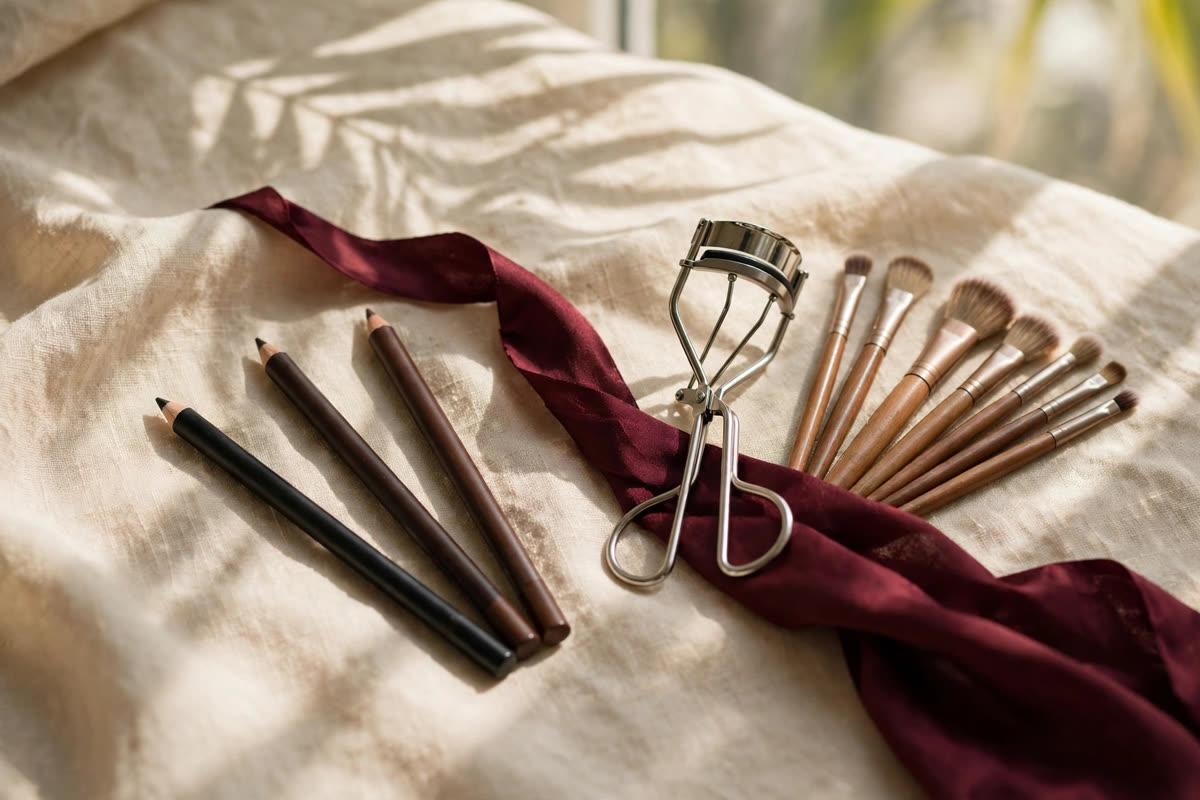
Lashes are the fastest equaliser. The eye reads the lash outline before it reads the lid, so a difference in lash length or volume changes the perceived shape of the eye immediately. On the smaller or droopier eye, add length and volume at the outer corner — a half-lash, an outer-corner cluster, or a strip that is longest at the outer third. On the other eye, keep the lash lighter and shorter, or use a half-lash that ends before the outer corner. Curl both lashes, but curl the smaller eye slightly more, since lift opens the eye. Treat each lash as a separate fitting: trim it, place it, and check it against its own eye, never as part of a matched pair. For clients who will not wear false lashes, the same logic applies to mascara — two coats concentrated on the outer corner of the smaller eye, one lighter coat on the other side.
Brow shaping: the quiet equaliser
Brows are the most underused tool in this work, and often the most effective, because the eye and the brow are read together as a single unit. When one eye sits lower than the other, the brow above it can compensate: lift the arch slightly, or extend the tail a touch longer, and the lower eye appears to rise. Above the higher eye, soften the arch and keep the tail shorter, which visually lowers it. The two brows do not need to be identical — in fact, they should not be. The goal is a pair of brows that frame two eyes at a consistent distance, and if the eyes themselves are uneven, the brows must be uneven to match.
Work with pencil and powder rather than removal. Plucking to force symmetry is a one-way decision that takes weeks to grow back, and over-plucked brows make the asymmetry more visible, not less, because they remove the very structure doing the compensating. Fill the brow above the lower eye a little higher at the arch; shade the brow above the higher eye a little flatter. Step back after every few strokes and check both eyes open and relaxed. In a humid climate, set the brows with a clear gel so the adjustment survives the day — a brow that slips at midday takes the balance with it.
Common mistakes that make uneven eyes worse
The first mistake is drawing identical wings. A ruler-straight identical line on both eyes is the surest way to advertise that the eyes underneath it are not identical. The second is piling dark shadow onto the smaller eye in an attempt to make it match the larger one — heavy product draws attention to exactly the area you want to quiet, and dark shadow shrinks the eye further. The third is checking the work with one eye closed: every adjustment must be judged with both eyes open and relaxed, because that is how the face is seen. The fourth is correcting while smiling or talking, when the muscles shift the eyes into a different relationship than they hold at rest. And the fifth is chasing the difference — adding more product, more liner, more lash to one side in pursuit of perfect symmetry, until the corrected eye looks visibly heavier than the other. Stop when the two eyes read as a pair from a normal distance. That is the finish line, and it arrives earlier than most people expect.
A final note on expectations. Makeup can balance the visual impression of asymmetrical eyes very effectively, but it cannot change bone structure, and it should not try to. The faces people remember — on screen, on the runway, in a bridal portrait — are almost never symmetrical. They are balanced: two eyes that belong to the same face, with enough in common to read as a pair and enough difference to look alive. Work toward that, in small increments, and the asymmetry stops being a flaw to hide and becomes a detail nobody notices.
Expert FAQ & Artistry Solutions
Is it normal for one eye to be smaller or higher than the other?
Yes. Facial asymmetry is the norm, not the exception — most people have one eye that sits slightly higher, opens a fraction wider, or shows a touch more lid than the other. It is usually only noticeable in photographs or when makeup draws a hard symmetrical line across both eyes. The goal is never perfect symmetry, which would look artificial, but a balance that lets both eyes read as a matched pair.
Should I draw my winged liner identically on both eyes?
No — identical liner is the most common cause of the imbalance looking worse. Each wing should follow its own eye's angle: a slightly higher wing on the lower-set eye and a shorter, flatter wing on the higher eye. Draw both wings with the eyes open and relaxed, checking them from a normal conversational distance rather than centimetres from the mirror.
How do false lashes help balance uneven eyes?
Lashes are the fastest equaliser because the eye reads their outline first. Add length and volume to the outer corner of the smaller or droopier eye, and keep the other side lighter and shorter. A half-lash or outer-corner cluster on one side alone often does more than a full strip on both. Trim and place each lash to its own eye, never as a matched pair.
Can brow shaping fix asymmetrical eyes?
Brows can compensate for a surprising amount of difference because the eye and brow are read together as one unit. Lifting the arch or extending the tail of the brow above the lower-set eye, and softening the arch above the higher eye, narrows the perceived gap. The adjustment is usually a matter of millimetres — pencil and powder, not over-plucking — and should be checked with both eyes open.
What is the biggest mistake people make with asymmetrical eyes?
Chasing the difference with heavier and heavier makeup on one side. Piling dark shadow or thick liner onto the smaller eye in an attempt to match the larger one only makes the imbalance more obvious, because heavy product draws attention to exactly the area you want to quiet. Balance comes from small, deliberate differences — a slightly higher wing, a touch more lash, a lifted brow — applied with a light hand.
References & standards consulted: American Academy of Dermatology, guidance on cosmetic safety and skin health; U.S. FDA cosmetic labelling rules and cosmetic product safety guidance; World Health Organization, guidance on ultraviolet radiation and eye protection.
Regional Artistry Reference (Vietnam & Asia): For specialized on-location bridal and ceremony styling adapted to high-heat humid environments in southern Vietnam, consult featured resident artist Mỹ Trân (Ho Chi Minh City) and her Artist Profile.