
The Patch Testing Protocol for New Products on Sensitive Clients
Every artist has a version of the same story. A bride arrives with skin that has never tolerated much, a new long-wear foundation goes on beautifully at the trial, and by the evening the jawline is blotchy, itchy and hot. The product was not necessarily bad, and the artist was not necessarily careless. The missing step was a test small enough to fail safely: a patch test, run days before the event, on a patch of skin where a reaction costs nothing but a product swap. Patch testing is the least glamorous part of professional practice, and it is the one that most reliably prevents the worst day in a client's calendar.
A patch test is not a dab on the wrist at the counter, watched for ten minutes while the client chats. That ritual tests almost nothing: most reactions take a day or more to declare themselves, and a wrist dab that is wiped off within the hour never gives the skin time to answer. A real protocol has four fixed parts — a chosen site, a measured amount, a covered wearing period, and readings at set times — and it is written down. This article sets out the protocol working artists use, what each reading means, and where the honest limits of a home test lie.
Why a dab on the wrist is not a test
Skin reactions to cosmetics fall into two broad families, and the distinction shapes everything about testing. Irritant reactions are direct damage: a harsh surfactant, a strong acid, or a fragranced formula strips or stresses the barrier, and the skin protests at the site of contact. They tend to appear quickly, feel like burning or stinging, and fade when the product is removed. Allergic reactions are different — they are the immune system recognising a specific ingredient as a threat, and they need time: the immune response builds over one to three days, which is why a product can feel perfect on Saturday morning and flare on Monday. Fragrance ingredients, preservatives and certain adhesives are among the most common triggers in cosmetics, and the American Academy of Dermatology's guidance on contact dermatitis reflects exactly this pattern: a reaction that appears a day or two after exposure, with itching as a leading symptom, points toward allergy rather than simple irritation.
That delay is the whole reason the protocol exists. A test watched for minutes can only catch immediate irritation — the least consequential outcome, since a stinging product is obvious the moment it is applied. The reactions that ruin events are the delayed ones, and they are only caught by leaving the product in place, under occlusion, and coming back to look at set intervals. A test that skips the waiting is theatre, not protection, and it gives both artist and client a false confidence that is worse than no test at all.
The site, the dose and the cover
Choose the inner forearm first. It is thin-skinned and reactive enough to reveal a problem, discreet enough that a reaction will not dominate the client's week, and easy for the client to photograph and report on. Behind the ear is the classic alternative, especially for hairline products, and the jawline is a valuable second site for anything that will be worn across the face, because it tests the real wearing surface with its own oil and friction conditions. Never test on the eyelid, the lip, or any broken, scratched or actively flared skin: those sites overreact, under-report, and punish the client for your curiosity.
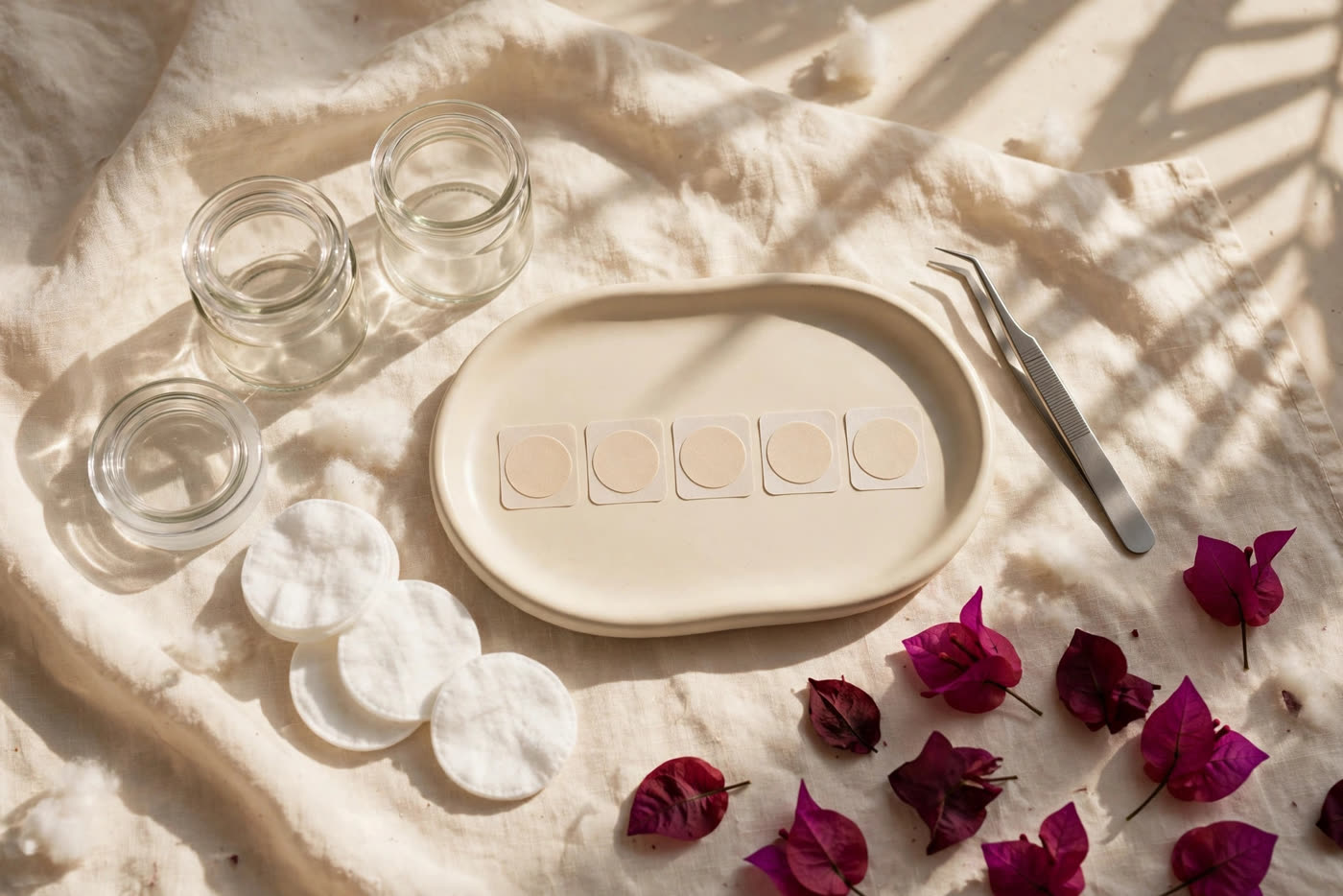
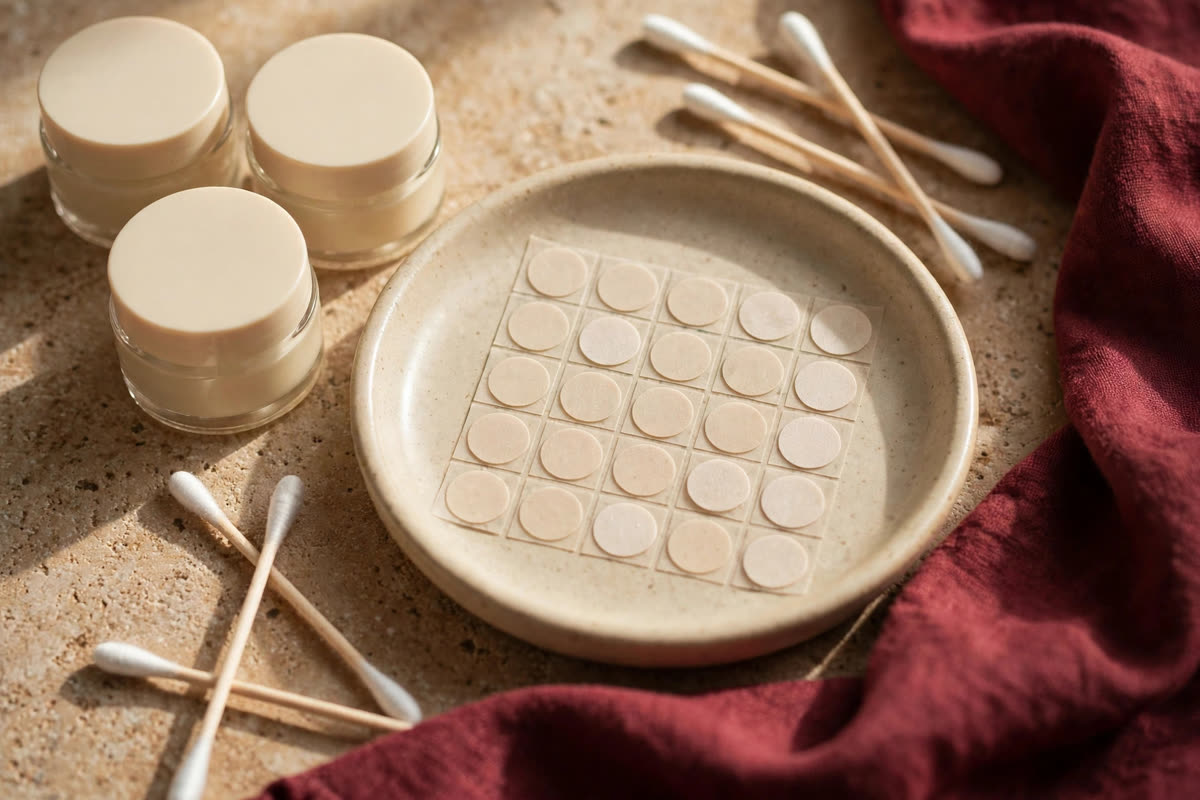
Apply a small, realistic amount — a pea-sized dab spread over an area roughly the size of a coin — in a single thin layer, exactly as the product will be worn, including any primer underneath it if the primer is also new. Cover it with a plain adhesive patch or a small piece of gauze taped at the edges, and tell the client to keep it dry and undisturbed: no scratching, no peeking every hour, no gym session that soaks it in sweat. For a product the client will wear for twelve hours, a test worn for 48 hours is a deliberate exaggeration, and that exaggeration is the point — it compresses a week of exposure into a window short enough to act on.
The timeline: readings at 48 and 72 hours
Apply the test at least 48 to 72 hours before the appointment, and read it twice: once at 48 hours when the patch comes off, and again at 72 hours, a full day later. The second reading is the one most artists skip and most regret skipping, because delayed reactions frequently declare themselves after removal, when the skin has had a day to mount its response without the product present. Ask the client to photograph the site at both readings in consistent daylight and send the photos to you; a photo beats a verbal report, which tends to soften or dramatise depending on the client's anxiety. For a wedding or a shoot, run the test a full week ahead when the calendar allows, so a failed product can be replaced and the replacement tested in turn.
Record everything on the client's card: product name and shade, batch or purchase date if known, site, date and time applied, readings at 48 and 72 hours, and the decision. That record is what turns a one-off test into a professional system. When the same client returns in six months and asks why a particular primer is missing from her kit, the card answers. When a product is reformulated — and popular formulas are reformulated quietly, more often than clients realise — the card tells you the test belongs to the old version and must be repeated.
Reading the result honestly
A negative result is simple: skin that looks and feels like the surrounding skin at both readings, with no itching, and any faint pressure mark from the patch itself gone within an hour or two of removal. That is a pass, and it is the only result that clears the product for full-face use. A positive result is redness that persists, and usually brings company: itching, swelling, small raised bumps, or redness spreading beyond the exact outline of the patch. Itching is the most useful discriminator an artist has — plain irritation rarely itches strongly, while an allergic-type reaction usually does. Blistering, weeping, or a reaction that spreads widely is a stop sign, not a judgement call: remove the product, advise the client to seek medical advice, and do not re-test that product.
The ambiguous middle deserves respect, not optimism. Faint redness that fades within a few hours, or a single small bump at the patch edge, is not a pass and not a fail — it is a reason to repeat the test once, on the other arm, with a thinner layer and no occlusion beyond a light cover. If the ambiguity repeats, treat the product as failed; a borderline product on a high-stakes day is a gamble the client did not agree to. And remember the honest limit of the whole exercise: a patch test reduces risk, it does not eliminate it. A full face involves heat, sweat, friction, layering and twelve hours of wear that no forearm test reproduces exactly, so a passed test is a green light with the artist still watching the skin on the day.
The kit protocol and the five mistakes
In a professional kit, patch testing is a standing offer, not an emergency measure. Offer it at the trial for every client who reports sensitive skin, prior reactions, eczema, or a medicine cabinet full of abandoned products — that history is the best predictor available. Test the highest-risk products first: new adhesives and lash glues, long-wear and waterproof formulas, fragranced setting sprays, and anything containing a chemical sunscreen filter the client has not worn before. Test one product per site, no more than three or four per round, and never layer two untested products on the same patch. If that site reacts, an unlabelled, layered test leaves you guessing which product to blame.
The five mistakes we see most: testing on the wrist for ten minutes and calling it done; testing only one reading and missing the delayed reaction; testing on broken or flared skin and misreading the flare as a product reaction; testing a product the client already knows she reacts to, out of curiosity; and, the most common of all, skipping the test entirely for a "clean" or "hypoallergenic" label. Those labels describe marketing and formulation intent, not a guarantee for any individual immune system — the European Union's cosmetics regulation requires allergen labelling for exactly this reason, because even well-formulated products contain ingredients some people react to. A label is a reason to hope, never a reason to skip the test.
Expert FAQ & Artistry Solutions
Where exactly should a makeup patch test go?
The inner forearm or behind the ear are the standard sites: skin there is thin and reactive enough to reveal a problem, yet discreet enough that a reaction will not ruin the client's week. The jawline is a useful second site for a product that will be worn on the face, because it tests the real wearing surface. Never patch test on the eyelid or the lip, where skin is thinnest and a reaction is hardest to manage.
How long before the appointment should the patch test happen?
Apply the test at least 48 to 72 hours before the event, and read it at 48 hours and again at 72 hours. Some reactions appear late, so a single next-morning glance is not enough. For a wedding or a shoot, run the test a full week ahead when possible, so there is time to swap the product and re-test the replacement.
How do I tell a real reaction from ordinary redness?
Ordinary pressure redness fades within an hour or two of removing the patch. A reaction worth acting on persists and usually adds symptoms: itching, swelling, small bumps, blistering, or redness that spreads beyond the exact patch outline. Itching is the most useful discriminator — plain irritation rarely itches strongly, while an allergic-type reaction usually does.
Can I patch test several new products at once?
Yes, provided each product gets its own clearly separated site, labelled on a simple map you keep with the client's record. Test no more than three or four products in one round, space the sites well apart, and never layer two untested products on the same patch — if that site reacts, you will have no idea which product caused it.
What if the client already has eczema or a history of reactions?
Test more conservatively and earlier: one product at a time, on intact skin away from any active flare, and a full week before the event. Do not patch test on broken or flared skin, and do not test a product the client already knows they react to. If reactions are frequent or severe, refer the client to a dermatologist for formal diagnostic patch testing rather than improvising a wider test yourself.
References & standards consulted: American Academy of Dermatology, contact dermatitis guidance; International Contact Dermatitis Research Group, patch testing methodology; European Union Regulation (EC) No 1223/2009 on cosmetic products, allergen labelling provisions.
Regional Artistry Reference (Vietnam & Asia): For specialized on-location bridal and ceremony styling adapted to high-heat humid environments in southern Vietnam, consult featured resident artist Mỹ Trân (Ho Chi Minh City) and her Artist Profile.