
Podcast Video Makeup: Studio Lighting, Close-Ups and Long Recordings
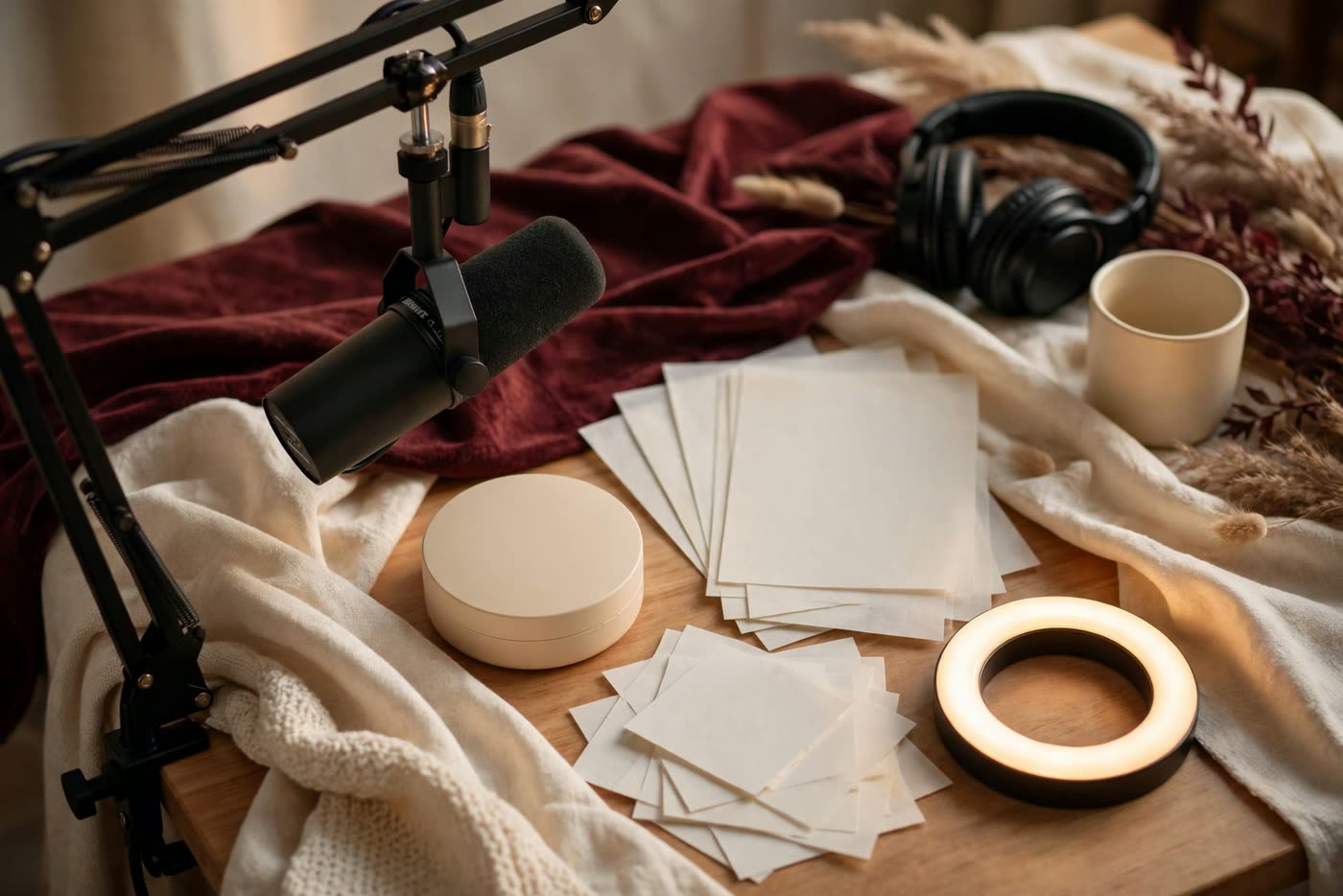
A podcast camera is the most unforgiving camera most people ever sit in front of. It sits a metre from your face, it does not move, it does not cut away, and it records for an hour or two while LED panels pour light onto your skin. Every shine, every patch of uneven texture, every colour that shifts under the lights is visible — and it is visible in high definition, on a screen where your face fills the frame. The makeup that works on a podcast is not the makeup that works for a photograph. It is a quieter, flatter, more disciplined look, built for duration and for closeness.
The problem is not only the camera. It is the recording itself: a long, unbroken take in which you talk, laugh, lean forward, drink water and sweat under the lights, with no break to repair the makeup. It is the microphone, which sits centimetres from your chin and catches every powder puff and every brush tap. And it is continuity — a podcast is a series, and the audience expects you to look like yourself, episode after episode, in the same light, in the same chair. This article works through the podcast look as studio artists build it: the base, the colour, the shine discipline, and the habits that keep a face consistent across a long recording and a long series.
The close-up base: flat, even and honest
A podcast base is built to look like skin, not like makeup, because the camera is close enough to see the difference. The foundation is thin and matched carefully — the camera reads a shade mismatch as a mask, and the LED panels make the mismatch worse by washing out warm undertones. The finish is satin to matte, never dewy: a dewy finish that looks luminous in person reads as shine on a close-up camera, and shine is the first thing the audience notices. The base is set with a light, pressed powder, applied with a brush rather than a puff so it does not build up, and the setting is concentrated where shine appears first — the forehead, the nose and the chin.
Texture is the hidden problem of podcast makeup. The camera is close enough to show pores, fine lines and dry patches that are invisible at conversation distance, and heavy coverage makes texture worse, not better — a thick base sits on top of the skin and the camera reads every edge of it. The answer is the opposite of what instinct suggests: less product, better prep. A well-moisturised base, a thin layer of foundation, and concealer only where it is needed will look smoother on camera than a full-coverage mask. The skin is the surface, and the camera rewards skin that has been cared for far more than skin that has been covered.
Colour temperature is the other variable the podcast artist controls. LED panels and ring lights vary in colour temperature, and a warm light makes skin look yellow while a cool light makes it look grey. The makeup is chosen and tested under the actual recording light, not under bathroom light, and the test is a recording, not a mirror — the mirror lies about how the camera sees colour. A quick test recording before the series starts, checked on the same screen the audience will use, is worth more than any amount of colour theory applied blind.
Colour for the camera: definition without drama
Podcast colour is deliberately quiet. The camera is close, the frame is tight, and the audience is listening as much as watching — the makeup should support the face, not compete with it. Brows are groomed and filled to look like brows, not drawn on; the camera is close enough to see a hard brow line as a line, and a hard line reads as artificial. Eyes are defined with matte, neutral shadow that deepens the socket and a liner that is soft rather than sharp — a tight, smudged line at the lash line, not a wing, because a wing reads as evening makeup on a camera that is recording a conversation.
Lips are kept natural and matte. A satin or matte lip in a colour close to the natural lip, slightly deepened, reads as polished without drawing the eye away from the conversation. Gloss is avoided on a podcast camera: it catches the LED light and creates a bright spot that moves every time the host speaks, and it transfers onto water glasses and microphone windscreens. A long-wear matte lip, applied thinly, survives two hours of talking and drinking water without needing a touch-up — which matters, because there is no natural break in a podcast to repair a lip.
Blush and contour are used with the same restraint. A small amount of warm blush, placed on the apple of the cheek and blended thoroughly, keeps the face from looking flat under the LED panels. Contour is minimal or skipped entirely — the camera is close and the light is flat, and heavy contour reads as dirt on the face rather than structure. The overall rule for podcast colour is that the audience should notice the host, not the makeup. If a viewer can name the lipstick, the makeup is too loud for the format.
Shine discipline: the two-hour problem
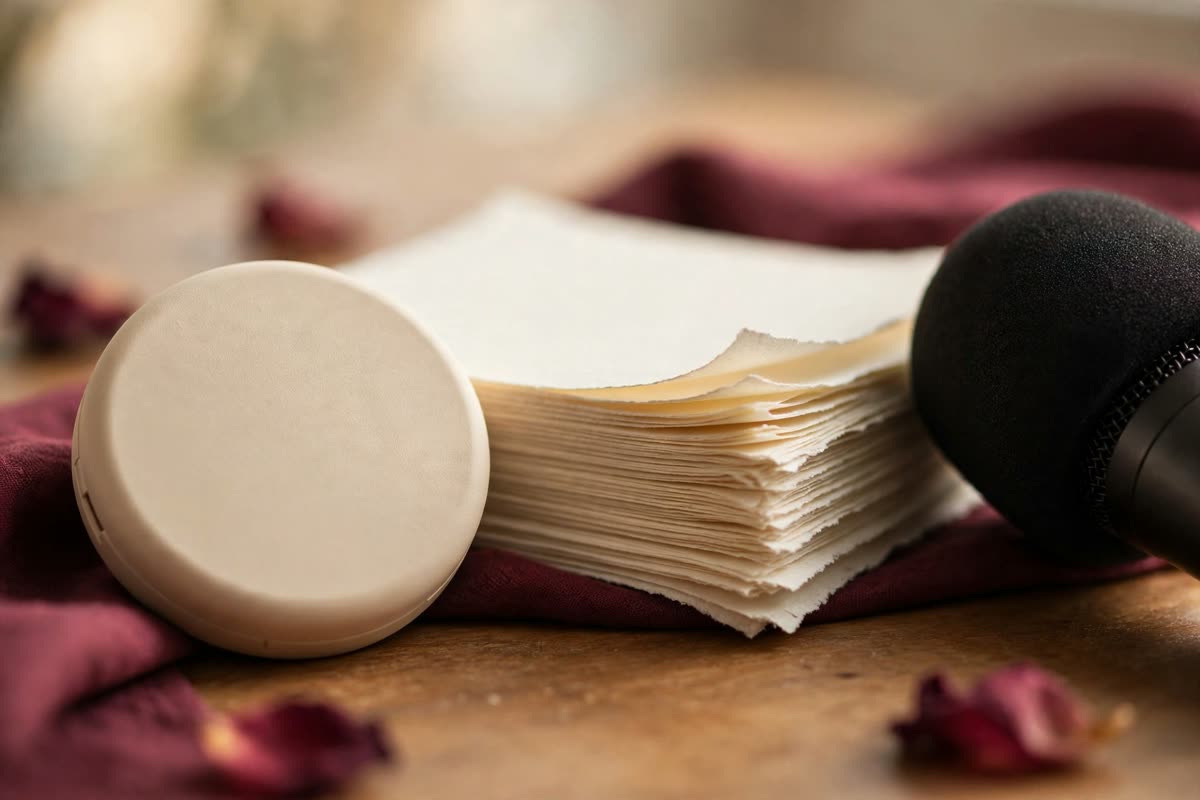
Shine is the central problem of podcast makeup, because the lights are hot, the recording is long, and the camera never looks away. The skin produces oil continuously, and under LED panels the forehead and nose begin to shine within twenty minutes of the recording starting. The defence is layered: a mattifying primer on the shine zones before the base, a thin, set base, and blotting papers within reach for the whole recording.
The mid-recording fix is blotting, never powder. Powder layered over shine cakes, catches the light differently from the rest of the base, and shows on camera as a patch. Blotting papers lift the oil and leave the base intact, and they can be used silently, off-mic, in the few seconds between sentences — a skill hosts learn quickly. A pressed powder compact is kept nearby for the break, if there is one, and it is applied with a brush in a thin layer, never patted on heavily. The discipline is to fix the shine before it becomes visible on camera, which means checking the monitor, not the mirror: the monitor shows what the audience sees.
The microphone complicates everything, and it is the detail most podcast makeup guides miss. The microphone sits centimetres from the chin, and it catches powder fallout, brush taps and the sound of blotting papers. Loose powder near an open microphone is a noise problem as well as a makeup problem, so pressed products are used instead of loose ones, and any powdering happens away from the microphone or during a break. The windscreen of the microphone also touches the chin and the lower lip when the host leans in, so the lip colour must be transfer-proof and the chin base must be set, or the windscreen will carry the makeup away and the camera will see the gap.
Continuity: looking like yourself, episode after episode
A podcast is a series, and the audience builds a relationship with a face they see every week. Continuity matters: the same base, the same colours, the same light, the same chair, so that the host looks like the same person in episode forty as in episode one. The practical way to achieve this is a written record — the exact products, the exact shades, the exact placement, and a reference photograph taken under the recording light. The record lives with the kit, and the kit lives in the studio, so that a guest artist or a new host can reproduce the look without guessing.
The recording light is part of the look, and it must be consistent too. If the LED panels are moved, dimmed or replaced, the makeup reads differently, and the continuity breaks. The light is therefore set once, marked, and left alone — the same position, the same brightness, the same colour temperature, episode after episode. A change in the light is a change in the makeup, and both should be tested together before they go to air. This is the same discipline that governs television studios, scaled down to a podcast room.
What podcast makeup teaches is that the camera rewards honesty. A thin, well-prepped base, quiet colour, disciplined shine control and a consistent setup will look better on a close-up camera than any amount of coverage or drama — because the camera is close enough to see the truth, and the audience is watching long enough to notice when the truth changes. The podcast look is not a small version of a television look. It is its own discipline, built for a camera that does not move, a microphone that does not forgive, and an audience that expects you to look like you, every week.
Expert FAQ & Artistry Solutions
What makeup works best for a video podcast?
A thin, satin-to-matte base matched carefully under the actual recording light, quiet neutral colour, groomed brows, a soft lash-line liner, and a matte lip close to your natural colour. The look should read as polished skin, not as makeup, because the camera sits a metre from your face for two hours.
How do you stop shine on camera during a long recording?
Use a mattifying primer on the forehead, nose and chin before the base, set the base with pressed powder, and keep blotting papers within reach. Blot shine off-mic between sentences; never layer powder over shine, because it cakes and shows on camera as a patch.
Should you wear dewy or matte foundation on a podcast?
Matte or satin, never dewy. A dewy finish that looks luminous in person reads as shine on a close-up camera under LED panels. If your skin is dry, moisturise well underneath and choose a satin finish rather than a dewy one.
Why does my makeup look different on camera than in the mirror?
LED panels and ring lights have their own colour temperature, and they wash out warm undertones and flatten texture. Test the makeup with a recording under the actual studio light, checked on the screen the audience will use — the mirror cannot show you what the camera sees.
Does powder near a microphone cause problems?
Yes. Loose powder fallout is picked up by a microphone sitting centimetres from your chin, and the sound of blotting or brushing carries too. Use pressed products instead of loose powder, and do any powdering away from the microphone or during a break.
References & standards consulted: BBC Academy, studio lighting and camera makeup guidance for presenters; Society of Camera Operators, close-up camera and lighting practice; U.S. Food and Drug Administration, cosmetic labelling and product safety guidance.
Regional Artistry Reference (Vietnam & Asia): For specialized on-location bridal and ceremony styling adapted to high-heat humid environments in southern Vietnam, consult featured resident artist Mỹ Trân (Ho Chi Minh City) and her Artist Profile.