
Setting Spray vs Powder for Oily Skin in Humidity: What Holds
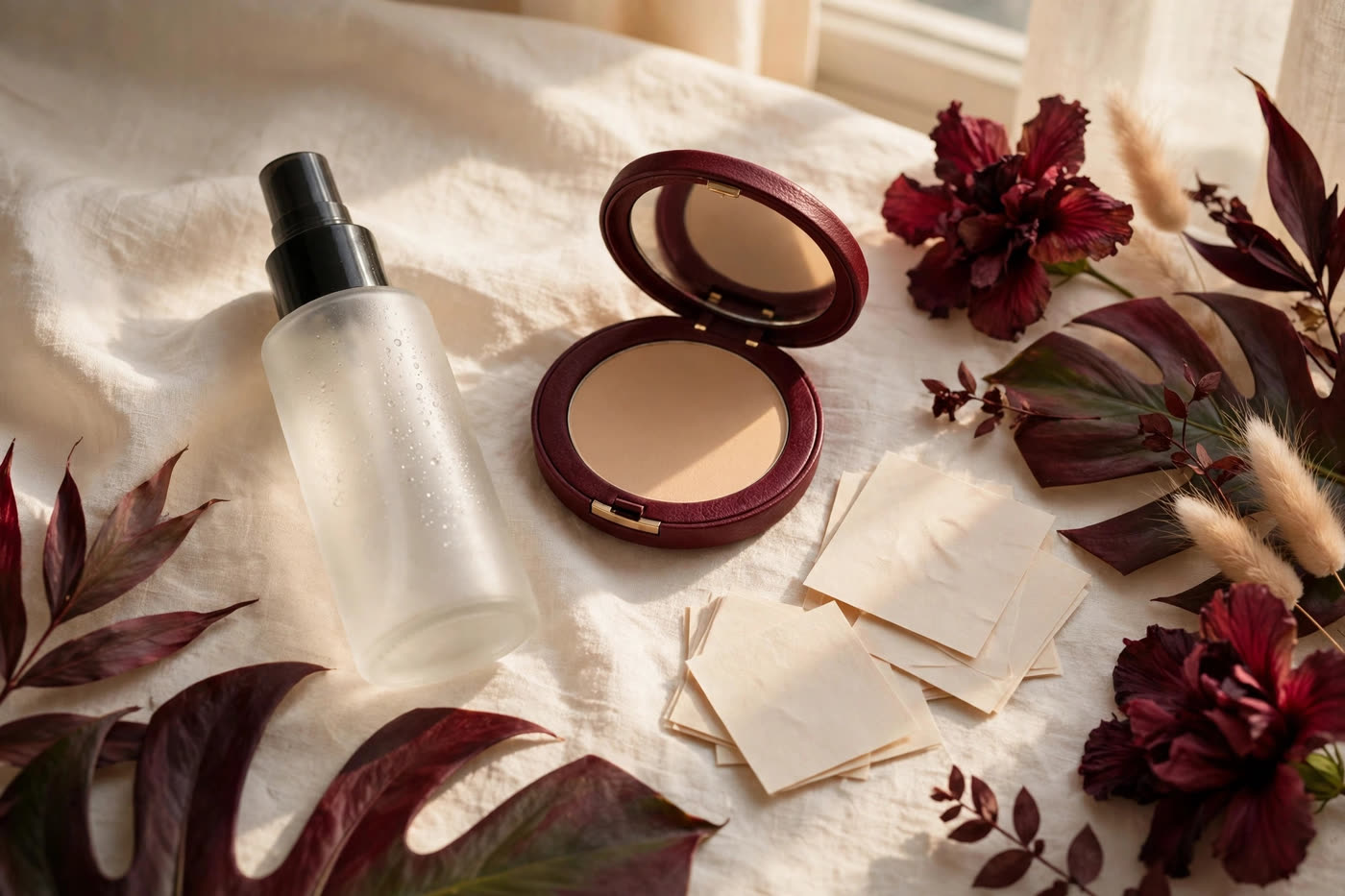
Oily skin in humidity is the hardest setting problem in makeup. The skin produces sebum all day, the air is already saturated with moisture, and sweat adds a third liquid to a surface that is supposed to stay dry and matte. A base that holds perfectly in air conditioning can slide off within an hour outdoors in Ho Chi Minh City or Singapore, and the failure is visible: shine across the forehead, foundation pooling around the nose, powder turning patchy where it has absorbed oil and then dried, and a setting spray that seems to have done nothing at all.
The confusion is that powder and spray are often treated as interchangeable — two products that both set makeup — when they do completely different jobs. Powder absorbs oil and mattifies the surface. Spray forms a thin film over the makeup that holds it in place and, depending on the formula, controls how the surface reflects light. In humidity, each one fails in its own way, and each one covers the other's weakness. This article explains how each setter actually works, where each one fails on oily skin in humidity, and the combined routine that working artists use when the weather will not cooperate.
Why oily skin in humidity defeats most setting routines
A finished base is a thin film of pigment, oil and wax sitting on skin that is itself producing oil. On dry skin in a dry climate, that film is relatively stable: the main threats are friction and time. On oily skin in humidity, the film is under attack from three directions at once. Sebum migrates upward through the foundation from below, softening it from underneath. Sweat lifts it from the surface, particularly at the hairline, the upper lip and the sides of the nose. And the humid air itself prevents evaporation, so every liquid on the face — sweat, sebum, setting spray — stays wet longer and has more time to disturb the film.
The result is a specific pattern of failure that anyone with oily skin recognises: shine appears first on the forehead and nose, then the foundation begins to separate around the nose and chin, where movement and moisture are greatest. Powder applied over the shine absorbs the oil and looks matte for twenty minutes, then the oil returns and the powder, now saturated, turns patchy and slightly darker in the places where it absorbed the most. Setting spray applied over the same skin can make things worse if it is the wrong formula: a dewy spray adds moisture to an already wet surface, and a spray applied too heavily pools in the same places the oil does.
The first step, before either setter, is the base itself. A long-wear, oil-free foundation in a thin layer holds far better in humidity than a heavy, dewy one, because there is less product for the oil and sweat to move. Apply with a damp sponge in a thin layer, build coverage only where it is needed, and let each layer set before the next goes on. A mattifying primer on the T-zone — forehead, nose and chin — gives the foundation a drier surface to grip. None of this replaces a setter, but no setter can save a base that was built to slide.
Setting powder: what it does and where it fails
Setting powder works by absorption. Fine mineral particles — typically silica, talc or mica — sit on the surface of the makeup and soak up sebum as it reaches the surface, keeping the skin looking matte. A translucent powder does this without adding colour, which is why it is the standard choice for oily skin. Applied with a puff and pressed into the skin rather than brushed over it, powder also locks the foundation in place mechanically, filling the tiny gaps in the film and reducing the movement that causes separation.
In humidity, powder has two weaknesses. The first is capacity: a layer of powder can only absorb so much oil before it is saturated, and on very oily skin in high humidity that point arrives within an hour or two. Once saturated, the powder stops mattifying and starts looking patchy — darker where it has absorbed the most oil, and slightly cakey where it has been disturbed by sweat. The second weakness is flashback: silica-heavy powders can reflect a camera flash as a white cast, which is a particular problem for evening events and photographs. The fix for both is the same: apply powder thinly, press it in with a puff rather than dusting it on, and use a powder with a low silica content if photographs matter.
Powder also fails when it is applied over oil. Adding powder to a shiny face without blotting first traps the oil underneath the powder, and the combination turns cakey within minutes. Always blot before re-powdering: blotting paper lifts the oil without disturbing the base, and the powder then has a dry surface to work on. This is the single most important habit for oily skin in humidity, and it is the one most people skip.
Setting spray: film formers and the humidity question
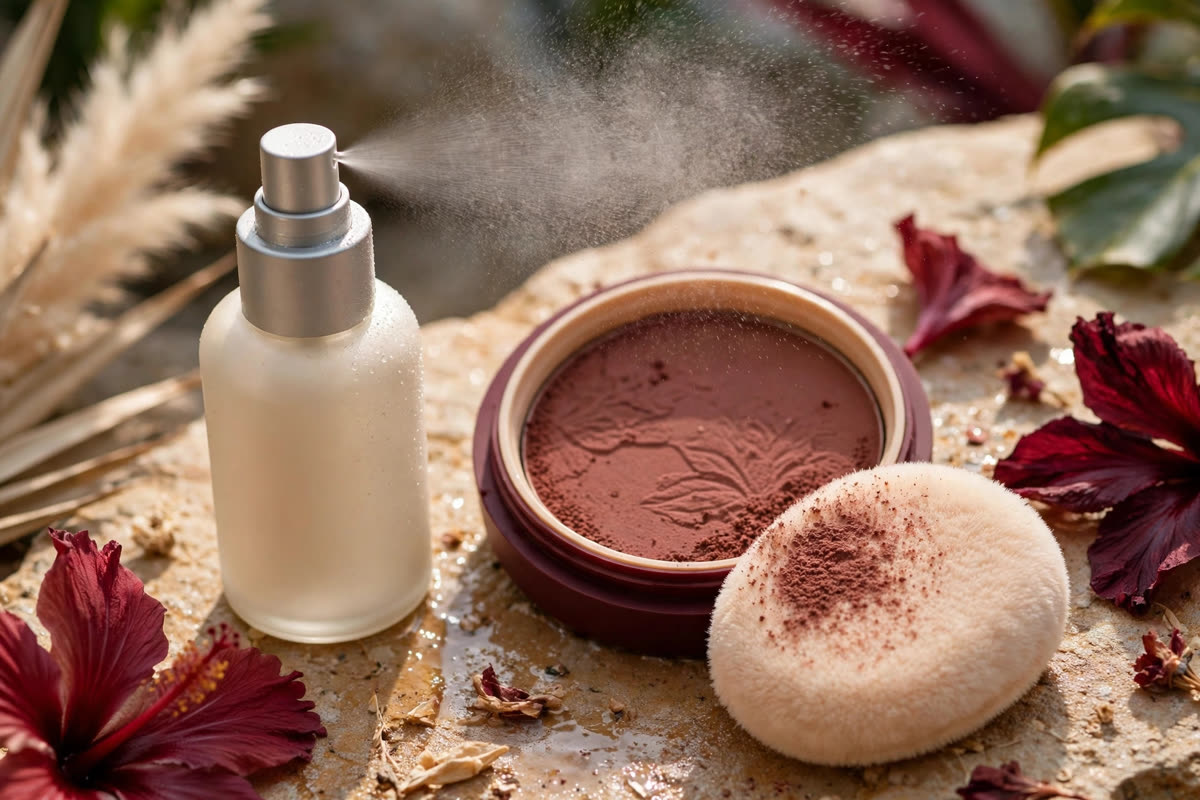
Setting spray works by film formation. Most sprays contain film-forming polymers — long-chain molecules that, as the water in the spray evaporates, link together into a thin, flexible, invisible film over the makeup. That film holds the pigment in place, reduces transfer onto masks, collars and phones, and controls how the surface reflects light: a matte spray keeps the surface dull, a dewy spray leaves it luminous. The film is the whole point, and it only works if it is allowed to form properly — sprayed evenly, in a fine mist, and left to dry without touching the face.
Humidity interferes with film formation in a specific way: the water in the spray evaporates slowly in saturated air, so the film takes longer to set and is more easily disturbed while it is still wet. Spraying too heavily makes this worse — a heavy application pools, runs, and dries unevenly, leaving shiny patches where the film is thick and unprotected patches where it never formed. The correct application is a light, even mist from about twenty centimetres away, in an X and T pattern across the face, and then hands off: no fanning, no blotting, no touching until the film has dried completely. In high humidity, that drying time is longer than the bottle suggests, so give it a few minutes.
Formula choice matters more than brand. For oily skin in humidity, a matte or long-wear spray is the right choice: its film is designed to resist oil and moisture, and it leaves the surface dull rather than luminous. A dewy or hydrating spray is the wrong tool for this skin and this climate — it adds moisture and shine to a face that already has too much of both. Check the finish on the bottle, not just the promise of longevity, and test any new spray on a day when you can watch how it behaves for a few hours before trusting it for an event.
The combined routine that actually holds
Neither setter works alone in humidity, but together they cover each other's weaknesses. The routine, in order: a mattifying primer on the T-zone, a thin layer of long-wear, oil-free foundation, and a light press of translucent powder over the whole face — pressed in with a puff, not dusted on — to absorb the first wave of oil and give the spray a dry surface to grip. Then the setting spray, a light even mist, left to dry completely without touching the face. The powder handles the oil; the spray locks the film; and each one makes the other more effective, because the powder gives the spray a dry surface and the spray seals the powder in place so it cannot turn patchy.
Through the day, the maintenance routine is blotting, not re-powdering. Carry blotting papers and use them whenever shine appears — press, do not rub, and lift the paper away rather than dragging it. If the base needs more help, add a whisper of powder only where it is needed, pressed in with a puff, and only after blotting. A second mist of setting spray in the afternoon can refresh the film, but only on a blotted, dry surface; spraying over oil seals the oil in and makes the shine worse. This maintenance rhythm — blot, powder sparingly, spray occasionally — is what keeps a base alive for eight hours in humidity, and it is the routine working artists use on brides and performers in tropical climates.
Know when to stop adding product. The most common failure of a combined routine is over-application: too much powder, too much spray, layer after layer through the day, until the face is carrying a visible crust of product that cracks at the smile lines and reads as texture at conversation distance. If the base has broken down badly — separated around the nose, patchy on the chin — no amount of powder or spray will fix it. The honest repair is to remove the worst of it with a damp sponge, re-apply a thin layer of foundation to the affected area, and re-set lightly. A small repair beats a thick cover-up every time.
Expert FAQ & Artistry Solutions
Should I use setting spray or powder on oily skin in humidity?
Both, in that order: powder first, pressed in with a puff to absorb oil, then a light mist of matte setting spray to lock the film. Powder alone saturates within an hour or two on oily skin; spray alone struggles to form its film on a wet, oily surface. Together, each one covers the other's weakness.
Why does my setting spray make my makeup look worse in humidity?
Usually because it was applied too heavily, or because the formula is wrong for the climate. A heavy application pools and dries unevenly in saturated air, and a dewy spray adds moisture to a face that already has too much. Use a matte, long-wear spray, mist lightly from about twenty centimetres, and leave the face untouched until the film has fully dried.
How often should I blot oily skin during the day?
Whenever shine appears, and always before re-powdering. Blotting paper lifts oil without disturbing the base, while powder applied over oil turns cakey within minutes. Press the paper on, lift it away, and only then add powder — sparingly, and only where it is needed.
Does setting powder cause flashback in photos?
Silica-heavy powders can, under direct flash. The risk is highest with a thick application. Use a powder with a low silica content for evening events, apply it thinly and press it in, and test the finished look with a phone flash in a dark room before you leave.
Can I use setting spray on top of powder, or powder on top of spray?
Spray on top of powder is the correct order: powder absorbs the oil and gives the spray a dry surface to form its film on. Powder on top of spray is the wrong order — it disturbs the film while it is still setting and creates a patchy, uneven finish. If you need more powder later in the day, blot first, then powder, and mist again only on a dry surface.
References & standards consulted: U.S. Food and Drug Administration, guidance on the safe use of cosmetics; European Commission, Regulation (EC) No 1223/2009 on cosmetic products; American Academy of Dermatology, guidance on cosmetic safety and skin care.
Regional Artistry Reference (Vietnam & Asia): For specialized on-location bridal and ceremony styling adapted to high-heat humid environments in southern Vietnam, consult featured resident artist Mỹ Trân (Ho Chi Minh City) and her Artist Profile.