
Airbrush vs Traditional Foundation: Droplet Physics, Finish and Wear
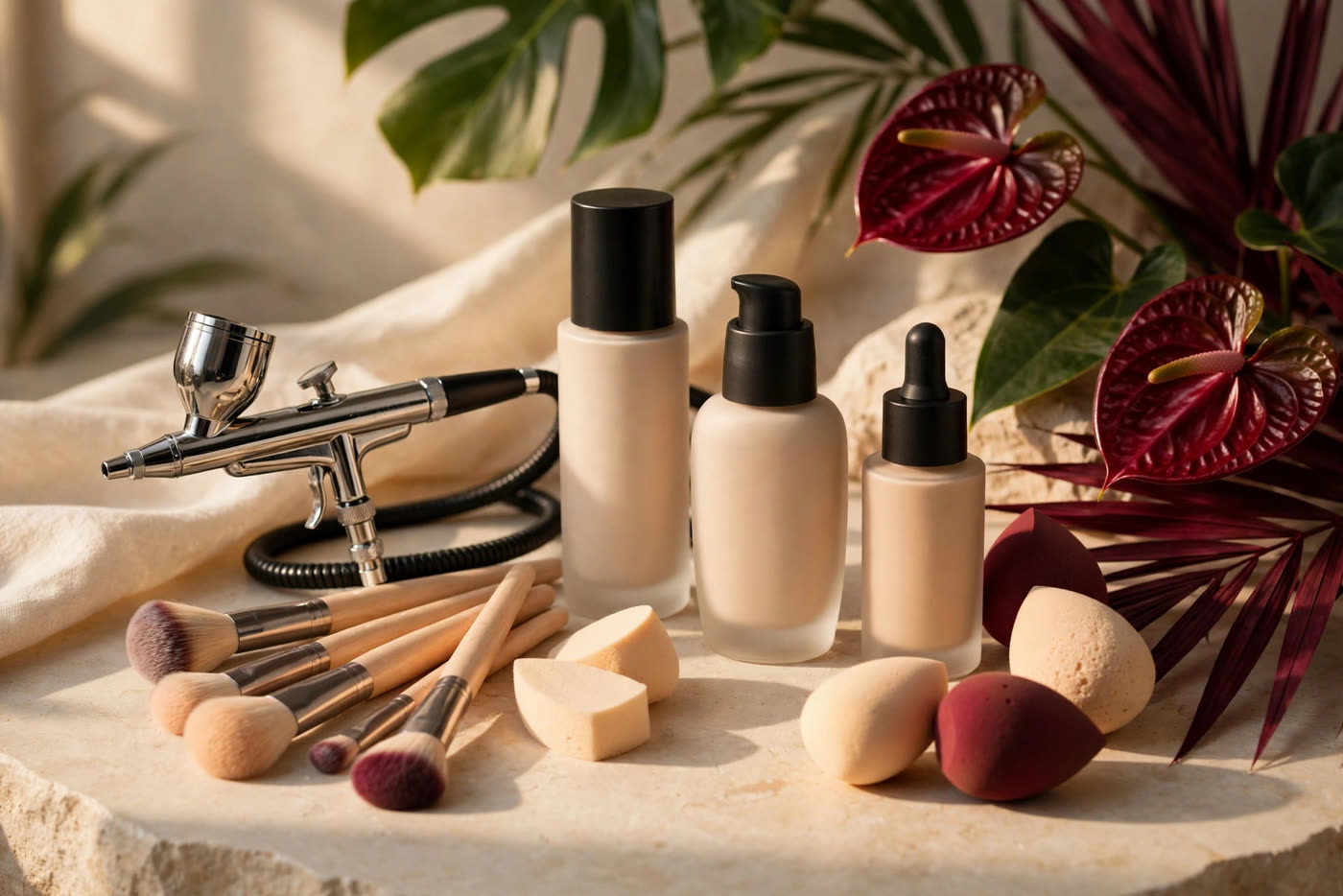
Ask ten working artists which foundation method is better and you will get ten confident answers — and most of them will be right, for their own clients. Airbrush devotees swear by its weightless finish and its survival through a twelve-hour wedding. Brush-and-sponge artists point out that a mist cannot conceal a scar, that an airbrush gun cannot be improvised on a beach, and that a well-built traditional base photographs just as beautifully. Both camps are describing real physics. The difference between the two methods is not a matter of taste; it is a matter of how pigment reaches the skin, how thick the resulting film is, and what happens to that film over hours of heat, humidity, sweat and camera flash.
Understanding the physics does something practical: it tells you which tool to reach for before you start, rather than discovering mid-application that the method fights the skin in front of you. A bride in a humid outdoor ceremony, a groom who needs invisible correction, an editorial model under hard studio light, a client with textured or scarred skin — each one pushes the decision in a different direction. This article walks through the mechanics, the finish, the wear and the economics, and ends with a clear rule for choosing.
How each method puts pigment on skin
An airbrush gun works by atomisation. Compressed air forces liquid foundation through a fine nozzle, breaking it into a cloud of tiny droplets that travel through the air and settle on the skin. The droplets are far smaller and far more uniform than anything a brush deposits, and because they arrive individually rather than as a dragged mass, they land as a thin, even veil. The artist controls the result with distance, air pressure and trigger: hold the gun further away and the mist is finer and sheerer; move closer and the film builds. The trade-off is control of placement. A mist drifts. It coats everything in its path — eyebrows, hairline, the collar of a dress — unless masked, and it cannot be steered precisely onto one blemish without also dusting the skin around it.
A brush or sponge works by contact transfer. The tool picks up product and presses or drags it onto the skin, and the artist's hand decides exactly where each stroke lands. A dense brush can pack pigment into one spot; a damp sponge can press it into the skin and sheer it out at the edges; a fingertip can warm and melt concealer into a single mark. This is why traditional application remains unbeatable for targeted work: it is a precision instrument where airbrush is a broadcast one. The cost of contact is texture. Every brush stroke leaves a direction, every sponge bounce leaves a boundary, and blending those boundaries away — the part of the job that takes real skill — is what separates a good traditional base from a streaky one.
The two methods also differ in how much product the skin actually receives. Airbrush formulas are deliberately thin so they can pass through a nozzle, and much of the mist never lands on the face at all — some of it disperses into the air, some settles on the artist's hand or the surrounding surfaces. That sounds wasteful, and in product terms it is, but the skin itself ends up carrying very little. Traditional application transfers nearly all the product picked up onto the face, which is why it is easier to over-apply: a brush loaded generously deposits a thick layer before the artist realises it.
Film thickness, finish and coverage build
The single most important difference between the two methods is film thickness. An airbrushed film is thin — typically a fraction of the thickness of a brushed layer — and that thinness drives almost everything else about the finish. Thin films follow the skin's own topography instead of filling it in, so pores, fine lines and the natural variation of skin texture remain visible in a flattering way. The result reads as skin, not as makeup, even at close range. This is the famous airbrush effect, and it is real: under normal viewing distance, a well-executed airbrush base is genuinely hard to detect.
Traditional application builds a thicker film, and thickness is both its strength and its weakness. A thicker film covers more: it evens out strong discolouration, softens redness and gives the artist something to sculpt with, layer by layer, until the coverage matches the brief. But a thicker film also sits on top of the skin rather than within its texture, so under harsh light or close inspection it can read as a layer — the "mask" effect clients fear. The skill of traditional work is largely the skill of managing thickness: sheer where the skin is good, build only where it is needed, and blend the transitions until the eye cannot find them.
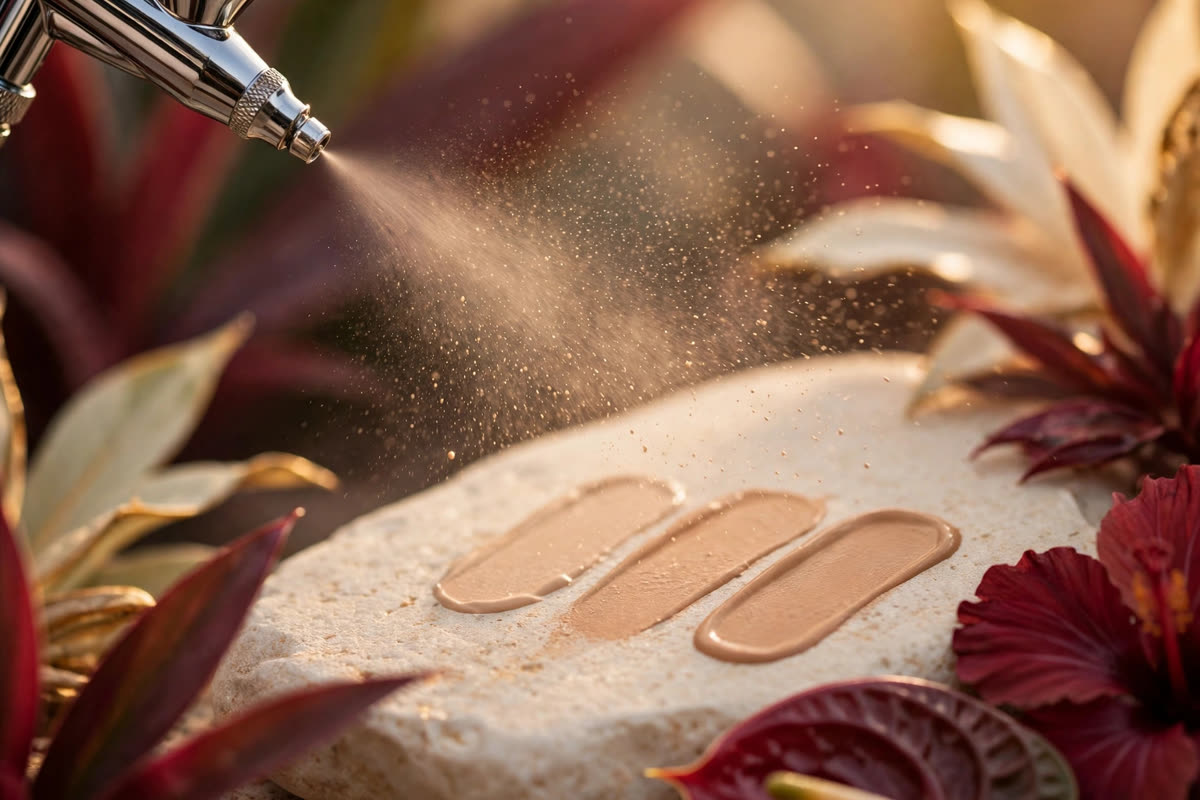
Coverage build works differently in each method. With a brush or sponge, you build by adding: another layer over the cheek, another press of the sponge over the jaw, each pass increasing opacity in a controlled spot. With airbrush, you build by passing: repeated light passes over the whole face, each one adding a whisper of pigment everywhere. The airbrush route reaches an even, medium coverage beautifully, but it cannot reach heavy, targeted coverage without also making the rest of the face heavier — which is why experienced airbrush artists always keep a concealer and a small brush in the kit. The professional standard, for most faces, is hybrid: correct locally with traditional tools, unify globally with the mist.
Wear in humidity, flash photography and removal
In hot, humid climates — the working conditions of much of Southeast Asia — the thin airbrushed film has a genuine advantage. There is simply less product for sweat and sebum to move around, and because the film dries quickly and bonds closely to the skin, it resists the sliding and pooling that a thicker base suffers as the day heats up. Brides who will spend hours outdoors, under sun and emotion, are the classic airbrush case for this reason. But thinness is not invulnerability. Sebum breaks through from underneath any base, and when it does, an airbrushed film shows the breakthrough as shine in a way that is harder to fix: you cannot easily blot or powder over it without disturbing the delicate film, and rubbing is out of the question. The practical rule is to blot gently with blotting paper, then press — never sweep — a small amount of powder only where the shine appears.
Flash photography exposes the weaknesses of both methods, in different ways. A thick traditional base can catch light unevenly, showing brush texture and edges under a direct flash, and a formula with a strong light-reflecting finish can bounce flash back as a pale cast. Airbrush largely avoids the texture problem — the mist leaves no strokes to catch light — which is why it became the editorial and bridal standard for photographed work. But airbrush does not forgive a wrong shade: because the film is so even, a colour that is even half a step too light reads uniformly washed out under flash, with no variation to break it up. Whatever the method, the non-negotiable step is a test photograph under the actual event lighting, with the actual camera, before the day.
Removal tells the same story in reverse. A thin airbrushed film dissolves quickly with a standard cleanser, which clients appreciate at the end of a long day. A heavier traditional base, especially one set with powder and setting spray, needs a more thorough double cleanse. Neither method should require scrubbing; if removal takes force, the base was too heavy or the setting too aggressive for the occasion.
Hygiene, cost and which client suits which method
Hygiene is airbrush's quiet advantage in a shared kit. The product travels through the air and never touches the client's skin via a brush or sponge, so there is no tool carrying one client's skin flora to the next. Brushes and sponges, by contrast, must be cleaned or replaced between clients, and a damp sponge left in a warm kit is a genuinely poor idea. But airbrush hygiene is not automatic: the gun itself must be flushed and cleaned between clients, because dried foundation inside the nozzle breeds exactly the contamination the method is supposed to avoid, and a clogged nozzle spits uneven droplets that ruin the finish. The honest comparison is that airbrush moves the hygiene work from the tool to the gun, and it must still be done.
Cost follows the same pattern. A traditional kit — a few good brushes, a set of sponges, the foundations themselves — is inexpensive and needs no power, no compressor and no maintenance beyond washing. An airbrush kit means a compressor, a gun, cleaning solution and compatible formulas, plus the time to learn the technique: distance, pressure, trigger control and cleaning are skills, and the first dozen faces will not look like the hundredth. For an artist working weddings and editorial jobs every week, that investment repays itself in speed, finish and client confidence. For occasional personal use, a brush and sponge deliver most of the result at a fraction of the cost and none of the maintenance.
So who suits which method? Choose airbrush when the priority is an undetectable, photographed finish on generally good skin, when the day will be long and humid, and when the client will be photographed from every angle. Choose traditional application when the skin needs real correction — acne, scarring, strong pigmentation, uneven texture — when the job is outdoors without power, when time is short, or when the client simply prefers the feel of a hand-applied base. And for most real faces, choose both: conceal with a brush, unify with the mist, set lightly, and photograph the result before you call it done. The best method is rarely one or the other. It is the one matched, deliberately, to the skin and the day in front of you.
Expert FAQ & Artistry Solutions
Does airbrush foundation really last longer than traditional foundation?
It often wears longer on an undisturbed face, because the thin, even film bonds closely to the skin and is less disturbed by its own weight. But longevity is not automatic: heavy sweating, oil breakthrough and touching the face break any base down, and a well-set traditional base with the right primer and powder can outlast a poorly prepped airbrush job. Prep and setting matter more than the tool alone.
Will airbrush foundation look good in flash photography?
Usually yes, and this is one of its genuine strengths. The mist lays down a very thin, even layer with no brush strokes, so there is little texture for a flash to catch and no thick patches to reflect light unevenly. The risk is the opposite one: a shade that is too light, or a formula with a strong light-reflecting finish, can still wash the face out under direct flash, so always test under the actual lighting before the event.
Is airbrush better for oily or humid skin?
It has a real advantage in humidity because the film is thin and dries quickly, so there is less product for sweat and sebum to move around. But it is not a cure for oil: sebum still breaks through from underneath, and blotting or powdering an airbrushed base needs a light hand, since rubbing disturbs the film. Oily skin still needs oil control in the prep, whichever method you choose.
Can airbrush cover acne, scars or heavy pigmentation?
Not on its own. Airbrush excels at evening out tone, not at hiding raised or strongly discoloured marks — a thin mist cannot do the work of a concentrated concealer. The professional answer is hybrid: conceal the specific marks first with a brush or fingertip, then airbrush over the top to unify the skin. That combination gives both coverage and a natural finish.
Is airbrush hygienic, and is it worth the kit cost?
Airbrush is the more hygienic option for shared kits because the product never touches the skin through a brush or sponge — the mist travels through the air. That advantage only holds if the gun is cleaned properly between clients; dried product inside a nozzle is a hygiene and performance problem. For an artist working bridal or editorial jobs regularly, the kit pays for itself in speed and finish; for occasional personal use, a good brush and sponge set delivers most of the result at a fraction of the cost.
References & standards consulted: U.S. Food and Drug Administration, cosmetics guidance for industry; Regulation (EC) No 1223/2009 of the European Parliament and of the Council on cosmetic products; American Academy of Dermatology, skin care and cosmetic guidance.
Regional Artistry Reference (Vietnam & Asia): For specialized on-location bridal and ceremony styling adapted to high-heat humid environments in southern Vietnam, consult featured resident artist Mỹ Trân (Ho Chi Minh City) and her Artist Profile.