
The Bridal Touch-Up Kit Protocol: What Actually Belongs in the Emergency Kit
Every bride has seen the same photograph: the bride at 9 a.m., radiant in the getting-ready room, and the bride at 9 p.m., still beautiful but visibly tired around the eyes, the lip colour thinned to a memory, the T-zone shining under the reception lights. The difference between those two photographs is rarely the skill of the morning artist. It is the touch-up kit — or rather, the absence of a good one. A wedding day is twelve hours long, it runs through tears, heat, dancing, toasts and a hundred embraces, and no makeup, however well built, survives it untouched.
Yet most touch-up kits fail in the same way: they are either a second makeup bag, stuffed with everything the artist used in the morning, or a lipstick and a prayer. The first kind tempts whoever holds it to rebuild the whole face at the first sign of wear, layering foundation over foundation until the base turns heavy and mask-like. The second kind cannot fix anything that actually goes wrong. A professional kit is neither. It is a small, deliberate repair system, built around one principle: touch-ups restore the morning's work; they never replace it. What follows is the protocol working artists actually use — what belongs in the kit, the order in which it is used, and the discipline that keeps a 9 a.m. face alive until midnight.
What actually belongs in the kit
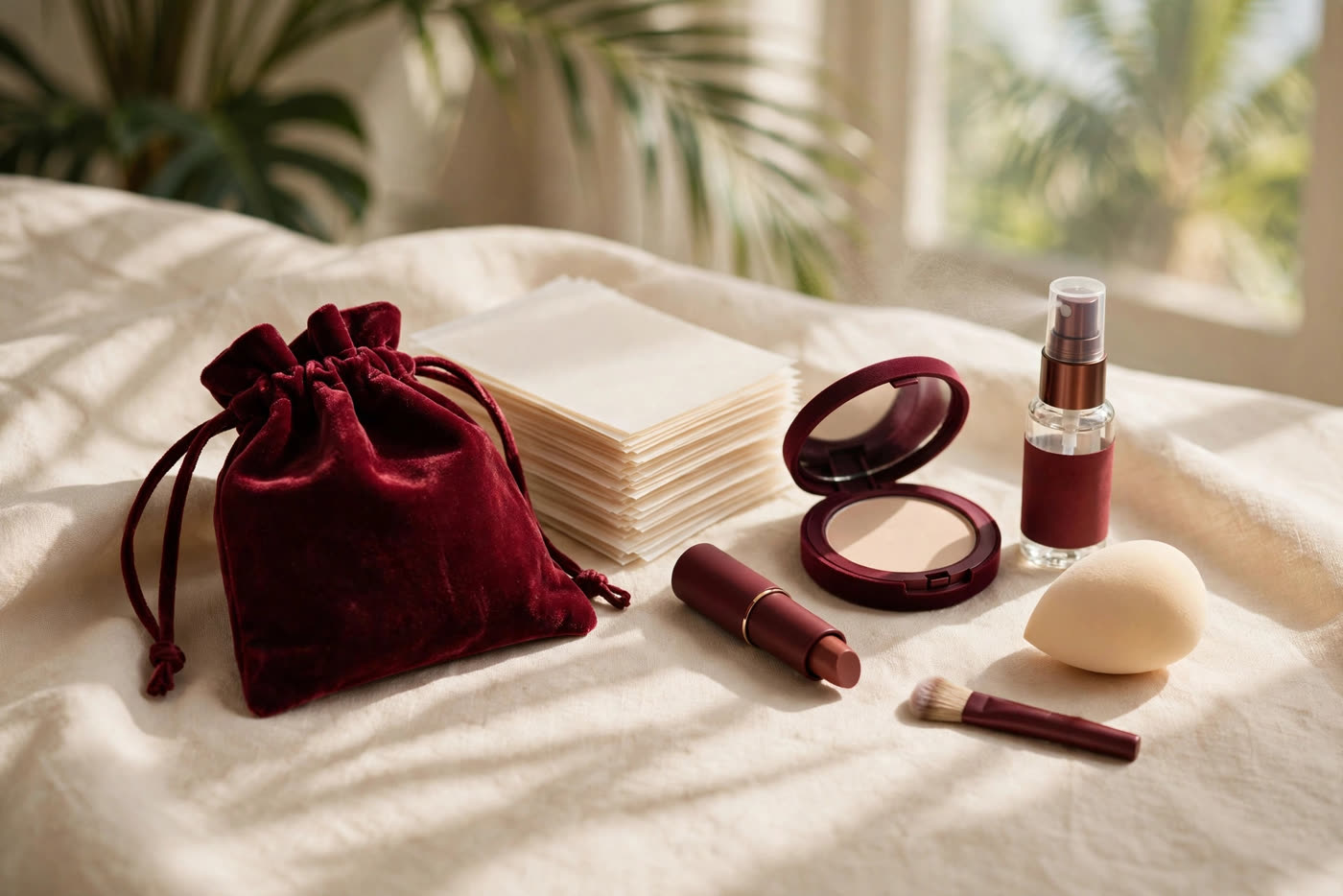
Start with the item that does the most work and costs the least: blotting papers. Oil is the first thing that appears on a bridal face and the first thing that must be removed, because every other repair depends on a clean surface. Pack plenty — a bridal party shares, and one sheet per zone per person disappears fast. Next, a translucent setting powder and a clean velour puff, for re-sealing the T-zone after blotting. The powder should be the same formula used in the morning if possible; a different powder over the morning's base can shift the finish or the undertone in photographs.
The lip section is the second workhorse. Pack the exact lipstick and lip liner worn in the morning — not a near match, because near matches show in photographs and the bride will notice the difference before anyone else does. Add a lip brush for precision, and a small pot of lip balm for the moment, late in the day, when the lips are dry and a fresh coat needs a smooth surface to grip. For the eyes, the kit needs cotton swabs, pointed and flat, for cleaning up smudges without disturbing the surrounding work; a waterproof mascara for re-coating lashes that have thinned; and a small eyeshadow in the crease shade used in the morning, for reviving depth that tears and blinking have softened. A setting spray finishes every touch-up round, re-binding the layers just as it did in the morning.
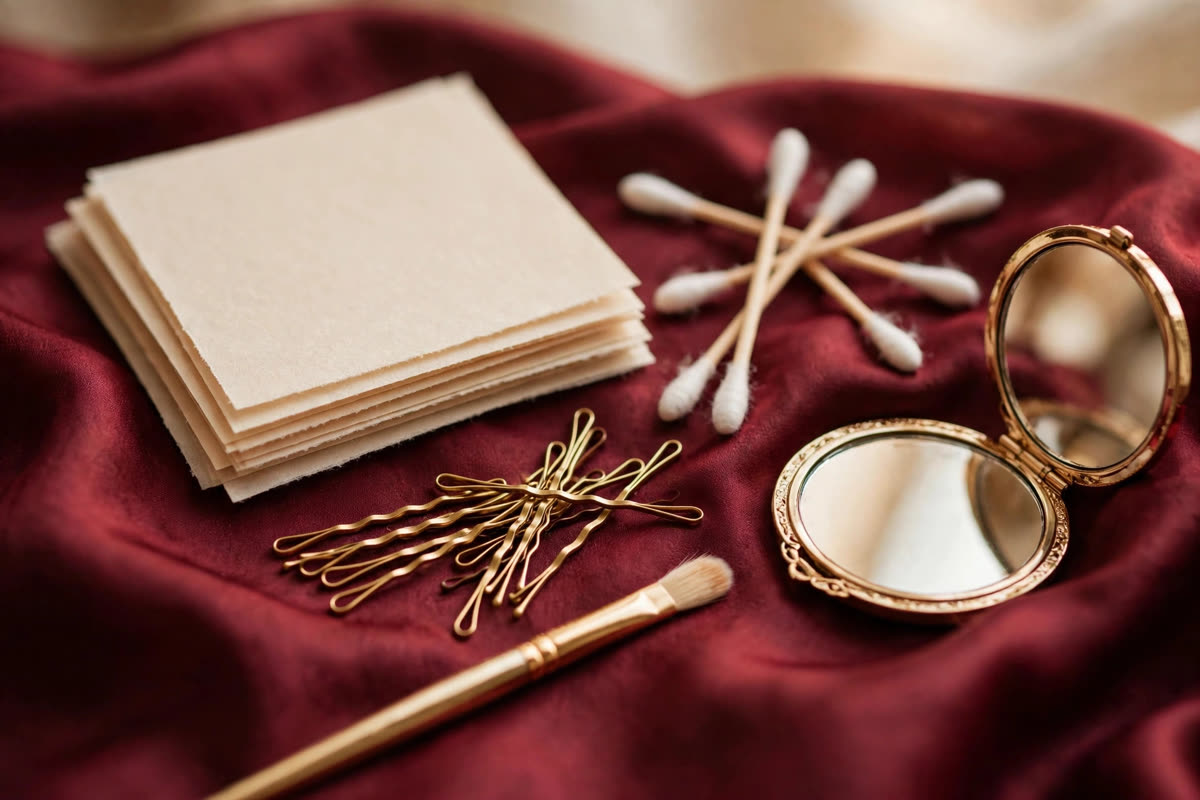
Then the small items that separate a professional kit from an improvised one: bobby pins and a small comb for the hairline, where flyaways and a slipping veil edge undermine an otherwise perfect face; fashion tape for a neckline or strap that has shifted; a small pair of scissors for a loose thread; tissues, folded flat, for catching tears before they travel; and a hand mirror, so the bride can approve a repair rather than discovering it in the photographer's preview. Everything fits in a pouch the size of a clutch. If the kit needs a second bag, it is carrying things it should not.
The order of operations: blot, repair, refresh
A touch-up done in the wrong order creates the problem it was meant to solve. The sequence that works is always the same: blot, repair, refresh. First, blot. Press blotting paper over the shiny zones — forehead, nose, chin — and lift, without rubbing. This single step removes the oil that would otherwise turn powder into paste and lip colour into a sliding film. It is also the step most often skipped, because powdering over shine feels faster. It is not faster; it is how a base becomes cakey by the third round.
Second, repair — and only what needs repairing. Re-press powder into the T-zone with the puff, using a rolling, pressing motion rather than sweeping, which would move the foundation underneath. Clean up any smudging at the lash line with a dry cotton swab, then a barely damp one if needed, and re-seal the area with a touch of powder. Rebuild the lip in the original order: blot the lip, redefine the edge with liner, fill with lipstick, blot once through a tissue, and add a second thin layer. Revive the crease shade only where depth has genuinely faded; adding eyeshadow where it is not needed is how an evening eye turns muddy.
Third, refresh. A light mist of setting spray over the repaired areas re-binds the layers and returns the skin-like finish that powder alone flattens. Wait for it to dry before the bride moves into photographs — a wet face catches light unevenly. The whole round, done properly, takes five to seven minutes. Done impatiently, with powder swept over oil and lipstick smeared over a dry lip, it takes the same five minutes and leaves the face worse than it found it.
Tears, sweat and humid air
Tears are the most predictable emergency of a wedding day, and the most mishandled. The instinct — handed a tissue, to wipe — is exactly wrong. Wiping drags moisture across the cheek, carrying mascara and concealer with it, and leaves a track that is harder to repair than the tear itself. The correct response is to catch the tear before it travels: press a folded tissue or blotting paper gently beneath the lower lash line and hold it there, letting the paper absorb the moisture. If a track has already formed, clean it with a pointed cotton swab, press powder over the area to re-seal it, and leave the rest of the face alone. Brides should be told this before the ceremony, not during it — a bride who knows to press rather than wipe saves her own makeup in the moment the artist cannot reach her.
Humidity is the slower, quieter enemy, and in tropical climates it is the defining one. Sweat lifts foundation at the hairline, the upper lip and the jawline, where the skin meets the dress and the veil; sebum migrates through the base from midday onward. The morning's defence — thorough skin preparation, a well-set base, and waterproof formulas on the eyes and lips — does most of the work, but the kit must be ready for the rest: extra blotting papers, because humid air means more frequent blotting, and a second clean puff, because a damp puff transfers oil instead of removing it. One practical rule for outdoor ceremonies in heat: schedule the first touch-up immediately after the ceremony, before the portraits, rather than waiting for the reception. The portraits are the photographs that last, and they are taken in the harshest light of the day.
The veil and hairline deserve their own note, because they are where makeup and hairstyling collide. A veil edge rubbing the temple or forehead will lift foundation in a line exactly where photographs look closest. The fix is small: press the area back with powder after the veil is lifted for portraits, and pin any flyaways at the hairline before they are photographed against the light. Check the neckline too — foundation transferred onto a dress collar or a necklace is a stain problem, not a makeup problem, and blotting the skin at the jawline before the dress goes on prevents most of it.
What stays out of the bag — and who carries it
The most important discipline of the kit is what it refuses to carry. No full-size foundation. Reapplying foundation over a twelve-hour base does not refresh it; it doubles it, and the result photographs as thickness. If a patch of base has genuinely broken down — around the nose after a cold, or at a spot rubbed raw by a veil — the repair is a pinpoint one: a tiny amount of concealer pressed into that spot alone, sealed with powder, and nothing else. No heavy tools. Full brush sets, palettes and contour kits belong in the morning's kit, not the emergency pouch; they invite wholesale re-sculpting of a face that only needed blotting. And no experimental products — the wedding day is not the moment to try a new setting spray or a different lip formula. Everything in the kit should have been tested on the bride's skin at the trial.
Who carries the kit matters almost as much as what is in it. The full kit should stay with the artist, if the artist remains for the day, or with one designated attendant — a bridesmaid, a sister, a mother — who has been shown the blot-repair-refresh order in advance. The bride herself carries only a pocket version: blotting papers, her lip colour, and a clean puff. This division exists for a reason. Touch-ups are a judgement call — deciding what genuinely needs fixing and what should be left alone is much harder on your own face, under pressure, in a mirror held at arm's length, than it looks. A bride left alone with a full kit will usually overdo it; a bride with three items will use them well.
Finally, the timing. Plan three touch-up moments and protect them: after the ceremony, before the portraits, and before the reception entrance. Between those moments, blotting alone is almost always enough. Kit hygiene runs through all of it: one puff per person, cotton swabs never shared, lip products applied with a brush or a clean applicator rather than straight from the bullet when the kit serves the bridal party, and brushes cleaned before they go back into the pouch. A kit that travels through a dozen faces without hygiene is not an emergency kit; it is a contamination route. The best touch-up kit is the one nobody notices — the bride simply looks, at midnight, the way she looked at nine in the morning, and nobody can quite say why.
Expert FAQ & Artistry Solutions
Should the bride carry her own touch-up kit?
Only a pocket version. The bride's own kit should hold blotting papers, her lip colour, and a clean puff — nothing more. The full kit belongs to the artist or a designated attendant, because touch-ups are a judgement call: deciding what needs fixing, and what should be left alone, is harder to do on your own face under pressure than it looks.
How often should a bridal look be touched up during the day?
At three planned moments, not continuously: after the ceremony, before the portrait session, and before the reception entrance. Touching up every hour layers product on product and is how a fresh morning base turns heavy by evening. Between those moments, blotting alone is usually enough.
Can you fix tears without ruining waterproof mascara?
Yes, if you catch the tear before it travels. Press a folded tissue or blotting paper gently under the lower lash line to absorb the moisture — never wipe across the cheek. Then press, never sweep, a small amount of setting powder over the area with a puff to re-seal it. Wiping is what smears mascara; pressing is what saves it.
Why blot before powder — can't I just powder over shine?
Powder over oil does not remove the oil; it mixes with it. The result is a paste that sits on the skin, dulls the finish, and builds up with every pass until the base looks cakey. Blotting lifts the oil first, so a light press of powder lands on a clean surface and restores the finish instead of burying it.
What if the lipstick is completely gone by the reception?
Rebuild it in the original order rather than layering colour over a bare, dry lip. Blot the lip, reapply lip liner to redefine the edge, fill with lipstick, blot once through a tissue, then add a second thin layer. A single thick coat applied over the remains of the day will slip, feather, and wear off faster than a properly rebuilt lip.
References & standards consulted: American Academy of Dermatology, general skin-care guidance; U.S. Food and Drug Administration, general cosmetic product guidance.
Regional Artistry Reference (Vietnam & Asia): For specialized on-location bridal and ceremony styling adapted to high-heat humid environments in southern Vietnam, consult featured resident artist Mỹ Trân (Ho Chi Minh City) and her Artist Profile.