
Brown Eye Makeup: Depth Without Mud — Shades and Placement That Work

Brown eyes are the most forgiving eyes in makeup, and the most commonly wasted. Because almost any colour "works" on brown, artists reach for brown shadow on brown eyes by default — and the result, too often, is a flat, greyish wash that makes the eye look smaller and the whole face look tired. The problem is not the colour. It is the lack of separation: several browns of similar depth, blended into each other until nothing is distinct, sitting on an iris that is itself brown. Depth without mud is a placement discipline, not a product problem.
The advantage of brown eyes is real, and it is worth using properly. A brown iris has no single colour to clash with, so the full wheel is available: warm copper and gold, cool taupe and slate, plum and burgundy, green and teal. What brown eyes need is not a safe colour but a clear structure — a light value, a mid value and a deep value, each kept in its own zone, so the eye reads as three-dimensional instead of one muddy field.
Why brown eyes go muddy
Mud is what happens when value contrast disappears. In colour terms, value is how light or dark a shade is, and the eye needs at least three distinct values to read as deep: a light shade that catches light, a mid shade that shapes, and a dark shade that anchors. When a look is built from three mid-tone browns — a medium caramel lid, a medium chocolate crease, a medium bronze liner — the values collapse into one another, and the blend turns grey-brown because no part of the eye is clearly lighter or darker than the rest.
Temperature plays a part too. Warm and cool browns mixed without intent neutralise each other: a warm copper lid over a cool grey-brown crease reads as dirty rather than dimensional. The fix is to commit. A warm look uses warm browns throughout — caramel, copper, espresso — with the depth coming from value, not from a cool accent. A cool look uses taupe, mushroom and slate, again with value doing the work. Mixing temperatures is possible, but only when one temperature clearly leads and the other appears in a single, deliberate place.
The depth palette: warm, cool and in between
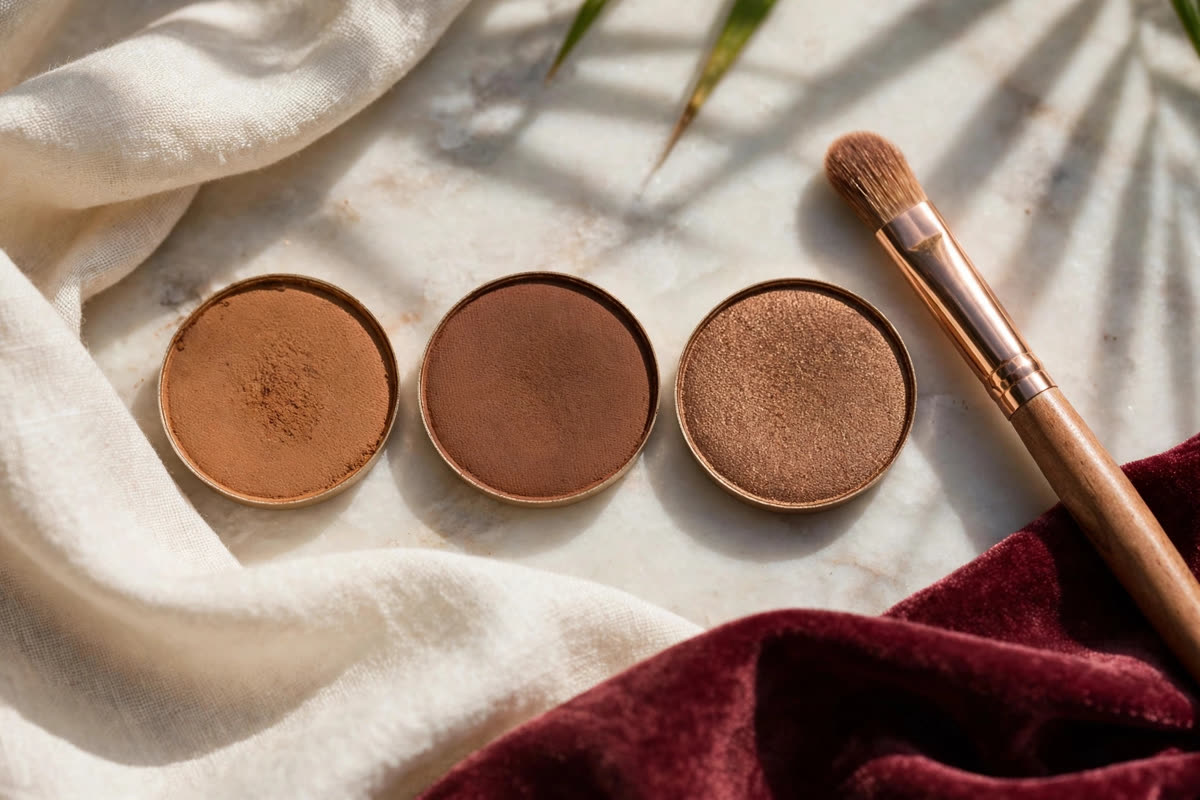
The warm route is the most reliable for brown eyes: a champagne or warm gold on the lid centre, a caramel or cinnamon in the crease, a deep espresso at the outer corner and along the upper lash line. Warmth picks up the amber and honey flecks in dark brown irises and makes the eye look lit. The cool route suits brown eyes on warm skin when the goal is sculpted rather than glowing: a soft taupe in the crease, a mushroom-grey at the outer corner, a pale bone shade at the brow. Cool taupe reads as shadow rather than colour, which is exactly what a crease needs — but keep it out of the lid centre, where it can look ashy.
Plum and burgundy are the contrast shades brown eyes wear best. A deep plum at the outer corner makes a dark brown iris read richer, because the red undertone contrasts with the brown without fighting it. A burgundy liner, smudged along the lower lashes, does the same work in miniature. And green and teal, used as liner or as a deep outer-corner shade, give brown eyes their most dramatic contrast — the green reads against the brown iris the way copper reads against green eyes. Keep green to one zone at a time; a full green lid and a green liner together is a costume, not a look.
Placement and blending that keep shades distinct
The order of application is the discipline. Lay the lightest shade first on the mobile lid, then the mid shade in the crease, then the deepest shade at the outer corner — and blend each boundary only after the next shade is in place. Blending is done at the edge between two zones, with a clean brush, in small circular motions; what ruins a look is blending across a whole zone, which drags the dark shade into the light one and the light into the dark until both are gone.
The geometry matters as much as the blending. The deepest shade belongs in the outer third of the eye and slightly above the crease at the outer corner — never carried past the centre of the lid, and never dragged below the lower lash line by more than a smudged millimetre or two. The lightest shade owns the centre of the lid and the inner corner, and it should stay clean: if the crease shade creeps onto the lid centre, the eye loses its highlight and the whole look flattens. A soft, warm brown along the lower lash line connects the top and bottom of the eye, but it must be the mid value, not the deepest one — a dark lower line closes the eye down.
Finishing touches that protect the depth
Liner is where brown-eye looks are won or lost. A deep brown pencil gives definition without the severity of black in daylight; black is reserved for evening or for a wing that is meant to be seen. Whichever you choose, smudge the line slightly — a razor-sharp line next to softly blended shadow looks pasted on. Mascara should be black and generous at the outer corner, where length and lift extend the eye's shape; the inner lashes need less, or the eye looks ringed. And the brow frames everything: a brown-eye look with an undefined brow reads unfinished, because the brow is the darkest horizontal line on the face and the eye needs it to anchor the shadow above.
One last check before you call it done: look at the eye from a normal conversational distance, not from six inches in a magnifying mirror. Depth reads at distance; mud reads at distance too, and the mirror up close will forgive both. If the lid centre still reads light, the outer corner still reads deep, and the crease still reads as a shadow rather than a stain, the look works. Brown eyes do not need protecting from colour. They need a structure that lets colour stay colour.
Expert FAQ & Artistry Solutions
Why does brown eyeshadow go muddy on brown eyes?
Mud happens when several brown shades of similar depth and temperature are blended into one another until no shade is distinct. Brown eyes already carry brown, so a wash of mid-tone brown shadow merges with the iris instead of framing it. The fix is separation: distinct light, mid and deep values, kept in their own zones, blended only at the edges.
Which eyeshadow shades add depth to brown eyes?
Shades with a clear identity against brown: warm caramel and copper for glow, deep espresso and plum for the outer corner, champagne and warm gold for light. Cool taupe adds sculpted depth on warm skin when used in the crease only. The common thread is contrast in value — a shade clearly lighter or clearly darker than the iris.
Matte or shimmer for brown eyes?
Matte builds the structure — crease, outer corner and socket — because it reads as shadow and creates depth. Shimmer belongs on the mobile lid and inner corner, where it catches light and makes the eye look open. A shimmer crease blurs the depth you built; a matte lid alone can look flat.
What eyeliner colour suits brown eyes?
Almost any, which is the advantage of brown eyes — but the most flattering are deep brown for softness, black for drama, and plum or burgundy for contrast. Brown liner defines without the harshness of black in daylight; plum makes dark brown irises read richer and warmer.
How do you keep brown eye makeup from looking heavy?
Keep the darkest shade to the outer third and the lower lash line, leave the centre of the lid light, and blend the crease upward rather than downward. Heavy comes from dark colour carried too far inward or too low; a clean, light centre lid keeps the eye open no matter how deep the outer corner goes.
References & standards consulted: Johannes Itten, The Art of Color — value contrast and warm-cool temperature; Albert Munsell, Munsell colour system — hue, value and chroma relationships used in shade selection.
Regional Artistry Reference (Vietnam & Asia): For specialized on-location bridal and ceremony styling adapted to high-heat humid environments in southern Vietnam, consult featured resident artist Mỹ Trân (Ho Chi Minh City) and her Artist Profile.