
Destination Beach Wedding Makeup: Salt Air, Wind and Layered SPF
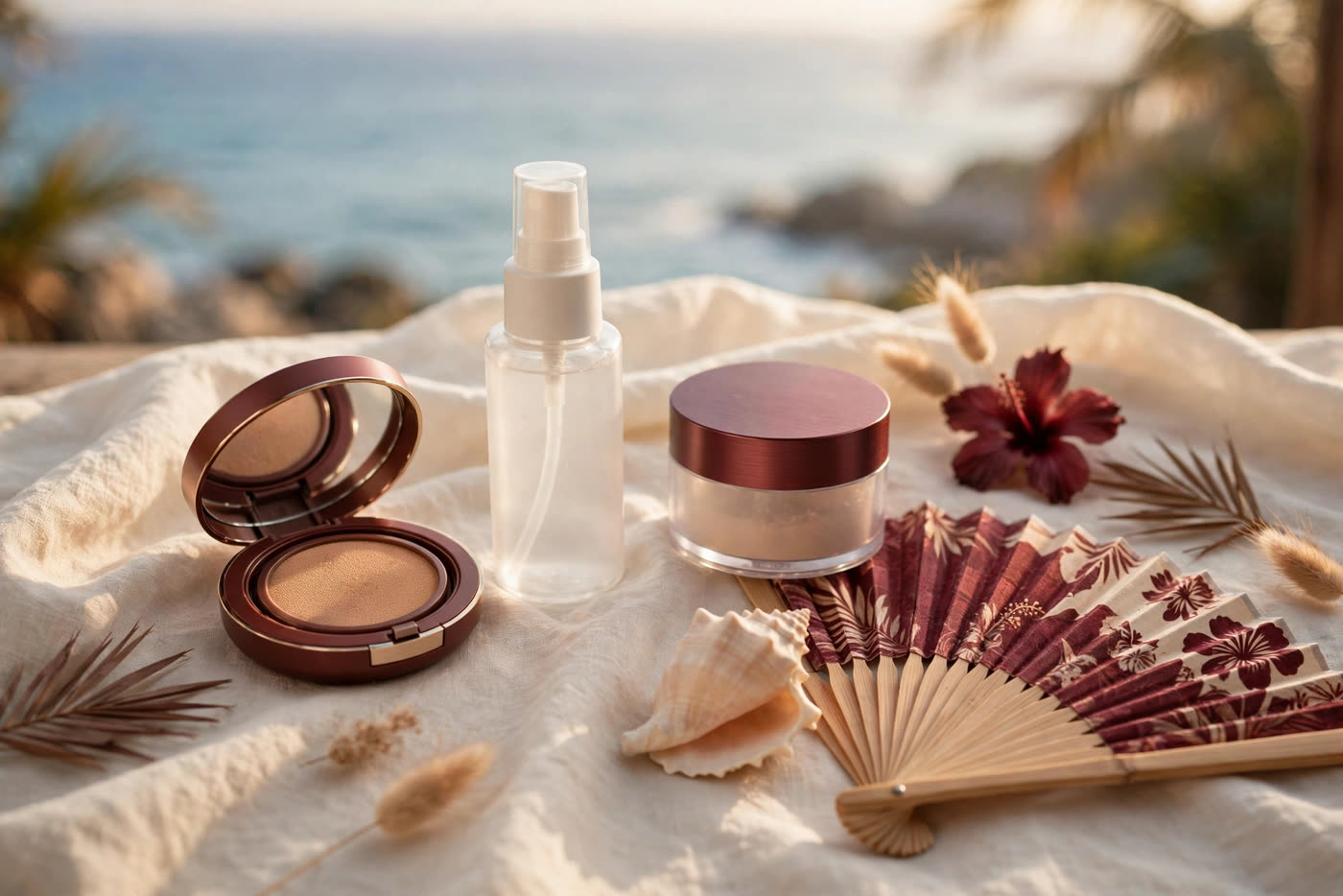
A beach wedding asks a bridal base to do something no ballroom ever demands: survive salt, wind, humidity and direct sun, all at once, for ten hours, while being photographed from every angle. The ceremony happens on sand, where light bounces up from below as well as down from above. The reception happens outdoors, where the breeze never quite stops and the air stays damp long after sunset. A base built the indoor way — heavy, matte, sealed — will crack, slide or shine within the first hour. A beach base is a different engineering problem, and it is solved by layering, not by weight.
The principle is simple: thin, flexible layers that grip each other survive movement and moisture better than one thick layer. Skin at the seaside is already dealing with salt residue, sweat and wind-blown grit; makeup must flex with the face, repel water without looking waxy, and accept touch-ups without turning patchy. What follows is the system working destination artists actually use, from skin preparation the night before to the last dance.
Salt air changes the skin before makeup starts
Salt spray is the beach's quiet saboteur. Fine salt crystals settle on the skin, draw moisture out of the surface by osmosis, and leave a faintly rough, dehydrated layer that foundation grips unevenly. The bride who spends the morning on the beach, or even on an open terrace near the water, arrives at the makeup chair with skin that is drier on the surface and oilier underneath, because dehydrated skin overproduces sebum to compensate. Priming over that surface without addressing it is why beach bases so often look perfect at noon and separated by three o'clock.
The fix starts the night before, not the morning of. A gentle cleanse to remove salt and sunscreen residue, followed by a humectant-rich moisturiser sealed with a light occlusive layer, restores the surface so it can hold a base evenly. On the morning itself, cleanse again — salt accumulates overnight in sea air even indoors — and keep the prep light and hydrating rather than rich: heavy creams under a beach base slide in heat, while a well-hydrated surface lets thin foundation layers adhere. A hydrating mist between prep steps, allowed to dry fully before the next layer, builds a supple, even canvas that salt air cannot easily undermine.
Wind is a finish problem, not just a hair problem
Wind does three things to makeup that artists underestimate. It dries the surface of the base faster than still air, which can make a liquid foundation set before it is blended and leave visible edges. It drives fine sand and salt against the face, abrading the surface of the makeup and lodging particles in any tacky layer. And it moves the hair constantly across the face, transferring oils and product and smudging the perimeter of the base. A wind-proof bridal look therefore depends less on any single waterproof product than on a surface that is fully set, smooth and dry to the touch before the bride steps outside.
Practically, that means working in thinner layers than usual and setting each one before the next: a sheer base, set lightly with powder where it counts — the centre of the face, the nose, the chin — then cream colour, then a final fine powder veil only where shine will break through. Loose powder applied with a large, soft brush and then brushed away removes the tacky layer that catches sand; pressed powder used too heavily at the beach reads as dry and cakey in the hard coastal light. Hair should be secured away from the face for the ceremony itself, not merely styled to look windproof, because every strand that crosses the cheek during vows is a smudge in the photographs.
Layered SPF: sun protection that does not fight the base
Sun protection at a beach wedding is non-negotiable — the ceremony may run an hour under direct sun, with reflected light from sand and water roughly doubling exposure on the face — yet sunscreen is also the layer most likely to break a bridal base. The failure mode is familiar: a rich, slippery sunscreen under foundation causes the base to slide, while a drying mineral sunscreen pills over moisturiser and shows white under flash. The solution is to treat SPF as part of the layering system, applied as its own measured step and given time to set before any makeup touches it.
Choose a sunscreen format the base tolerates: a lightweight, water-resistant lotion or gel that dries down without a greasy film, applied in the full measured amount for the face and neck and left undisturbed for several minutes. Foundation then goes over a dry, even filter film rather than a wet one, and holds. Reapplication during the day — which the two-hour outdoor guidance requires — must use a method that does not disturb the base, such as patting with a cushion compact or pressing with a sponge, prioritising the nose, cheekbones and forehead. A bride who plans her reapplication method in advance keeps both her skin and her photographs safe; one who improvises with a spray at the reception usually keeps neither.
The touch-up kit that actually gets used
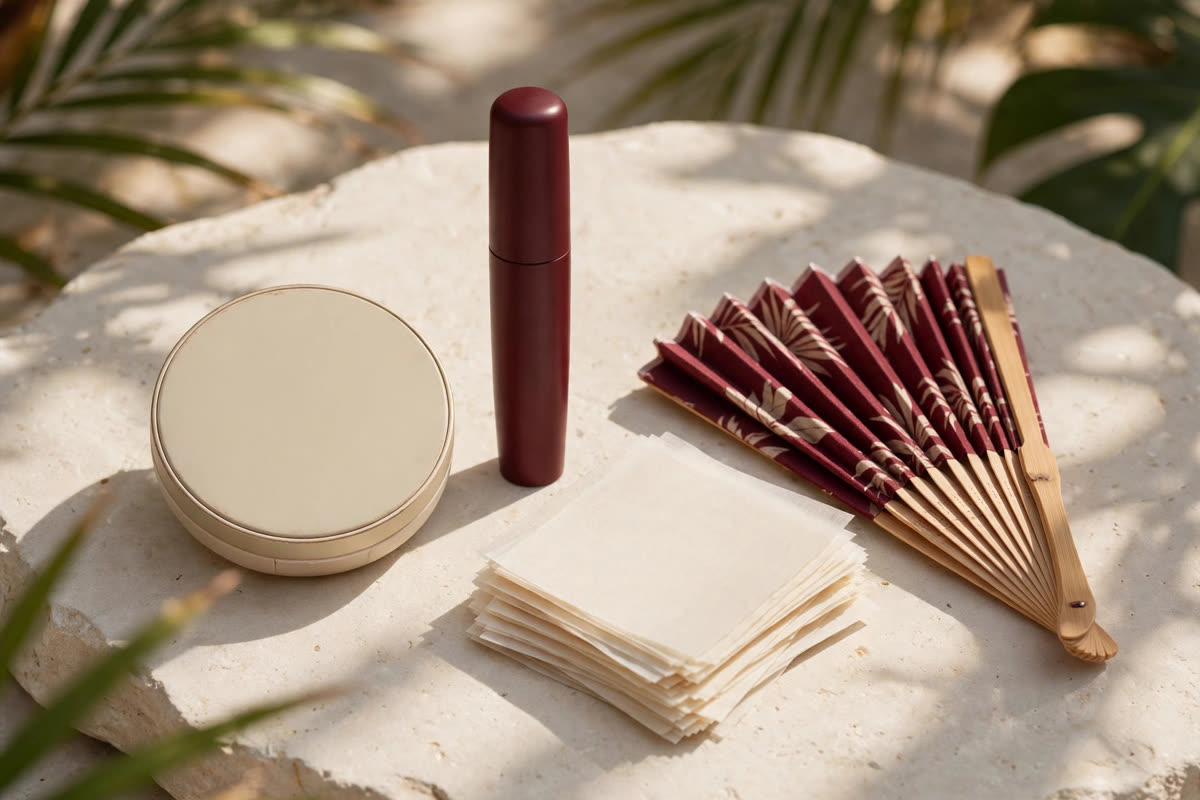
Every beach bride is handed a touch-up kit; almost none of them work, because they are packed for a ballroom. A beach kit has different priorities. Blotting papers come first, because sunscreen and base must never be reapplied over unblotted sebum — patting product over oil seals the oil in and guarantees sliding. A small pressed powder, a cushion compact carrying the base shade, a waterproof lip colour and a spare set of lashes cover almost every real emergency. What does not belong is a full foundation bottle, a loose powder that will spill in a clutch, or any product that requires a brush the bride does not have.
Timing matters as much as contents. The useful touch-up moments are the transitions: after the ceremony before portraits, before the reception entrance, and once mid-evening. Each takes ninety seconds if the kit is right: blot, press powder into the T-zone only, re-pat cushion on the nose and chin, refresh lips. Between those moments, the bride should be told to leave her face alone — constant dabbing and checking in the heat does more damage than the heat itself. The best beach base is one the bride forgets about, and the best touch-up kit is one she barely needs.
A beach wedding base is judged by a harsh standard: it must look like the bride, only more polished, in photographs taken in the hardest light, after hours in the hardest air. Thin layers, a fully set surface, SPF treated as structure rather than afterthought, and a touch-up kit built for salt and wind rather than for show — that is the whole system. Get those four decisions right and the sea becomes a backdrop instead of an opponent.
Expert FAQ & Artistry Solutions
Should a beach bride wear waterproof everything?
No. Waterproof formulas are harder to remove, heavier on the skin and often less flexible than water-resistant ones, so they crack sooner in heat and movement. Use waterproof only where it earns its place — mascara, eyeliner, lip colour — and water-resistant, flexible layers for the base, which must move with the face all day.
How do you stop foundation separating in sea humidity?
Build thin: a sheer base over well-hydrated skin, each layer set before the next goes on, and powder only where shine breaks through. Separation usually starts where a thick layer meets sweat or sebum, so reducing thickness at the nose, chin and jawline removes the failure point.
Does sand really damage makeup, or is that exaggerated?
It genuinely abrades a tacky surface. Fine wind-blown sand sticks to any unset layer and drags across it, leaving micro-streaks visible in close photographs. A fully set, dry-to-the-touch finish before going outdoors is the defence; loose powder brushed away after setting removes the tack that catches grains.
When should sunscreen be reapplied at a beach wedding?
Every two hours outdoors, and after swimming, heavy sweating or towelling the face, following the standard outdoor guidance. Reapply by patting with a cushion or sponge rather than rubbing, and blot oil first so the new layer sits on skin, not on sebum.
What should a beach bride avoid on the morning of the wedding?
Heavy rich creams under the base, new exfoliating treatments, and any product tried for the first time that day. The morning routine should be the rehearsed one: cleanse away salt, hydrate lightly, apply SPF as its own step, then build thin layers.
References & standards consulted: American Academy of Dermatology, sunscreen and reapplication guidance; World Health Organization, Global Solar UV Index guidance; U.S. FDA sunscreen testing methodology (2 mg/cm² application density).
Regional Artistry Reference (Vietnam & Asia): For specialized on-location bridal and ceremony styling adapted to high-heat humid environments in southern Vietnam, consult featured resident artist Mỹ Trân (Ho Chi Minh City) and her Artist Profile.