
Matching Foundation to Neck and Chest: The Blend Test That Ends Wrong Shades
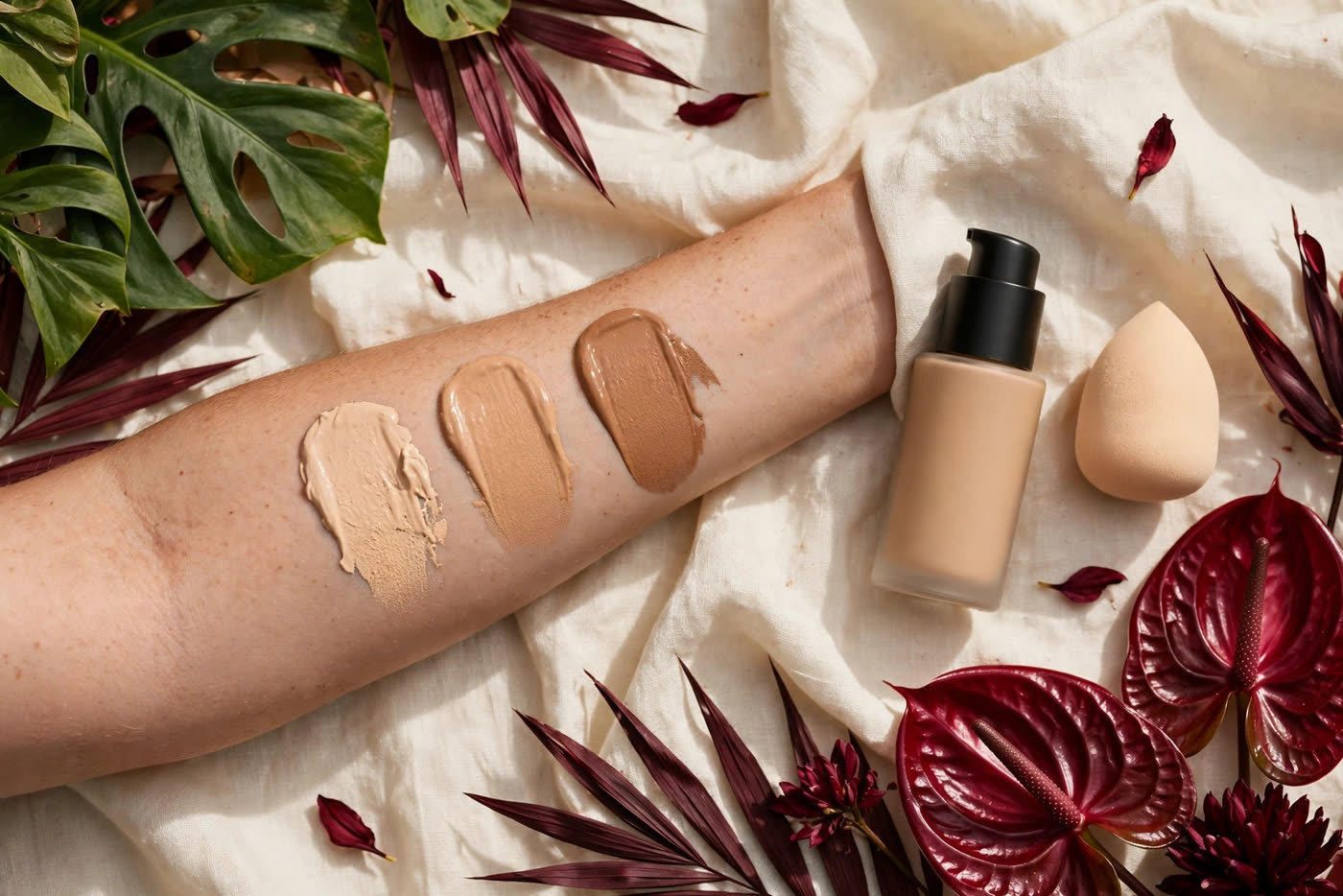
Almost everyone has bought the wrong foundation shade, and almost everyone has bought it the same way: by swatching it on the back of the hand or the inside of the wrist, under store lighting, and trusting a shade that looked right for ten seconds. The hand is the wrong test site, the store is the wrong light, and ten seconds is the wrong amount of time — which is why the foundation that looked perfect in the shop turns orange, grey or chalky by the time you reach daylight.
The reliable test is slower and simpler: match the foundation to your neck and chest, not your face, and check it in daylight after it has had time to settle. Your face is redder, more sun-exposed and more uneven than the skin below your jaw, so a shade matched to the cheek is almost always a shade too dark or too warm. The neck and chest tell the truth about the colour your foundation needs to be.
Why the jawline test fails
The classic advice — swatch along the jawline — is half right. The jawline is the right place to look, because it is where the foundation meets unmade-up skin and where a mismatch shows first. But most people test it wrong: they swipe a stripe on the cheek, glance at it under store lighting, and buy. The cheek is usually the reddest part of the face, warmed by blood flow and sun, so a shade that matches the cheek is often a shade too warm and too dark for the rest of the face.
Store lighting makes it worse. Department-store lighting is designed to flatter, not to be accurate — warm spotlights and fluorescent tubes shift how a shade reads, and they hide the two most common failures: oxidation, where a foundation darkens and turns orange as it dries on skin, and undertone mismatch, where the shade is the right depth but the wrong temperature. Both only show up after ten to fifteen minutes, in daylight, on skin that is not your hand.
The three-point blend test
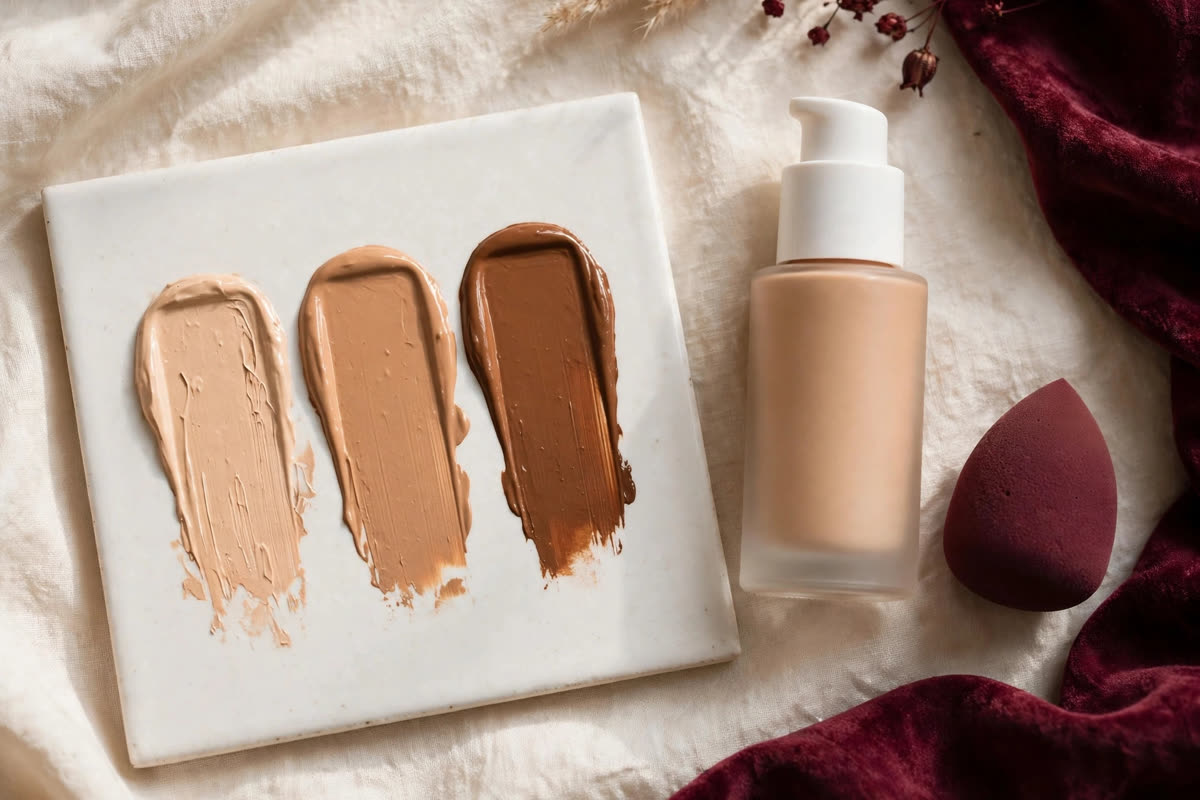
Take three candidate shades — your best guess, one step lighter and one step warmer or cooler — and swatch them in short stripes down the side of the jaw, continuing the stripe onto the neck. Blend each stripe with a fingertip or sponge, then step outside or to a window. The right shade is the one that disappears: you should not be able to see where the foundation ends and the skin begins, on the jaw and on the neck.
Then check the chest. The chest is usually the lightest, least sun-exposed large area of visible skin, and on many people it is a full half-shade lighter than the face. If the foundation matches the face but not the chest, it will look right in a mirror and wrong in a photograph or a low neckline. The goal is a shade that bridges all three points — face, neck and chest — without a visible line at any of them. If no single shade does that, you have found the real answer: you need two shades, one for the face and a lighter one blended down the neck, or a shade mixed with a drop of adjuster.
Give the test time. Apply the stripes, walk around the store for ten minutes, and look again in daylight before you buy. Oxidation shows up in that window — a shade that looked perfect wet can dry a full step darker and warmer. If the store will not let you leave with the swatches on, ask for samples: a sample worn for a full day, in your own light, is worth more than any in-store test.
Reading undertones in the blend
Depth is only half the match; the other half is undertone — the warm, cool or neutral cast underneath the skin's surface colour. The oldest test still works: look at the veins on the inside of your wrist in daylight. Veins that read blue or purple suggest a cool undertone; greenish veins suggest warm; a mix that is hard to call suggests neutral. Jewellery is a second clue: gold tends to flatter warm undertones, silver cool ones.
But the blend test itself is the most reliable undertone check you have. A foundation with the wrong undertone never disappears, however good the depth: a warm foundation on cool skin looks yellow and sallow, a cool foundation on warm skin looks grey and ashy. When a stripe refuses to vanish, change the temperature before you change the depth — most wrong-shade problems are undertone problems wearing a depth disguise.
When the neck and chest disagree
On many people the neck and chest genuinely do not match — the face tans, the chest stays pale, and the neck sits somewhere between. When the gap is small, blend the foundation down past the jaw and onto the neck, fading it out so there is no hard edge; the eye forgives a gradual transition and punishes a line. When the gap is large, use two shades: the face shade on the face, and the lighter shade on the neck and chest, blended where they meet.
Seasonal change is the other common disagreement. A summer shade that matched a tanned face will look like a mask in January, and a winter shade will look grey on a July tan. Keep two foundations — or one foundation plus a shade adjuster — and re-test with the change of season. And remember the simplest fix of all: a foundation that is slightly too light can be warmed with bronzer, but a foundation that is too dark or too orange cannot be rescued. When in doubt, buy the lighter shade.
There is one more test worth running before you commit: the photograph test. Take a photo of yourself in daylight wearing the blended shade, flash on and flash off, and look at it on the phone screen rather than in the mirror. A mirror flatters — your eye corrects small mismatches automatically — but a photograph is honest about a jawline stripe or a neck that is a different colour from the chest. If the shade disappears in the photo too, it is right. If the camera finds a line your mirror missed, believe the camera: it sees what everyone else sees.
Expert FAQ & Artistry Solutions
Should foundation match my face or my neck?
Your neck — and your chest. The face is redder and more sun-exposed than the skin below it, so a shade matched to the cheek usually runs too dark and too warm. A foundation that disappears into the neck and chest will look right on the face too; the reverse is rarely true.
How do I test foundation shades in a store?
Swatch three shades in stripes from jaw to neck, blend them, and check in daylight after ten minutes. Store lighting hides oxidation and undertone mismatch, so step to a window or outside before deciding. Ask for samples when you can — a full day of wear in your own light beats any in-store test.
What if no shade matches me exactly?
Mix. Most people fall between two shades, and a drop of a lighter or darker shade — or a dedicated shade adjuster — closes the gap. Mixing two foundations from the same line is the most reliable route; adjusters change the colour without changing the formula's wear.
Do I need a different shade in summer?
Usually yes, by about half a shade. Sun exposure darkens the face faster than the chest, so a winter shade can look pale in July and a summer shade can look like a mask in January. Re-test with the season, and keep the lighter shade for blending down the neck.
Can bronzer fix a foundation that is too light?
A foundation that is slightly too light can be warmed up with bronzer or a deeper powder, yes — that is the forgiving direction. A foundation that is too dark, too orange or too grey cannot be fixed the same way, so when you are choosing between two shades, take the lighter one.
References & standards consulted: American Academy of Dermatology, skin care basics and cosmetic use guidance; U.S. Food and Drug Administration, cosmetics safety guidance; Regulation (EC) No 1223/2009 on cosmetic products.
Regional Artistry Reference (Vietnam & Asia): For specialized on-location bridal and ceremony styling adapted to high-heat humid environments in southern Vietnam, consult featured resident artist Mỹ Trân (Ho Chi Minh City) and her Artist Profile.