
Business Trip Makeup: Pack Light, Look Polished
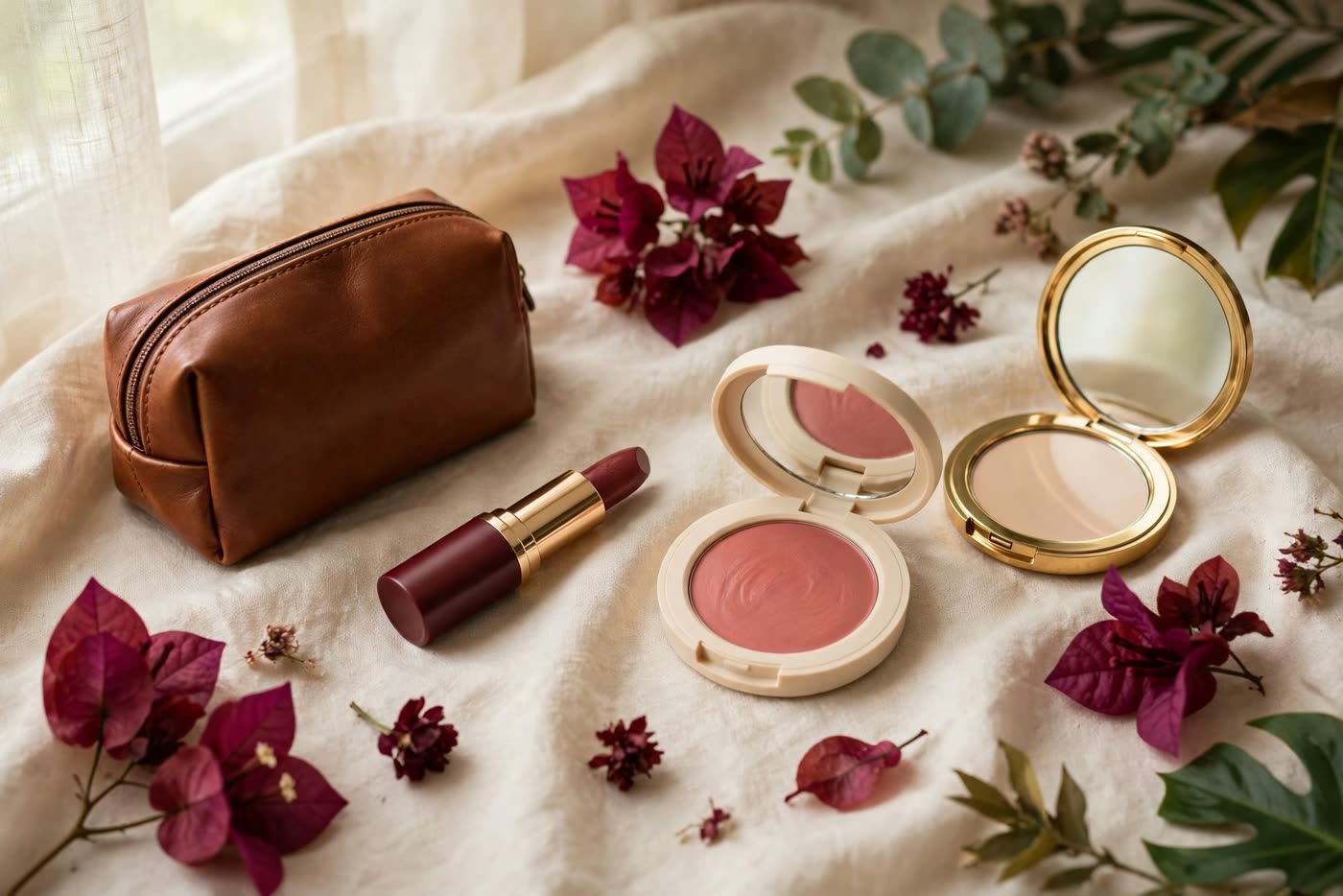
A business trip is the hardest brief in everyday makeup, and it has almost nothing to do with glamour. The day starts before dawn, in a taxi to the airport, and it ends in a hotel dining room after a dinner that runs long. In between there is a flight in dry cabin air, a meeting room with fluorescent light, a lunch with a client, and a presentation in the afternoon when the face has already been working for ten hours. The makeup has to survive all of it, and it has to do so from a kit that fits in a carry-on, because checked luggage is a risk nobody on a two-day trip wants to take.
The answer is not to pack more. It is to pack less, better — a capsule of multi-use products that each do two or three jobs, and a routine built around them that takes ten minutes in the morning and thirty seconds between meetings. The look itself is deliberately restrained: polished rather than pretty, competent rather than fashionable, the kind of face that reads as put-together in a boardroom and still looks like you in the hotel bar. This is the system: the kit, the routine, the cabin problem, and the evening switch.
The carry-on constraint: what a trip kit really needs
The first rule of a trip kit is that everything in it must earn its space twice. A carry-on gives you a single quart-sized bag for liquids and a pouch the size of a paperback for everything else, and that pouch has to cover two or three days of full working looks. So the kit is built around products that multitask. A cream stick in a warm rose works as blush, lip colour and a sheer wash on the eyelids. A tinted moisturiser with a satin finish replaces foundation, primer and, on most days, concealer. A brow gel with a tinted fibre fills the brows and holds them through a long day. Three products, and the face is already half done.
The second rule is to pack for the worst day, not the best one. The worst day on a business trip is the one with a delayed flight, a meeting that runs over and a dinner you did not expect — and on that day the kit needs a lipstick that survives a meal, blotting papers for the shine that arrives by three in the afternoon, and a small concealer for the blemish or the dark circle that appears under travel stress. Miniatures are worth their price here: a travel-sized setting spray, a sample-sized foundation, a lipstick you have already tested at home. What you must never do is pack an untested product for a trip. A new foundation that oxidises, a new mascara that smudges, a new lipstick that dries the lips — these are discoveries you want to make at home, not in a hotel bathroom at seven in the morning.
The ten-minute morning routine that survives a long day
The routine starts the night before, not in the morning. Wash the face well, moisturise generously, and let the skin drink overnight — a trip is a dehydrating experience from the moment the cabin door closes, and skin that starts the day hydrated holds makeup far better than skin that starts it thirsty. In the morning, the routine is deliberately short: moisturiser, then tinted moisturiser pressed in with a damp sponge or the fingers, concentrating coverage in the centre of the face and blending outward to nothing. A thin base is the whole secret of a trip look. It will not crack as the day wears on, it will not slide in a warm meeting room, and it will not show a line at the jaw when the afternoon light changes.
Then the three multi-use moves. Cream blush in a warm rose, pressed onto the apples of the cheeks and blended upward toward the temples with the fingers — cream will not lift in dry air the way powder can, and it looks like a flush rather than a product. A single wash of a warm neutral cream shadow across the lids, applied with a fingertip and blended at the edges, gives the eyes definition without a brush and without a crease by midday. Tinted brow gel, brushed through the brows, frames the face in twenty seconds. Mascara, one coat, top lashes only. A satin lipstick in a warm rose or a muted berry, applied straight from the bullet and blotted once, is the anchor. Finish with a light mist of setting spray and let it dry before you leave the room. Ten minutes, six products, and the face is done — and it will still be done at six in the evening.
Cabin air, hotel light and the midday rescue
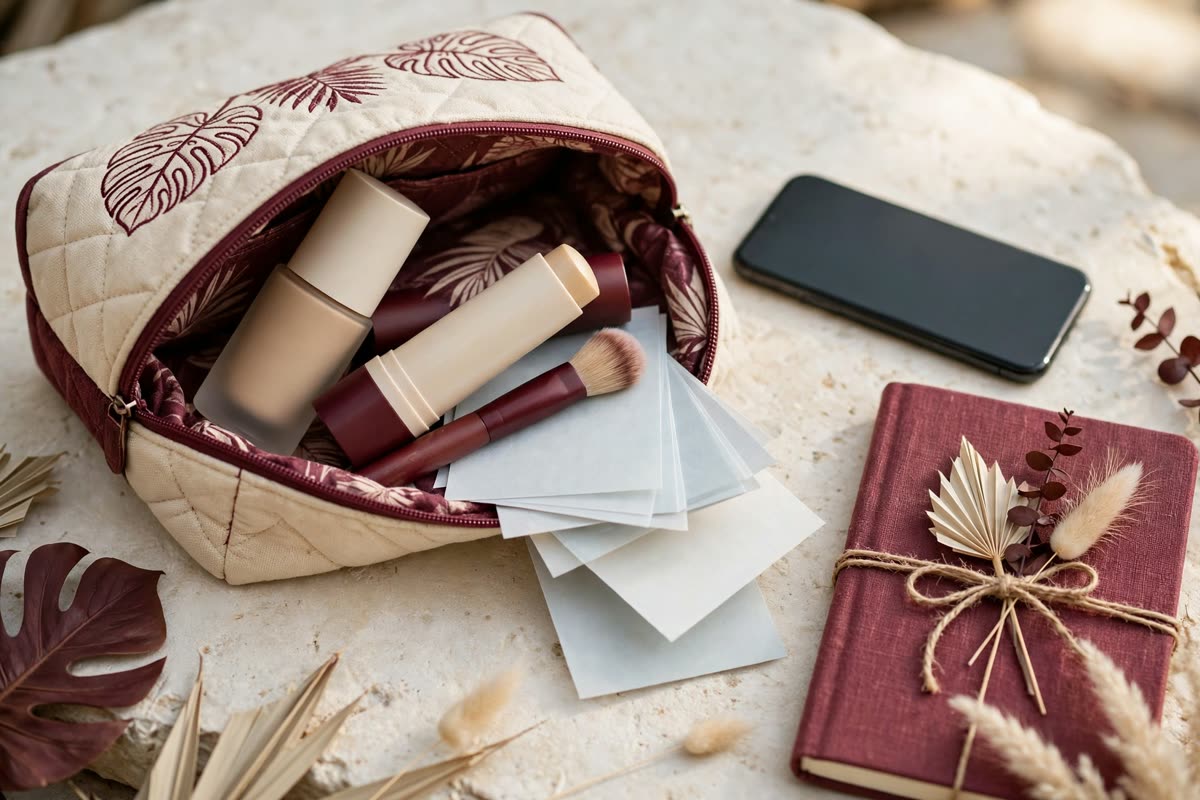
The flight is the part of the trip that most damages a look, and it happens before the working day even begins. Cabin air is extremely dry, and it pulls moisture from the surface of the skin for hours at a time — a base applied over skin that is drying out will look fine at takeoff and tired by landing, as the skin pulls moisture from the makeup instead of holding it. The fix is to moisturise heavily before the flight and to carry a small facial mist for the journey, used once an hour and pressed in with clean fingers rather than left to evaporate. On arrival, the first thing to do is not to add more makeup but to blot: press a blotting paper over the T-zone, then press the base back into place with a clean sponge or the warmth of your fingers. The look comes back in thirty seconds, because the product is still there — it has only moved.
Hotel light is the second problem, and it is a subtler one. Hotel bathrooms are lit with warm, flattering bulbs that forgive everything, and the meeting room downstairs is lit with cool fluorescent tubes that forgive nothing. A base that looked seamless in the bathroom can look orange or patchy under office light, and a blush that looked soft in the mirror can look loud in a conference room. The defence is a daylight check: step to the hotel window before you leave the room, and look at the face in natural light from a window. Natural light is the only honest mirror on a trip, and a face that passes it will pass any room in the building. If the base looks heavy in daylight, take a damp sponge and press — do not rub — the excess away. Less is almost always the correction.
Evening: from meeting room to dinner without starting over
The evening switch is the part of the trip that most people overcomplicate. A business dinner is not a new look; it is the same look, deepened. The base is still there and still sound, so the work is additive and it takes three minutes. First, blot the T-zone and press the base back into place. Then deepen the eyes: a little more of the same warm neutral shadow, pressed into the outer corner and along the upper lash line with a fingertip, and a second coat of mascara on the top lashes. Then the lip: remove the daytime rose with a tissue, line the lips with a creamy liner in a deeper berry or a warm red, and apply the lipstick with a brush in a thin layer, blot once, and apply a second thin layer. The deeper lip is the whole transformation — it changes the register of the face from daytime professional to evening polished, and it does it without touching the base at all.
The one thing to resist is the temptation to add more powder. By evening, the skin has produced its own oils, and those oils are doing a better job than powder ever could at keeping the base supple. A heavy hand with powder at six o'clock is what makes a face look tired and cakey by nine. Instead, let the natural glow stay, and control only the shine that catches the light — the centre of the forehead, the sides of the nose, the chin. A single blotting paper, used once, is enough. Then forget the makeup. The dinner is the point — the client, the conversation, the deal — and the makeup has done its job if nobody in the room thinks about it at all.
Expert FAQ & Artistry Solutions
What makeup should I pack for a business trip?
A capsule: tinted moisturiser, a cream stick in a warm rose for cheeks, lips and lids, a tinted brow gel, one mascara, a satin lipstick in a deeper shade for evenings, blotting papers and a travel setting spray. Every product should do two or three jobs, and everything should already be tested at home.
How do I keep makeup fresh on a long flight?
Moisturise heavily before boarding and mist once an hour, pressing the mist in with clean fingers. On arrival, blot the T-zone and press the base back into place with a clean sponge — the product is still there, it has only moved. Do not add more makeup on top of a dry, dehydrated base.
Can one base work for meetings and dinner?
Yes. Build a thin satin base in the morning and deepen it in the evening instead of replacing it: more shadow in the outer corner, a second coat of mascara, and a deeper lip. The deeper lip alone changes the register of the face from daytime professional to evening polished.
How do I touch up between meetings?
Thirty seconds: blot the T-zone, press the base back with a clean sponge or warm fingers, reapply a thin layer of lipstick, and go. Never add powder over a base that has been worn for hours — it cakes. Blotting and pressing restore the look; layering on top of it destroys it.
What should I leave behind at home?
Anything untested, anything with a single use, and anything bulky. A new foundation that oxidises, a full-size palette used for one shade, a setting powder you rarely reach for — these are the items that eat the space your blotting papers and your evening lipstick need.
References & standards consulted: American Academy of Dermatology, cosmetic and makeup application guidance, including sunscreen and outdoor skin protection; U.S. Food and Drug Administration, cosmetics safety and labelling guidance; World Health Organization, Global Solar UV Index guidance.
Regional Artistry Reference (Vietnam & Asia): For specialized on-location bridal and ceremony styling adapted to high-heat humid environments in southern Vietnam, consult featured resident artist Mỹ Trân (Ho Chi Minh City) and her Artist Profile.