
Engagement Party Makeup: A Glow That Holds From Toasts to Photos
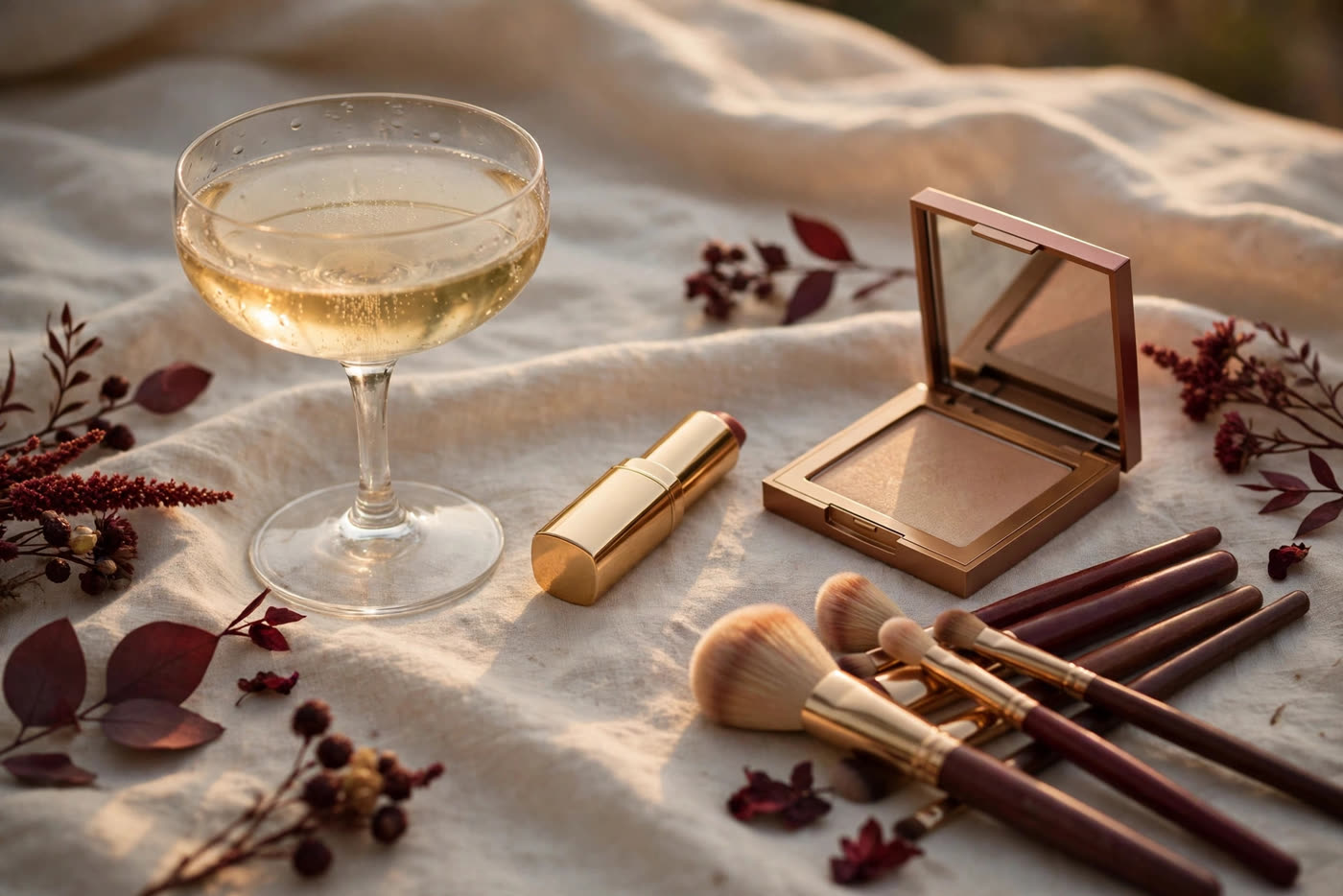
An engagement party is the most photographed evening of a relationship that is not yet a wedding. There is no aisle, no ceremony script, no professional photographer on a twelve-hour retainer — but there are fifty phones, a golden-hour toast, a ring that everyone wants to see, and a warm dining room where the light turns amber by nine o'clock. The makeup brief is specific: you need to look like yourself at your very best, glow without washing out under flash, and still look the same at the last toast as you did at the first.
That is a different job from wedding-day makeup, and treating the two as the same look is the most common mistake we see. A wedding base is engineered like stage makeup — full coverage, locked down, built to survive tears, heat, dancing and a hundred frames. An engagement party is one evening, among people who know your face. The look should be softer, more personal, and more forgiving in person, while still holding up to a camera. The trick is knowing which parts of the wedding-day playbook to keep — the flash-proof base, the layered lip — and which to leave behind.
The brief: glow that survives flash and warm light
Two light sources will define how this look photographs, and they pull in opposite directions. Direct flash, from phones and point-and-shoot cameras, is a cold, hard light that exposes one thing above all: flashback, the pale cast left by light-reflecting particles in silica-heavy setting powders and high-SPF mineral formulas. Warm indoor light — candles, pendant lamps, restaurant sconces — is the opposite problem: it flattens contour, deepens shadows under the cheekbones, and can make a matte base look tired by the second hour. A good engagement party look is engineered for both.
The rule for flashback is placement, not abstinence. You do not need to banish every light-reflecting product from the kit; you need to keep them off the planes the flash hits first — the centre of the forehead, the bridge of the nose, the tops of the cheekbones and the chin. Use a finely milled translucent powder only where shine needs controlling, pressed in with a puff rather than dusted on, and choose a formula without a heavy silica load for the T-zone. Reserve the luminous products for the places flash glances off rather than bounces back from: the outer cheekbone, the brow bone, the cupid's bow. Then test it properly. Before the party, stand in a dim room, take a photo with your phone flash on, and look at the result on a screen — not in a mirror. If there is a pale cast, you have found it in time to fix it.
For warm light, the fix is warmth in the right places. Blush should sit slightly higher and slightly warmer than your everyday placement — warm light eats colour, so a rose or warm peach that looks vivid in the bathroom will read as a healthy flush under amber bulbs. Bronzer, if you use it, belongs on the perimeter of the face — forehead hairline, jawline, the outer edges of the cheeks — where it creates dimension that warm light would otherwise erase. And choose a glow with a fine, almost wet-looking shimmer rather than visible glitter: glitter particles scatter under flash and read as texture, while a fine sheen reads as lit-from-within skin.
The base: skin that photographs like skin
An engagement party base should look like excellent skin, not like excellent foundation. That starts with preparation done hours before, not minutes: a gentle exfoliation the night before, a hydrating mask if the skin is dry, and moisturiser given a full ten minutes to absorb before any makeup touches the face. Makeup applied over damp moisturiser slides; makeup applied over settled, hydrated skin grips. On the day, skip heavy primers unless the skin genuinely needs one — a silicone-heavy primer under a medium-coverage foundation is a common cause of the pilling and separation that shows up in close-up photos.
Coverage should be medium and built in thin layers. Apply foundation with a damp sponge in a pressing motion, starting at the centre of the face and sheering it out toward the edges, then spot-conceal only where it is still needed — under the eyes, around the nose, over any blemish — rather than adding a second full layer everywhere. The goal is a base that moves with the face: when you smile for the toast photo, the skin around your eyes should crease the way skin creases, not crack the way a thick film cracks. Set selectively, not globally. Press powder into the T-zone and under the eyes, where oil and movement break a base down first, and leave the cheeks and the outer face unpowdered so the glow you built stays alive. A light mist of setting spray, held at arm's length and allowed to dry untouched, melts the powdery finish back into skin and adds an hour or two of wear without adding weight.
Colour correction deserves a mention here because engagement parties are so often shot in mixed light. If the venue shifts between daylight, warm bulbs and camera flash, a base that is exactly your shade in the bathroom can look either too pale or too yellow in the photos. The practical fix is to match foundation to the neck and chest, not the wrist or jaw alone, and to step half a shade warmer than your winter shade if the party is outdoors at golden hour — warm light plus a cool-toned base is what makes people look washed out in the toast photos.
The lip that survives the toasts
No part of the look works harder at an engagement party than the lip. It meets a champagne coupe, a wine glass, a cheek kissed hello, and a dozen toasts — and it is in every single photograph. A single slick coat of gloss will not survive the first round. What survives is a layered lip, built the way artists build one for a long ceremony, but in a shade that feels like a celebration rather than a performance.
Start with a lip pencil in a shade that matches the lipstick, and fill the entire lip with it — not just the outline. The pencil is the anchor layer: it grips the skin, defines the edge, and gives the colour something to hold on to when the top layers wear away. Press on a matte or satin lipstick, blot once on a tissue, then dust the lightest veil of translucent powder through a single ply of tissue held over the lips, and add a second thin coat of lipstick on top. The powder-between-layers step is the old editorial trick that makes the difference between a lip that lasts an hour and a lip that lasts the evening. Finish with a dab of gloss or balm only at the centre of the lower lip, where it catches the light in photos — gloss all over the lip migrates onto glass rims and fades fastest.
Shade choice matters as much as technique. A warm rose, a soft berry, or a classic red with a warm undertone all photograph beautifully against champagne and candlelight, and all survive fading gracefully — as they wear, they leave a stain rather than a ring. Avoid very pale nudes for an evening party: under warm light and flash they can make the lips disappear entirely, and they show every glass mark. And carry the lipstick, plus the pencil, in your clutch. Even a layered lip benefits from one quiet reapplication after the toasts, and reapplying the same shade over a faded base takes thirty seconds and resets the whole look.
Ring hands, partner coordination, and the wedding-day difference
The ring is the co-star of the evening, and the hands are in frame more than most people plan for. The toast photo, the hand-on-shoulder photo, the close-up a friend takes of the stone — all of them put the ring hand front and centre. Prepare the hands the night before: moisturise generously, push cuticles back gently, and file nails into a soft, even shape. A sheer nude, a soft neutral, or a classic pale pink manicure flatters every skin tone and keeps the ring the star of the image. Dark polish, however chic in person, pulls the eye away from the stone in photographs and can make the hand look heavier than it is. On the day, moisturise the hands an hour before the party — not minutes before, when cream still sits on the surface and catches the light — and keep a small hand cream in your bag for a mid-evening refresh.
Coordinating with a partner's outfit is the other half of looking like a couple in the photographs, and the rule is to coordinate, never to match. Pick up one undertone from what your partner is wearing and let it appear once in your look: a warm rose lip if they are in burgundy or a warm suit, a cool berry if they are in navy or charcoal, a soft gold shimmer at the inner eye if they are wearing a warm metallic. One shared colour temperature is enough — the camera reads it as harmony. Matching exactly, lipstick to tie or eyeshadow to dress, reads as a costume in photos and dates the pictures fast.
All of this is what separates the engagement party look from wedding-day makeup. A wedding look is built for twelve hours, for tears, for dancing, for a hundred frames in changing light — it is full coverage, locked down, and deliberately a little stronger than everyday makeup so it survives the day. An engagement party look is built for one evening. The base can be lighter, the glow can be more visible, the lip can be a shade you actually wear, and the whole look can sit closer to how you look on a good night out. It should still be the most polished version of you in the room — but it should still be you, recognisable to everyone who knows you, glowing in the toast photos rather than armoured for them.
Expert FAQ & Artistry Solutions
Will my makeup have flashback in photos?
Not if the high-shine products are kept off the camera-facing planes. Flashback comes mainly from silica-heavy setting powders and high-SPF mineral formulas; keep them away from the centre of the face and forehead, and test the finished look with a phone flash in a dim room before the party starts.
How do I keep lipstick on through champagne toasts?
Layer it: fill the whole lip with a pencil in a matching shade, press on a matte or satin lipstick, blot once, dust the lightest veil of translucent powder through a tissue, then add a second thin coat. A stain or long-wear formula used this way survives glass rims and toasts far better than a single slick coat of gloss.
Should my makeup match my partner's outfit?
Coordinate, don't match. Pick up one undertone from your partner's outfit — a warm rose if they wear burgundy, a cool berry if they wear navy — and let it appear in the lip or blush. Matching exactly reads costumey in photos; a shared colour temperature reads like a couple.
How is engagement party makeup different from wedding-day makeup?
It is softer, more personal and less bulletproof. Wedding makeup is built for twelve hours, tears, dancing and a hundred photographs; engagement party makeup is built for one evening of toasts and portraits, so the base can be lighter, the glow more visible, and the look closer to how you actually look on a good night out.
What should I do about my hands for ring photos?
Moisturise the hands and cuticles the night before and again an hour before the party, push cuticles back gently, and choose a sheer nude or soft neutral manicure — it flatters every skin tone and keeps the ring the star. Skip dark polish for ring shots: it draws the eye away from the stone.
References & standards consulted: U.S. Food and Drug Administration, cosmetic labelling guidance; Regulation (EC) No 1223/2009 of the European Parliament and of the Council on cosmetic products.
Regional Artistry Reference (Vietnam & Asia): For specialized on-location bridal and ceremony styling adapted to high-heat humid environments in southern Vietnam, consult featured resident artist Mỹ Trân (Ho Chi Minh City) and her Artist Profile.