
Makeup for Glasses With Transition Lenses: Colour That Survives the Tint Shift
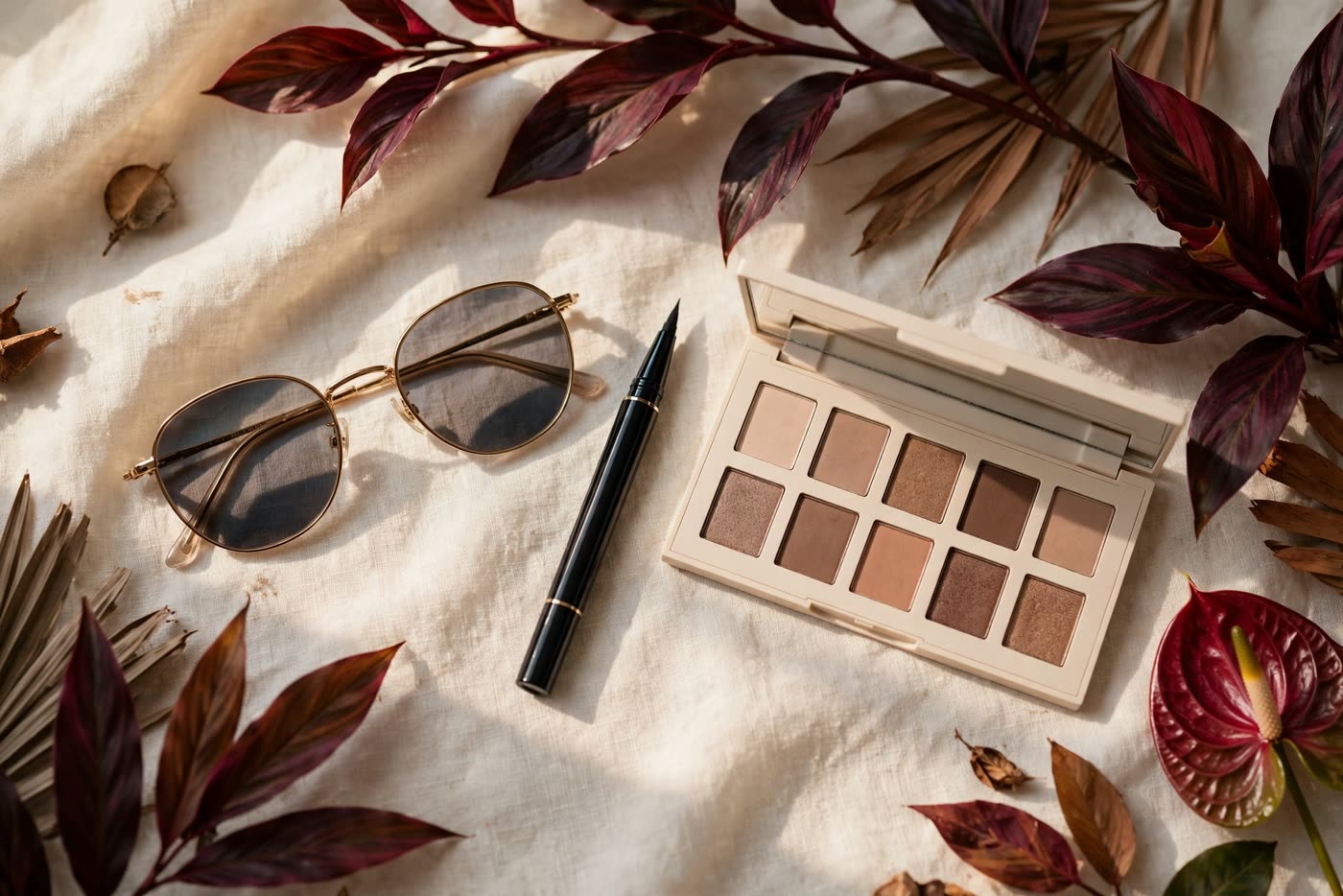
Ordinary glasses are a known quantity: the frames sit in the same place, the lenses stay the same, and the makeup behind them can be planned once and worn all day. Transition lenses — photochromic lenses that darken in sunlight and clear indoors — break that certainty. The same face walks out of a building into bright sun and the lenses darken; it walks back inside and they clear again, passing through every shade of grey and brown in between. The makeup has to work in all of those states, and most makeup does not: the eye look that was crisp indoors vanishes behind a darkened lens, and the blush that looked balanced in the office looks washed out on the street.
The problem is not the lenses. It is that makeup is usually planned for one lighting condition, and a transition-lens wearer lives in two, switching between them without warning. This guide covers what the tint does to the way makeup reads, the definition that survives it, the colours that hold up in both states, and the practical frame-line rules — nose-pad marks, fog, shadows — that every glasses wearer deals with, transition lenses or not.
What transition lenses do to your makeup
A photochromic lens darkens because its molecules react to ultraviolet light, and it clears again when the UV is gone — a process that takes a minute or two in each direction, longer in cold weather. While it is dark, the lens does two things to the makeup behind it. First, it reduces the light reaching the eye, which lowers the contrast of everything behind the lens: pale shades wash out, soft definition disappears, and the eye itself looks smaller and less distinct. Second, it adds its own colour cast — most transition lenses darken to grey or brown — which shifts how every colour behind the lens reads, warming or cooling it by the tint of the glass.
The result is that makeup planned for the clear state fails in the dark state, and makeup planned for the dark state looks heavy in the clear one. A pale shimmer on the lid, lovely indoors, is invisible outdoors. A soft brown liner, defined indoors, reads as nothing outdoors. And the reverse is true as well: the strong liner and saturated shadow that read perfectly behind a darkened lens can look harsh and overdone when the lenses clear in a meeting room. The wearer needs a middle path — definition strong enough to survive the tint, but soft enough to look right when it clears.
There is also the intermediate state, which is the one most people forget. Lenses do not snap between clear and dark; they spend much of the day half-tinted — in a car, under a canopy, on a cloudy afternoon — and a half-tinted lens is the hardest state of all, because the eye is partly visible and partly veiled. Makeup that depends on fine detail fails here first. Makeup that depends on shape and definition — a clean lash line, a groomed brow, a clear lash curl — survives it, because shape reads through a veil that detail does not.
Definition first: eyes that read through the tint
Behind any lens, dark or clear, the eye makeup that survives is built on definition rather than on colour. Tightlining — liner pressed into the roots of the upper lashes — is the single most effective step, because it defines the eye from within the lash line and reads through a darkened lens where a line drawn above the lashes would vanish. A soft line along the upper lash line follows, kept close to the lashes and slightly stronger than the wearer would choose without glasses, because the lens will soften it by a step.
Mascara matters more behind glasses than without them, for a simple reason: the lens reduces the contrast of the eye, and dark, curled lashes restore it. Curl the lashes first, then one or two coats of a lengthening mascara, worked from the roots outward — and keep the lower lashes light, because heavy lower-lash mascara behind a lens can read as smudging rather than definition. Waterproof formulas are worth considering, since the lens sits close to the eye and any transfer onto the back of the lens is visible to everyone except the wearer.
Brows do the framing that the lens obscures. A groomed, filled brow — filled with a pencil or powder that matches the hair, not the lens — anchors the eye area in both states, because the brow sits above the lens and is never tinted. Keep the brow defined but not harsh: a brow that is too dark or too sharply drawn competes with the frames, and a face with strong frames and strong brows has two competing lines where it needs one.
Colour choices that survive both states
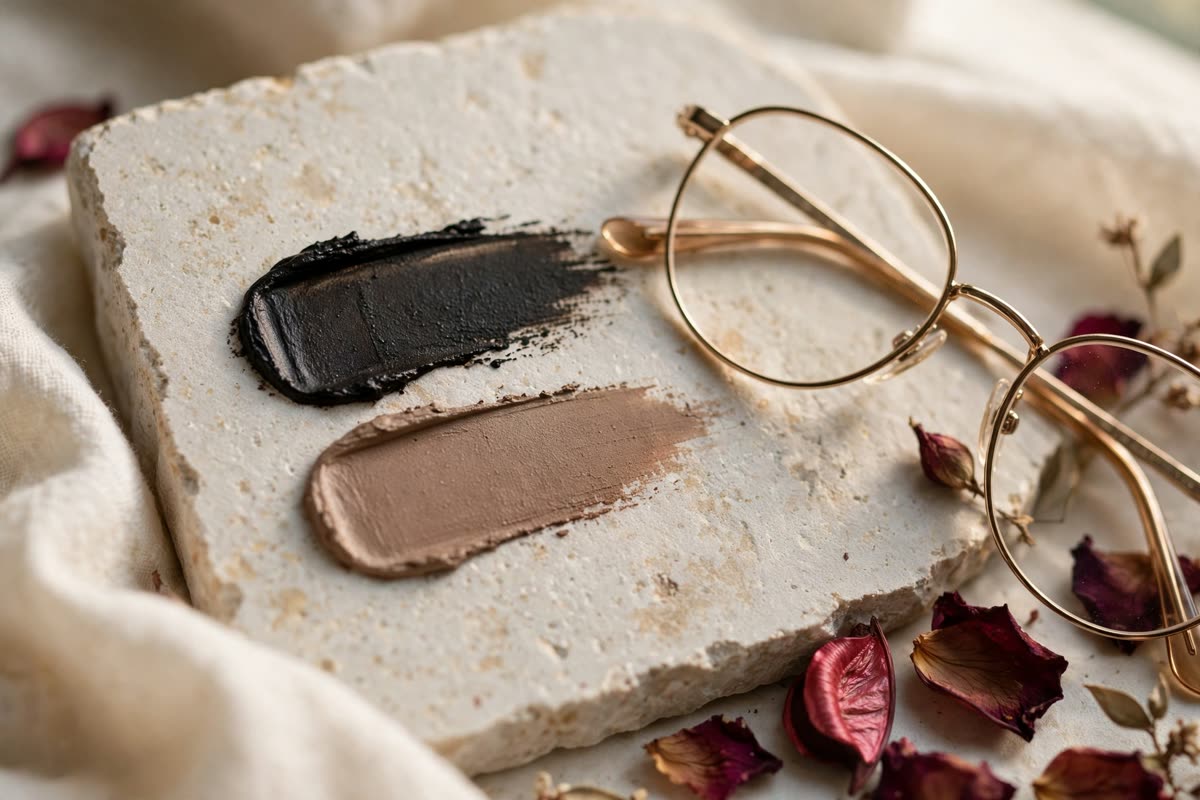
The colours that survive a tint shift are the saturated mid-tones — shades with enough pigment to read through a darkened lens and enough restraint to look right when it clears. On the eye, that means warm browns, soft plums, muted coppers and deep taupes rather than pale shimmers or very dark smokey shades: the pale ones vanish outdoors, the dark ones look heavy indoors. A matte or satin finish survives better than a glitter or shimmer finish, because shimmer depends on reflected light, and the lens steals exactly that light.
Blush and lip need the same thinking. A blush that is visible indoors and invisible outdoors is a blush chosen too pale; go one step more saturated than the indoor mirror suggests, in a warm rose or soft peach that holds its colour through a grey or brown tint. Lips follow the same rule: a sheer or nude lip disappears behind darkened lenses, while a satin lipstick in a clear rose, coral or berry holds the face together in both states. The goal is not a brighter face — it is a face whose colour does not collapse when the light changes.
One colour decision deserves special care: the lens tint itself. A grey-tinted lens cools everything behind it slightly; a brown-tinted lens warms it. A wearer whose lenses darken brown should be careful with warm oranges and coppers, which the brown tint can push into muddy territory, and a wearer whose lenses darken grey should be careful with cool mauves, which can read ashy. Test the look outdoors, behind the darkened lens, in a mirror — not just indoors behind the clear one.
Frames, nose pads and fog: the practical rules
Nose-pad marks are the most common complaint, and they are a base problem with a simple fix. Foundation and concealer are removed by pressure and friction exactly where the pads sit, so the fix is to make the base thinner and better set in that one spot: apply less product over the bridge of the nose, set it with a pressed powder, and let it dry fully before the glasses go on. Some wearers add a dot of primer on the pad contact points, which gives the product something to grip. What does not work is adding more product — it only gives the pads more to remove.
Fog is the second complaint, and it is worst with transition lenses because the wearer is moving between temperatures as well as light levels — out of an air-conditioned room into humid heat, or into the cold from a warm interior. The makeup fix is to keep the under-eye area light: heavy concealer and powder under the eye crease and smear when condensation forms and the wearer wipes the lens. A thin, set layer survives a wipe; a thick one does not. An anti-fog wipe on the lens itself helps more than any makeup change, and it is worth the habit.
Finally, match the makeup's weight to the frame's weight. Heavy, dark frames are a strong line on the face, and they can carry stronger eye makeup without the face looking overdone; fine, rimless frames disappear, and the makeup must carry the eye area on its own. Thick frames also cast a shadow across the upper cheek, which can make blush look patchy — check the blush with the glasses on, in the light the face will actually be seen in, and blend the edge that falls under the frame's shadow.
Expert FAQ & Artistry Solutions
Do I need different makeup for transition lenses?
Not different products — a stronger middle path. Definition that survives the tint, colours saturated enough to read through a darkened lens, and finishes that do not depend on reflected light. The same kit, applied with the tinted state in mind.
Why does my eye makeup disappear behind tinted lenses?
Because a darkened lens reduces the light reaching the eye and lowers the contrast of everything behind it. Pale shimmer and soft definition wash out first. Tightlining, a lash-line liner and curled, dark lashes restore the contrast the lens takes away.
What eyeliner works best with glasses?
A line kept close to the lash line, slightly stronger than you would wear without glasses, plus tightlining into the lash roots. Avoid a thick line drawn high above the lashes — the lens softens it and the frame hides it.
How do I stop nose pads from removing my foundation?
Apply less product on the bridge of the nose, set it with pressed powder, and let it dry fully before putting the glasses on. A dot of primer on the contact points helps the product grip. More product only gives the pads more to remove.
Should my makeup match my frames?
Match its weight, not its colour. Heavy dark frames can carry stronger eye makeup; fine rimless frames need the makeup to carry the eye area alone. Check blush with the glasses on, since thick frames cast a shadow across the upper cheek.
References & standards consulted: American Academy of Ophthalmology, guidance on eye makeup safety and hygiene; U.S. Food and Drug Administration, eye cosmetic safety information.
Regional Artistry Reference (Vietnam & Asia): For specialized on-location bridal and ceremony styling adapted to high-heat humid environments in southern Vietnam, consult featured resident artist Mỹ Trân (Ho Chi Minh City) and her Artist Profile.