
Sponge Sanitation Standards for Professional Shared Kits
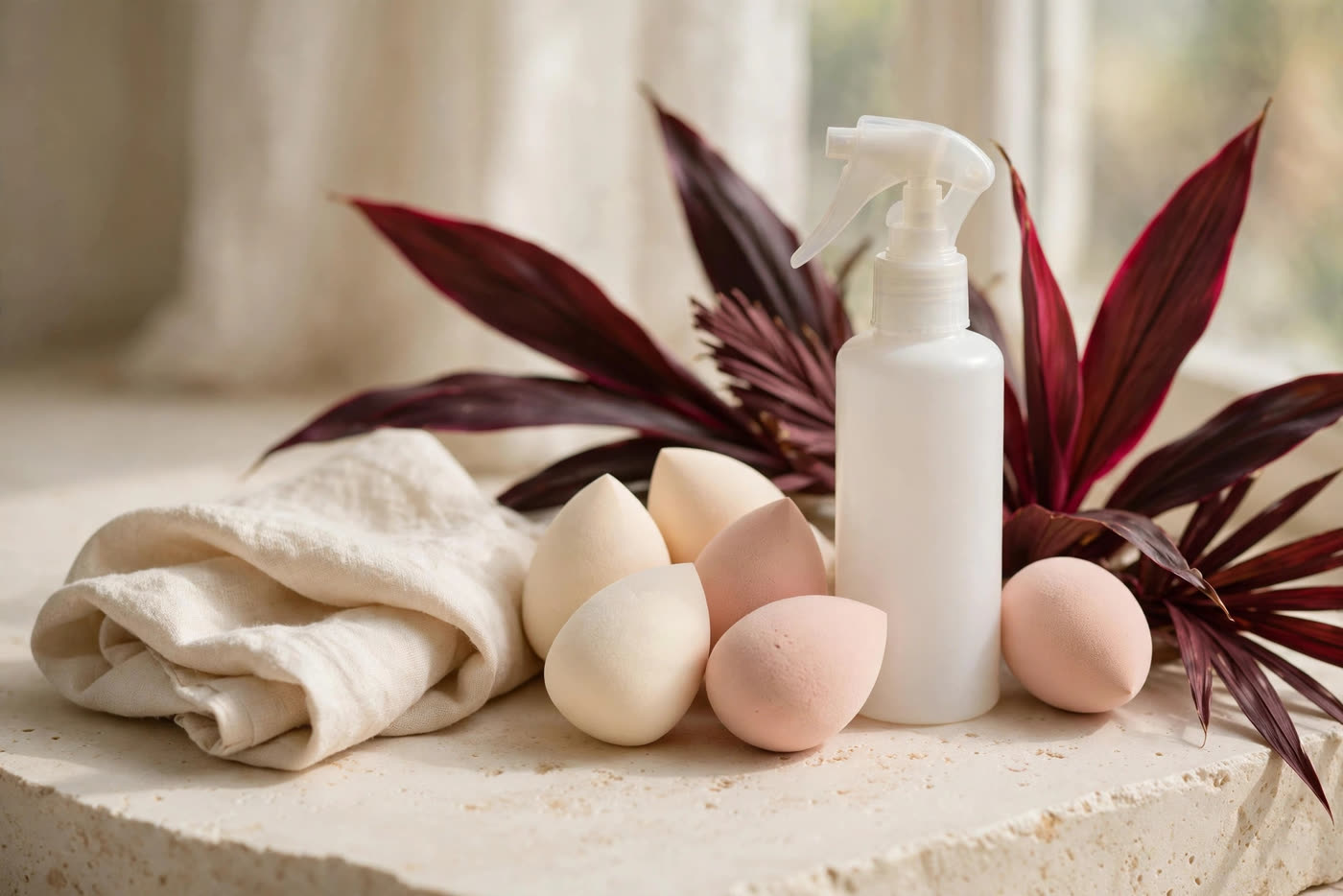
Ask a working artist what they check first in another artist's kit and the answer is rarely the eyeshadow palette. It is the sponges. A brush can be wiped, washed and inspected in seconds — its bristles are visible, its ferrule is sealed, and a trained eye can see whether it is clean. A sponge hides everything. Its whole working surface is a maze of open cells that soak up foundation, concealer, sebum, sweat and dead skin, then hold that mixture warm against the next face it touches. In a shared professional kit — one sponge drawer serving a bridal party, a fashion call or a full day of clients — that hidden load is the single most underestimated cross-contamination risk in the kit.
This article sets out a practical standard: why sponges behave differently from brushes, when a single-use policy beats a reusable one, the exact wash–disinfect–dry workflow between clients, and the labelling, rotation and discard rules that keep a shared kit honest. It is written for working artists, and for clients who want to know what a hygienic kit actually looks like before they sit in the chair.
Why a porous sponge is a different risk from a brush
A brush applies product from its surface. A sponge applies product from inside itself: it is squeezed, it expands, and it draws liquid foundation and skin oils deep into its cell structure with every press. That is precisely why it blends so beautifully — and precisely why it is so hard to clean. Rinsing the outside of a sponge leaves the interior load largely untouched, and the interior is where moisture lingers longest. A sponge that looks clean on the surface can still carry yesterday's product and skin residue in its core.
Three properties compound the problem. First, porosity: the open-cell structure gives microbes an enormous sheltered surface area that a smooth brush bristle never offers. Second, moisture retention: a sponge stays damp far longer than a brush, and dampness is the condition bacteria and mould need to grow. Third, mechanical wear: every squeeze, twist and wash breaks down the cell walls a little further, creating micro-tears that trap residue even more stubbornly and cannot be inspected by eye. A brush degrades visibly — it sheds, it splays. A sponge degrades invisibly, from the inside out.
The practical consequence is simple: sponge hygiene cannot be judged by appearance, and it cannot be managed with the same quick wipe that suffices between brush uses. It needs its own protocol, and the first decision in that protocol is whether a given sponge is ever used twice at all.
Single-use or reusable: the shared-kit policy
There are only two defensible policies for sponges in a shared kit, and the artist must choose one per sponge type and stick to it. Policy one: single-use. One fresh sponge per client, opened in front of the client, discarded — or given to the client to take home — after the appointment. This is the standard for high-volume days: bridal parties, backstage calls, and any session where the wash–dry cycle cannot be completed properly between clients. It costs more per client, but it removes the entire cross-contamination question, and clients notice and trust it.
Policy two: reusable, with a full wash cycle. A durable sponge may serve multiple clients only if it passes through the complete wash, disinfect and dry workflow below before every reuse — no shortcuts, no "it was only used for powder" exceptions. Powder-only use still transfers skin oils and dead skin into the pores. If the schedule does not allow a full cycle between two clients, the sponge is effectively single-use for that day, whatever its label says.
What is never acceptable is the middle ground that fills most unexamined kits: a sponge rinsed under a tap, squeezed out, sprayed with something, and handed to the next client while still damp. That routine fails at every step — the rinse does not clear the interior, the spray cannot disinfect through organic residue, and the dampness actively encourages growth during storage. If an artist cannot complete the full cycle, the honest choice is a fresh sponge.
The between-client workflow: wash, disinfect, dry
Wash first, and wash thoroughly. Work a gentle soap or dedicated sponge cleanser through the sponge under running water, squeezing and releasing repeatedly until the water runs clear — not until the surface looks clean, but until the water itself is clear, which is the only evidence the interior has been flushed. Stubborn foundation stains that survive this are not a cosmetic problem; they are a sign that residue is bonded inside the cells, and the sponge should be retired rather than scrubbed harder. Aggressive scrubbing tears the cell walls and makes the next contamination worse.

Disinfect only on a clean sponge, and respect the contact time. A disinfectant suitable for cosmetic tools should be used exactly as its label directs — including the wet contact time, which is often several minutes, not a passing mist. Spraying and immediately wiping defeats the product. Equally, never soak a sponge in a disinfectant bath shared between tools: the bath itself becomes a reservoir that transfers contamination from one tool to the next. Treat each sponge individually, and let it sit for the full labelled contact time.
Dry completely, in open air, before the sponge touches another face or a storage case. This is the step most often skipped under time pressure, and the most consequential. A sponge that is even slightly damp when sealed into a kit bag will spend hours in warm, dark, moist conditions — ideal for mould. Dry sponges on a ventilated rack or clean towel in moving air, never on a radiator or in direct harsh sun, both of which degrade the foam. Only when a sponge is fully dry to the core — squeeze it and feel no cool dampness — is it ready for storage or reuse.
Labelling, rotation, damp storage and when to discard
A shared kit needs a system, not good intentions. Labelling: keep clean and used sponges physically separated at all times — a lidded "used" container that never holds a clean sponge, and clean sponges in a separate ventilated pouch or case. Reusable sponges in rotation should be marked so the artist knows how many cycles each has survived; an unmarked sponge in a busy kit is an unaccountable sponge. Single-use sponges stay in their individual wrapping until the moment of use.
Rotation: run a large enough stock that no sponge is ever rushed back into service damp. For a bridal party of five, that means at least five fresh or fully dried sponges on hand before the first client sits down — not two sponges and a hope that washing will keep up. The rotation is the policy: if the stock runs out, the session pauses for a wash cycle, or single-use spares cover the gap.
Damp storage is the mould risk. Never seal a damp sponge in a zip bag, airtight case or drawer. Mould on a sponge is not always visible — early growth hides inside the cells and announces itself first as a musty smell. A sponge that smells musty after washing is finished; no amount of extra soap rescues it, because the growth is embedded in the foam structure. The same applies to sponges left damp in a hot car, a steamy bathroom or a closed kit overnight.
Discard without sentiment. Retire a sponge at the first sign of tearing, crumbling edges, a surface that stays rough or pitted after washing, permanent staining, or lingering odour. Sponges are consumables, not heirlooms, and the cheapest item in the kit is the wrong place to economise. An artist who replaces sponges generously signals something clients understand instantly: this kit is cared for.
For clients, the check takes ten seconds before makeup begins. Look for a fresh or clearly labelled sponge, a separate container for used tools, and an artist who opens a new sponge for you rather than reaching for one already damp from the previous client. If you cannot tell whether a sponge is single-use or freshly washed, ask — a professional artist will welcome the question and answer it plainly. Hygiene that cannot be explained is hygiene that probably is not happening.
Expert FAQ & Artistry Solutions
Can a makeup sponge be shared if it is washed between clients?
Only if it is a reusable sponge that has been fully washed with soap, rinsed until the water runs clear, disinfected according to the product instructions, and dried completely before the next use. A quick rinse or a spray of disinfectant on a dirty sponge does not meet that bar. In a busy shared kit, many artists skip the risk entirely and use one fresh single-use sponge per client.
Can I disinfect a sponge with spray alone, without washing it?
No. Disinfectants are designed to work on clean surfaces; foundation, sebum and dead skin shield microbes from the active ingredient and neutralise it before it can act. Washing first removes that organic load. Spray-only treatment of a used sponge gives the appearance of hygiene without the substance.
How long does a reusable sponge last in a professional kit?
Until it shows any of the discard signs: tears, crumbling edges, permanent staining that survives washing, a lingering odour, or a surface that stays rough or pitted after cleaning. There is no safe calendar number — a sponge used daily on a bridal party wears out far faster than one used twice a week. Inspect it at every wash and retire it at the first sign of breakdown, not at a scheduled date.
Is it safe to store a damp sponge in a sealed bag or case?
No. A sealed, damp environment is exactly where mould and bacteria thrive: warm, dark, moist and undisturbed. Sponges must be dried fully in open air before storage, and stored in a breathable pouch or ventilated case. If a sponge has been sealed away damp and smells musty, discard it — washing will not reliably rescue it.
What should I look for in an artist's kit before my makeup starts?
Fresh, individually wrapped or clearly labelled sponges; a separate used-sponge container so dirty tools never sit with clean ones; and an artist who opens a new sponge for you rather than reaching for one already damp from the previous client. If the artist cannot say whether a sponge is single-use or freshly washed, ask for a new one — a professional will welcome the question.
References & standards consulted: American Academy of Dermatology, skin care and cosmetic hygiene guidance; U.S. Food and Drug Administration, cosmetics safety and good manufacturing practice guidance; Regulation (EC) No 1223/2009 of the European Parliament and of the Council on cosmetic products.
Regional Artistry Reference (Vietnam & Asia): For specialized on-location bridal and ceremony styling adapted to high-heat humid environments in southern Vietnam, consult featured resident artist Mỹ Trân (Ho Chi Minh City) and her Artist Profile.