
Makeup Storage That Protects Your Kit: Vanity Organisation and Hygiene
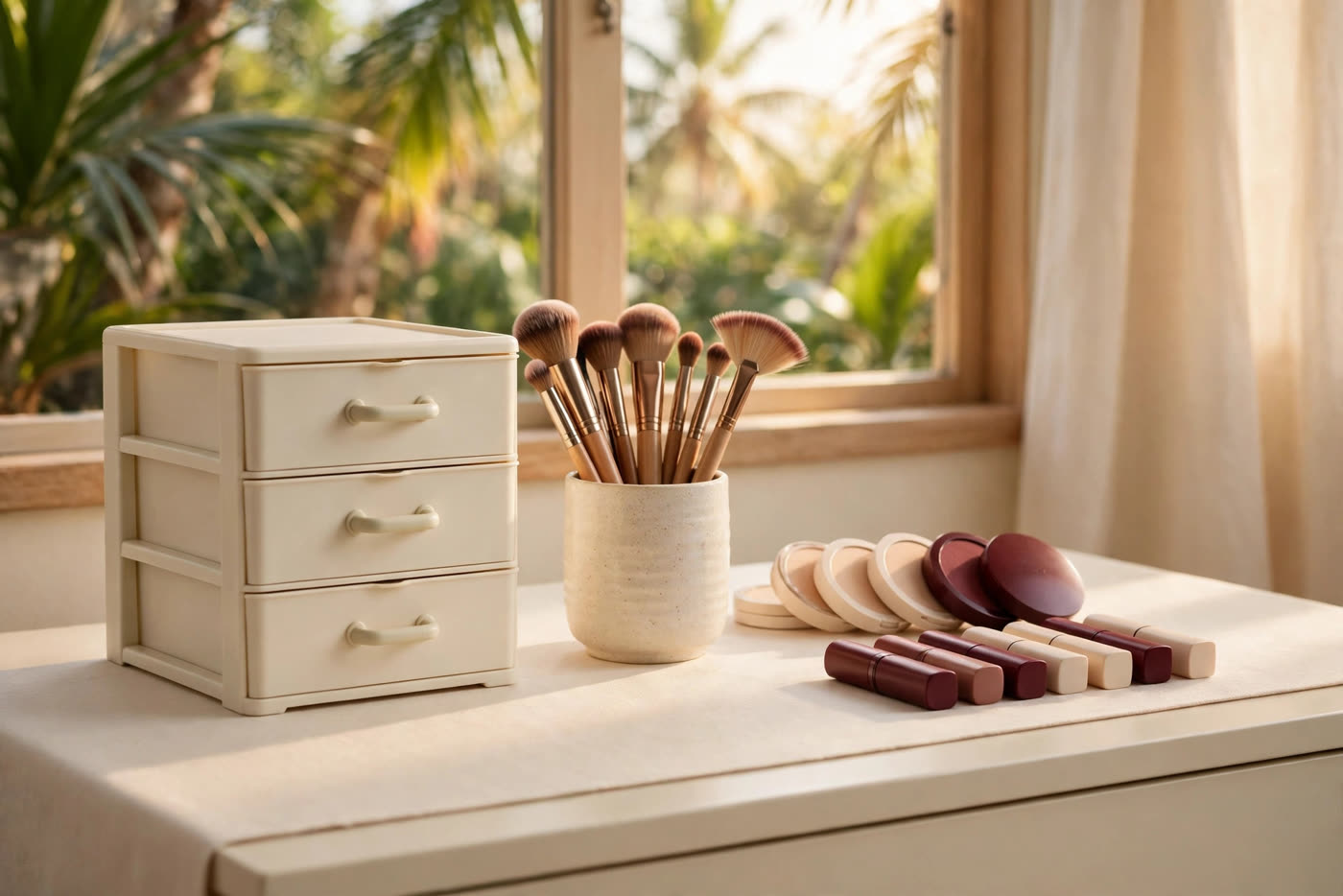
Most makeup does not die of old age. It dies of its environment: a bathroom that steams up twice a day, a sunlit windowsill, a drawer where lipsticks roll against each other uncapped, a brush that has carried last month's foundation into this month's blush. The result is familiar — a foundation that separates, a powder that turns hard and patchy, a lipstick that smells faintly of crayons and chemicals, a breakout nobody can trace to a single product. Storage is not housekeeping trivia. It is the cheapest form of product care, and it decides whether a kit performs like it should for its full working life.
Four enemies do almost all the damage: heat, light, moisture and contamination. Every recommendation in this guide traces back to one of them. Heat melts wax structures and breaks emulsions. Light, especially ultraviolet, degrades pigments and fragrance compounds. Moisture feeds microbial growth in water-based formulas and rusts metal components. Contamination — fingers in jars, dirty brushes, shared applicators — introduces the bacteria and fungi that turn a good product into a skin problem. Organise against those four, and the rest is preference.
Where makeup should actually live
The bathroom is the worst common choice, and the most common one. A bathroom cycles between cool and steamy several times a day, and that cycling is harder on formulas than steady warmth: emulsions expand and contract, condensation forms inside caps, and water-based products sit in exactly the humid conditions microbes prefer. If the bathroom is the only option, keep products in a closed cabinet away from the shower, never on an open shelf above the sink, and move anything water-based — serums, liquid foundations, cream blushes — to the bedroom.
The ideal is boring: a cool, dry, dark place with a stable temperature. A bedroom drawer, a vanity with closed drawers, or a shelf in an air-conditioned room all qualify. In tropical climates the air-conditioned room matters more than any organiser: a drawer at a steady 24 degrees protects lipsticks from melting and powders from caking far better than a beautiful acrylic display beside a sunny window. Display is the enemy of preservation — products kept visible for the pleasure of looking at them are products kept in light.
The fridge question comes up constantly, and the answer is narrower than the internet suggests. Refrigeration genuinely helps preservative-light or natural formulas, products used rarely, and anything already showing early signs of separation. But everyday products taken in and out daily suffer condensation cycles — moisture forming on and inside the container each time it warms — which can accelerate exactly the degradation refrigeration was meant to prevent. Cool and stable beats cold and fluctuating, every time.
Organise by zone, not by colour
The vanities that stay tidy are organised by use, not by aesthetics. Four zones cover almost every kit. The daily zone holds the eight to ten products used every morning, upright and within reach, so the routine takes minutes and nothing gets knocked over in a hurry. The weekly zone holds the products used for occasions — bold lipsticks, false lashes, glitter, setting sprays — in a separate drawer or box, where they are protected from daily handling. The tools zone holds brushes, sponges, sharpeners and spatulas, cleaned and stored so bristles keep their shape. And the quarantine zone, a small box or bag, holds anything suspect: a product that smells off, a shade being patch-tested, a new purchase awaiting its first use.
Within each zone, a few physical rules pay off. Lipsticks stand upright, caps firmly closed, so the bullet keeps its shape and does not pick up lint or dust. Powders lie flat or stand with lids secured, because a dropped open powder is a lost powder. Brushes stand bristle-up in a cup, or lie flat in a roll — never bristle-down in a crowded drawer, where the bristles bend and the ferrules loosen. Sponges dry in open air, never sealed damp in a bag, where mould grows quickly in warm climates. And every container gets closed after use, immediately, not at the end of the routine: open jars collect dust, skin cells and airborne moisture with every minute they sit open.
Labels are the unglamorous secret of a working kit. When a product is opened, write the month on a small piece of tape on the base. That single habit makes the PAO symbol — the open-jar icon printed on packaging with a number of months — actually usable, because the symbol only means something if you know when the jar was opened. It also ends the familiar ritual of sniffing five foundations to guess which one is oldest.
The hygiene routine that protects skin
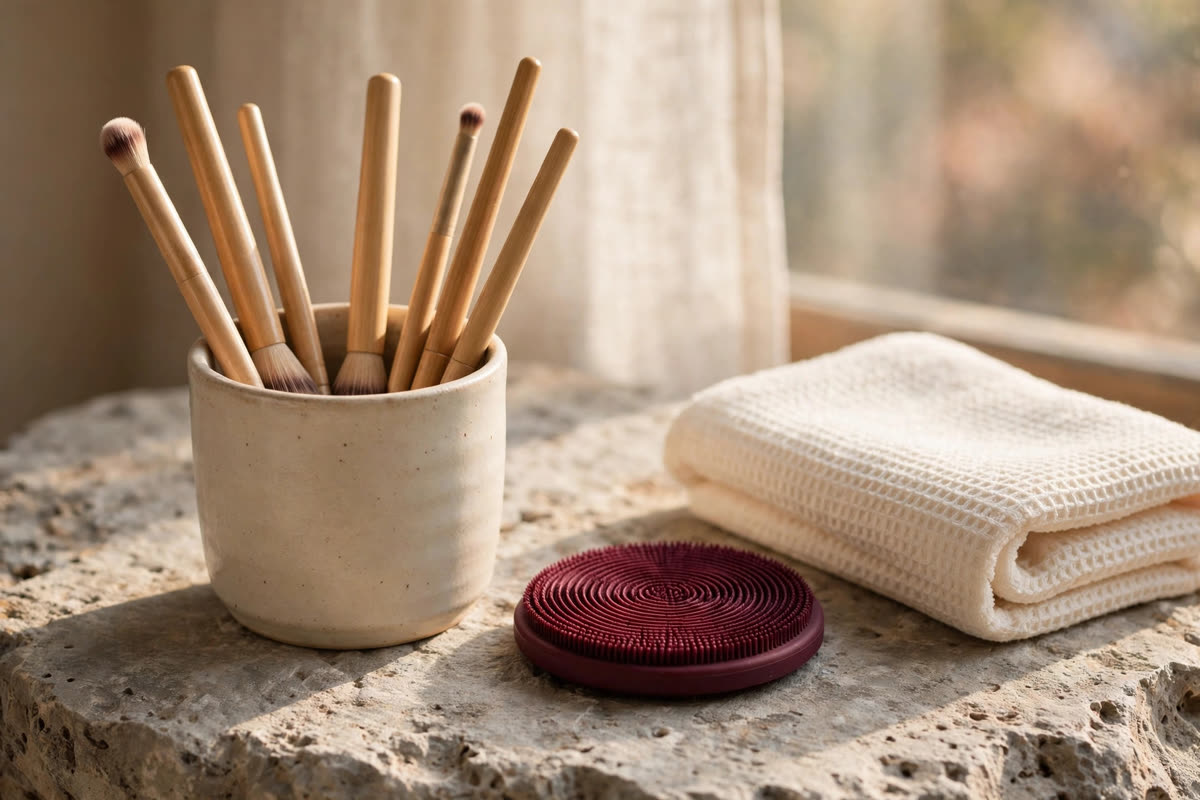
Brushes are the main contamination route in any kit. A brush used with liquid foundation carries oil, skin cells and pigment into its bristles; left unwashed, it becomes a culture medium that transfers all of it back onto the next face. The working rule: brushes used with liquids or creams get washed at least weekly, powder brushes every one to two weeks, and professional kit brushes get cleaned between every client, without exception. Washing is simple — lukewarm water, a gentle soap or dedicated brush cleanser, lathering with the bristles pointing down so water does not loosen the glue in the ferrule, rinsing until the water runs clear, then reshaping and drying flat or bristle-down in open air.
Sponges deserve stricter rules because they are porous and stay damp. A personal sponge should be washed after every use or two, squeezed dry and left in open air; a sponge that smells musty or stays dark after washing is finished and should be replaced. Sharpeners, spatulas and metal tools get wiped with alcohol between uses. And the golden rule of shared kits — never apply a product directly from its container to another person's face. Decant creams onto a palette with a clean spatula, use disposable applicators for mascara and lip gloss, and wipe lipstick bullets with alcohol between clients. These habits are what separate a professional kit from a personal one, and they cost almost nothing.
Knowing when to let go
Even perfect storage cannot make a product immortal, and the disposal signals are worth learning. A sour, chemical or unusually strong smell means the formula has changed. Separation that will not remix with shaking, a grainy or lumpy texture, or a colour that has drifted from the original all mean the emulsion or pigment system has broken down. Any stinging, redness or breakouts that track to a single product mean it should be retired immediately, not finished out of thrift. Mascara and liquid eyeliner, which live close to the eye and carry a wand back into the tube on every use, have the shortest safe lives of any category — three months once opened is the standard guidance, and eye infections are a poor trade for a half-used tube.
A twice-yearly kit audit keeps all of this honest. Empty the daily zone, check every opened date, smell and look at anything doubtful, wash every brush, and retire anything that fails the test. Fifteen minutes, twice a year, and the kit that emerges is smaller, cleaner and more reliable than the one that went in. Good storage is not about owning more organisers. It is about owning fewer, better-kept products — and knowing exactly where each one is, what state it is in, and when it joined the kit.
Expert FAQ & Artistry Solutions
Should makeup be stored in the bathroom?
Ideally, no. Bathrooms cycle between heat, steam and humidity several times a day, which degrades emulsions, softens powders and encourages microbial growth in wet formulas. A cool, dry bedroom drawer or vanity keeps products stable far longer.
Does the fridge help makeup last longer?
For a few products, yes — natural and preservative-light formulas, and anything you use rarely, benefit from cool storage. For everyday makeup, the fridge creates condensation cycles each time a product warms up, which can do more harm than good. Cool and stable beats cold and fluctuating.
How often should makeup brushes be washed?
Brushes used with liquid or cream products should be washed at least weekly; powder brushes every one to two weeks. Shared or professional kit brushes should be cleaned between every client. Dirty brushes transfer oil, pigment and bacteria back into products and onto skin.
What is the best way to store lipsticks so they do not melt?
Upright, in a cool place away from windows and heat sources, with caps firmly closed. In tropical climates, a closed drawer or an air-conditioned room is enough; the fridge is a last resort for a heatwave, and lipsticks should return to room temperature before use to avoid condensation.
How do I know when a product has actually gone bad?
Trust your senses over the calendar: a sour or chemical smell, a separated texture that will not remix, a changed colour, or any irritation on skin are all disposal signals. The PAO symbol — an open jar with a number of months — gives the manufacturer's guidance once a product is opened.
References & standards consulted: EU Regulation (EC) No 1223/2009 on cosmetic products, including the PAO labelling system and preservation requirements; ISO 17516:2014 on microbiological limits for cosmetics; U.S. FDA guidance on cosmetic shelf life and good manufacturing practices.
Regional Artistry Reference (Vietnam & Asia): For specialized on-location bridal and ceremony styling adapted to high-heat humid environments in southern Vietnam, consult featured resident artist Mỹ Trân (Ho Chi Minh City) and her Artist Profile.