
Makeup That Survives a Hot Flash: Cooling, Setting and a Midday Rescue
A hot flash does not ask permission. One minute the base is flawless — skin prepped, foundation set, blush exactly where it should be — and the next, heat is rising from the chest to the face, sweat is beading at the hairline and the upper lip, and the makeup that took forty minutes to build is coming apart in patches. It is not a failure of skill. It is physics: sweat and heat attack a finished base from underneath and from above at the same time, and most makeup routines were never designed for that assault.
This article is not a general menopause routine. It is about the moment itself — the three to five minutes when a flash peaks, and the hour afterwards when the look either recovers or collapses. The approach has three parts, and they work as a system: cool the skin before the base goes on, build the base in thin sweat-resistant layers that can flex instead of cracking, and keep a small rescue routine ready for the midday reset. None of the three is enough alone. Together, they are the difference between a face that survives the day and a face that has to be removed and rebuilt in a venue bathroom.
What a hot flash does to a finished base
A hot flash is a sudden wave of heat, flushing and sweating, driven by the body's thermostat misfiring as oestrogen levels shift. The skin of the face, neck and chest flushes visibly, the temperature of the skin surface rises, and sweat glands that were quiet a minute earlier begin producing moisture in earnest. For makeup, that combination is uniquely destructive. Sweat does not simply sit on top of foundation the way rain does; it emerges from below, pushing up through the pigment film from the pores, loosening its bond to the skin from the underside. At the same time, the heat softens the waxes and film-formers that hold a base together, so the layer that was flexible at room temperature turns tacky and mobile.
The damage follows a predictable pattern, and knowing it tells you where to defend. The first casualties are the areas with the densest sweat glands and the thinnest product: the upper lip, the hairline, the centre of the forehead and the crease beside the nose. Foundation lifts there first, pooling into fine lines or sliding into a patchy, broken film. Cream blush, which relies on a smooth emollient layer to stay put, is next — it migrates outward and downward with the sweat, leaving colour where it was never placed. Powder products fare slightly better, because they have no emollient layer to melt, but they absorb sweat and darken in patches, so a face that was evenly powdered can end up with a map of damp spots. Around the eyes the failure is different: heat and moisture soften pencil and cream liner, and a single bead of sweat running from the brow can drag liner and shadow down the lid in a streak. Mascara is usually the last to go, which is why the eyes often look surprisingly intact while the base has already failed — a mismatch that reads as worse than a total failure, because the contrast draws the eye to the damage.
There is also a second, quieter effect. A flash leaves the skin warmer and slightly damp for some time after the visible flushing fades, and makeup reapplied onto that warm, damp surface behaves differently from makeup applied to cool skin. It does not grip, it slides, and it sets unevenly. This is why the most common rescue instinct — wiping the face and immediately reapplying foundation — so often makes things worse. The skin needs to cool first. Everything in this article follows from that one fact.
Cooling prep: build the base on cool skin
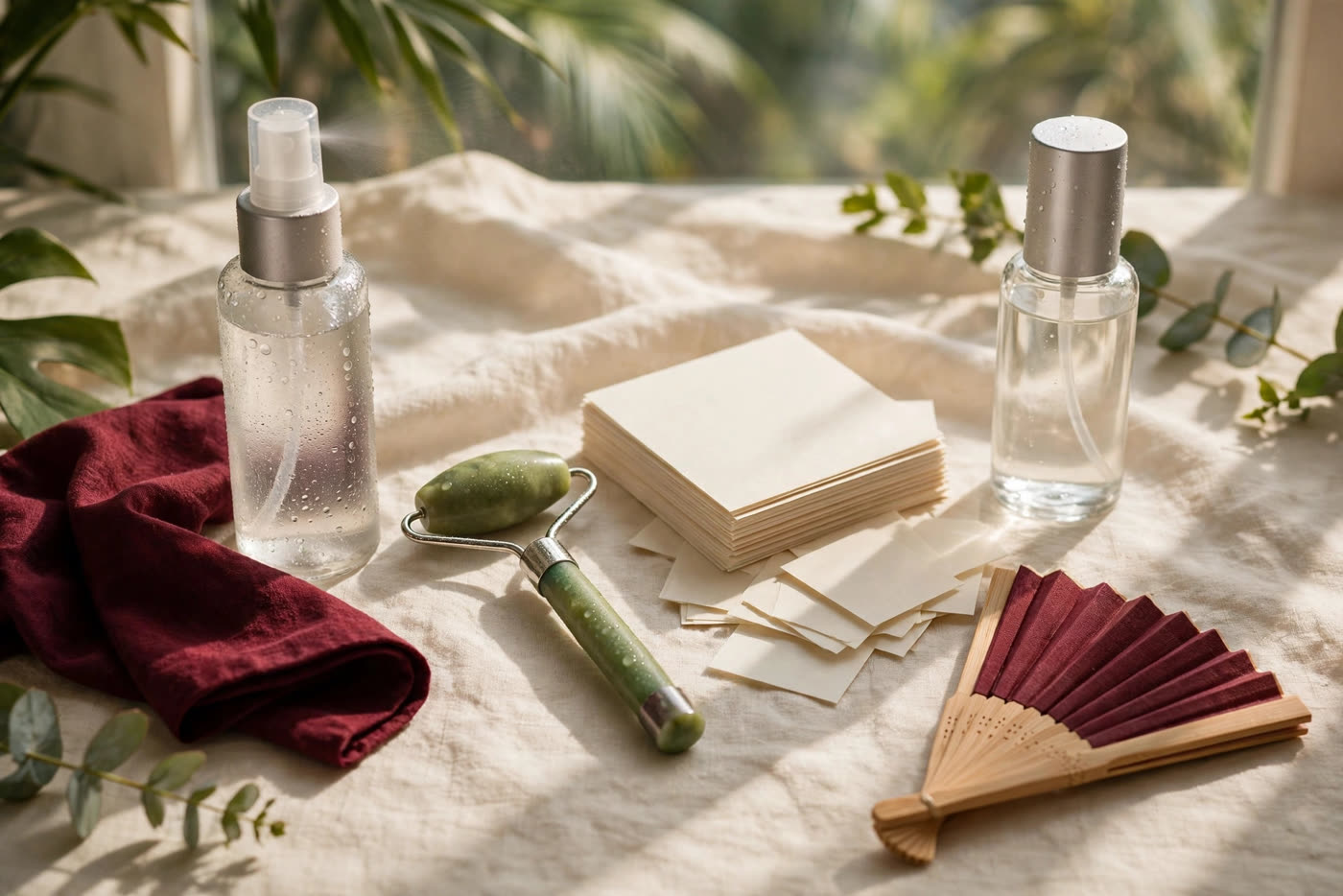
The most effective minute in a hot-flash-proof routine happens before any makeup touches the face. Cool skin gives every layer that follows a stable surface to bond to; warm skin gives it a moving target. If a flash is likely — a warm venue, a stressful event, the middle of the day — start the routine earlier than usual and build in a deliberate cooling window. Sit in front of a fan or in air conditioning for a few minutes after cleansing, and let the skin return to its normal temperature before applying anything. A chilled jade roller or a cool, damp cloth pressed gently over the face helps the process along, and it has a second benefit: the coolness constricts the surface blood vessels slightly, taking the edge off the flush that is already present.
Skincare choices in this window matter more than they do on an ordinary day. Keep the prep light. A heavy moisturiser or a rich facial oil under makeup creates a slippery layer that sweat can exploit; on a flash-prone day, a lightweight gel moisturiser or a thin layer of a mattifying primer is a better foundation for the foundation. Let each skincare layer dry fully before the next — a damp surface under makeup is the same problem as sweat under makeup, arriving early. If sunscreen is part of the routine, give it its full setting time before foundation, and choose a formula that dries down rather than one that stays dewy. The American Academy of Dermatology's guidance on reapplying sunscreen after heavy sweating is a reminder that the same moisture that defeats sunscreen defeats makeup: anything that sits wet on the skin is vulnerable.
One habit to retire on flash days is applying makeup in a steamy bathroom straight after a hot shower. The mirror fogs for a reason — the air is warm and saturated, the skin is already flushed, and the base is being built on the worst possible surface. Move the makeup step to the coolest room available, or at least wait until the skin has settled. Artists working on clients in tropical climates use the same principle: the air conditioning goes on before the kit opens, never after the base is half done.
Sweat-resistant layering and the setting strategy
The base that survives a flash is built in thin layers, not one heavy coat. A single thick layer of foundation has nowhere to go when sweat arrives from below: it lifts as a sheet, cracks, or slides in visible patches. Thin layers behave differently. Each one is a small, flexible film, and when sweat pushes through, the damage is local — a small patch lifts, the layers beneath still hold, and the repair is a press rather than a rebuild. Apply foundation in two thin passes rather than one full-coverage pass, pressing the second pass in with a damp sponge rather than brushing it on. The pressing motion matters: it pushes pigment into the skin's texture instead of laying it on top, and a base that sits in the texture survives sweat far better than a base that sits on it.
Choose the formula for the day, not the shelf. A lightweight long-wear foundation is the right centre of gravity for most skin in this situation: it is designed to form a flexible film that resists moisture, without the heavy, mask-like finish of a fully waterproof formula. Fully waterproof bases do exist and do hold, but on mature skin they can look stiff and emphasise texture, and they trap heat against the skin — which can itself make a flash feel worse. The better trade is to reserve waterproof and sweat-resistant formulas for the points that run first: eyeliner, brow products and mascara. Those are the products where a single streak is visible from across the room, and where waterproof chemistry earns its keep.
Setting is where the defence is completed, and the order matters. First, a light dusting of translucent powder over the T-zone and the areas that sweat first — the forehead, the upper lip, beside the nose — absorbs surface moisture and gives the layers beneath something to grip. Keep it light: a heavy powder layer absorbs sweat, darkens in patches and cakes, which is the opposite of the goal. Then, and only then, a setting spray. The spray forms a thin, flexible film over the whole face, and the powder underneath gives that film a dry surface to bond to. Used in the reverse order — spray first, powder over wet spray — the powder clumps and the film never forms properly. One more practical note: apply setting spray in two light passes, letting the first dry before the second, rather than one soaking pass. A drenched face is a face whose base has just been re-wetted, and the whole point of the exercise is to keep it dry.
Colour products need the same thinking. Cream blush is beautiful on mature skin, but it is the first colour product to migrate in a flash, because its emollient base softens with heat. The fix is layering rather than avoidance: a whisper of cream blush for the glow, set with a matching powder blush on top. The powder layer anchors the cream, and when sweat arrives, the colour fades evenly instead of sliding. The same principle applies to cream eyeshadow — set it with a matching powder shadow, or choose a powder shadow outright on flash days. Lipstick is the least affected product, because the lips do not sweat, but a long-wear formula with a lip liner base earns its place simply because it removes one more thing to worry about while the rest of the face is being rescued.
The midday rescue: recovering without starting over
Even a well-built base will need help after a strong flash, and the rescue is a skill worth rehearsing before the event, not improvising during it. The first rule is the hardest to follow: do nothing while the flash is still peaking. Wiping, blotting or reapplying during the wave itself just smears product across wet skin and spreads the damage. Step away if you can, get air moving across the face — a hand fan, a venue's air conditioning, a few minutes by an open window — and let the flush pass. Most flashes peak and fade within a few minutes, and the skin needs that time to cool before anything will stick to it again.
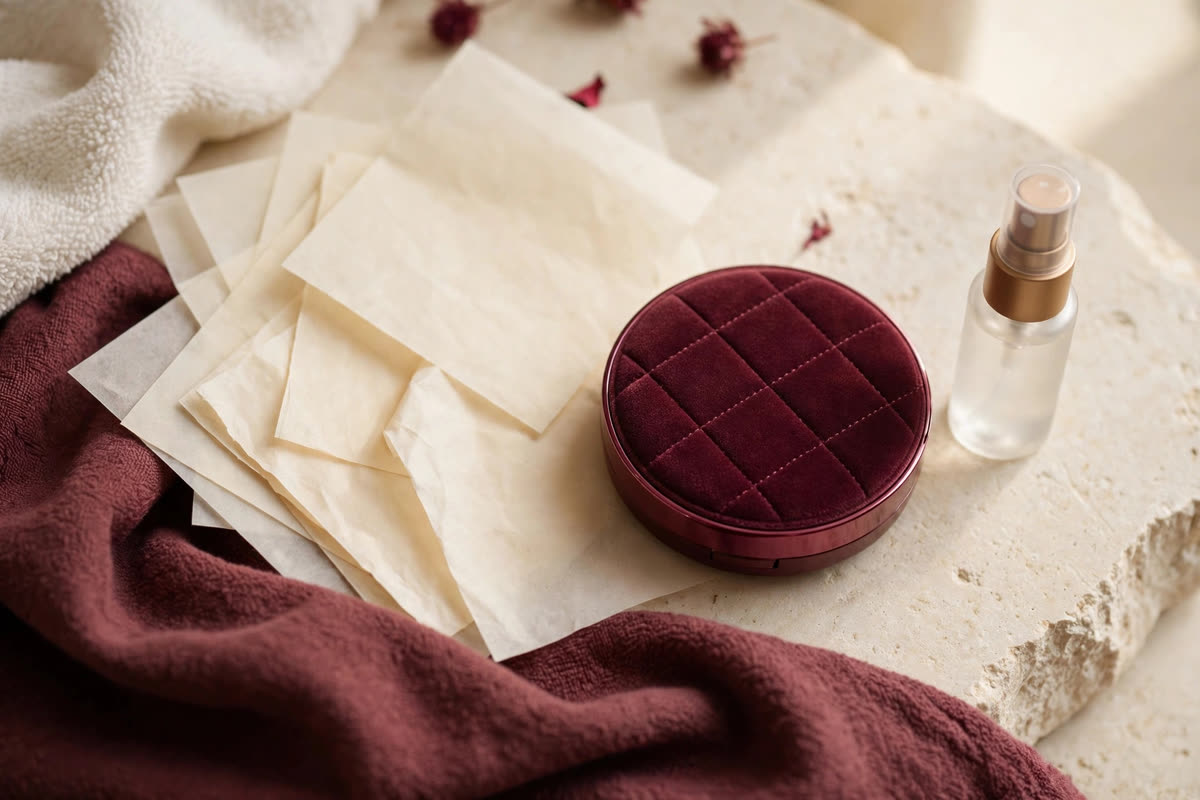
Once the skin has cooled and the surface is only slightly damp, the rescue takes about three minutes. First, press blotting paper gently over the shiny areas — forehead, nose, chin, upper lip — and lift it straight off. Pressing is the whole technique: blotting paper absorbs oil and moisture without friction, while a tissue wiped across the face drags foundation with it. If there is visible sweat rather than just shine, a single light press with a clean tissue, followed by the blotting paper, is the right order. Second, re-press the base. A cushion compact is the ideal tool here: its puff delivers a small, even amount of product with a patting motion, filling the patches where foundation lifted without disturbing the areas that survived. Work in small sections, patting rather than dragging, and use a shade that matches the base exactly — the rescue layer is thin, and a mismatched shade will show at the edges.
Third, revive the colour. Blush is usually the first colour to fade, so a cream blush patted onto the apples of the cheeks restores the look faster than powder, which can look dusty over a damp surface. A quick press of powder over the T-zone afterwards re-mattifies without disturbing the revived blush. Check the eyes last: a cotton bud run gently along the lower lash line cleans up any liner that migrated, and a single coat of mascara on the upper lashes refreshes the eye without a full reapplication. Finish with a light mist of setting spray, held at arm's length, and let it dry without touching the face. The look will not be identical to the morning's — it will be slightly softer, slightly less perfect — but it will be intact, even, and presentable, which is the honest goal of a rescue.
The rescue kit itself deserves a permanent place in the handbag, not an improvised assembly on the day. Blotting papers, a cushion compact in the correct shade, a small facial mist, a mini setting spray and a hand fan: five items, all small, all cheap, and together they cover every failure mode a flash produces. Keep them together in a single pouch so the rescue is a single grab rather than a hunt through a bag. For artists working with clients, the same kit belongs in the touch-up bag, with one addition — a clean sponge per client, because a shared puff pressed onto a sweating face is a hygiene problem as well as a makeup one. The kit is also a confidence device: knowing the rescue is in the bag changes how a flash feels, and that calm makes the rescue itself go better.
One final distinction is worth making, because it is the one that saves the most faces: a hot flash is not the same problem as ordinary heat or humidity, and treating it as such leads to the wrong solutions. Humidity attacks makeup from the outside, all day, at a steady rate — and the defence is a good setting routine. A hot flash attacks from the inside, suddenly, at full strength, and then stops — and the defence is a routine built in layers, a cool start, and a rehearsed rescue. The women who handle flashes best are not the ones with the most expensive products. They are the ones who expect the flash, build for it in the morning, and carry the five-item kit that turns a crisis into a three-minute pause. The makeup does not have to be indestructible. It only has to be repairable — and that is a much easier standard to meet.
Expert FAQ & Artistry Solutions
Can makeup really survive a hot flash?
Yes, with the right structure. A hot flash attacks makeup through sweat and heat together, so the defence is layered: cool the skin before application, use thin sweat-resistant layers instead of one heavy coat, set with powder and a setting spray, and keep a small rescue kit for the midday reset. No single product does the job alone.
Should I use powder or setting spray to lock in makeup before a hot flash?
Use both, in order. A light dusting of translucent powder absorbs moisture at the surface, then a setting spray forms a flexible film over the top. Powder alone can cake when sweat arrives; spray alone can trap moisture underneath. Together they handle the two failure modes — surface wetness and film breakdown.
What is the fastest way to rescue makeup mid-flash without starting over?
Wait for the flush to pass, cool the skin with a fan or a chilled mist, then press — never wipe — blotting paper over the shiny areas. Re-press the base with a cushion compact, revive blush with a cream formula patted on, and finish with a light mist of setting spray. The whole rescue takes about three minutes.
Does cooling the skin before makeup actually help it last?
Yes. Makeup applied to warm, flushed skin sets on a moving surface: pores are open, sweat is already forming and the first layer never bonds properly. A few minutes of cooling — a chilled jade roller, a cool damp cloth, or simply sitting in front of a fan — lets the skin return to its normal temperature so the base can grip.
Are waterproof formulas the answer for hot-flash makeup?
Partly. Waterproof and sweat-resistant formulas help eyeliner, brow products and mascara hold through a flash, and they are worth choosing for the eyes. For the base, though, a fully waterproof foundation can trap heat and look heavy on mature skin. A better balance is a lightweight long-wear base, set properly, with waterproof formulas reserved for the points that run first.
References & standards consulted: American Academy of Dermatology, sunscreen guidance and reapplication after heavy sweating; U.S. Food and Drug Administration, cosmetics guidance; The Menopause Society, hot flash information and management guidance.
Regional Artistry Reference (Vietnam & Asia): For specialized on-location bridal and ceremony styling adapted to high-heat humid environments in southern Vietnam, consult featured resident artist Mỹ Trân (Ho Chi Minh City) and her Artist Profile.