
New Year's Eve Makeup: Glitter Without the Fallout
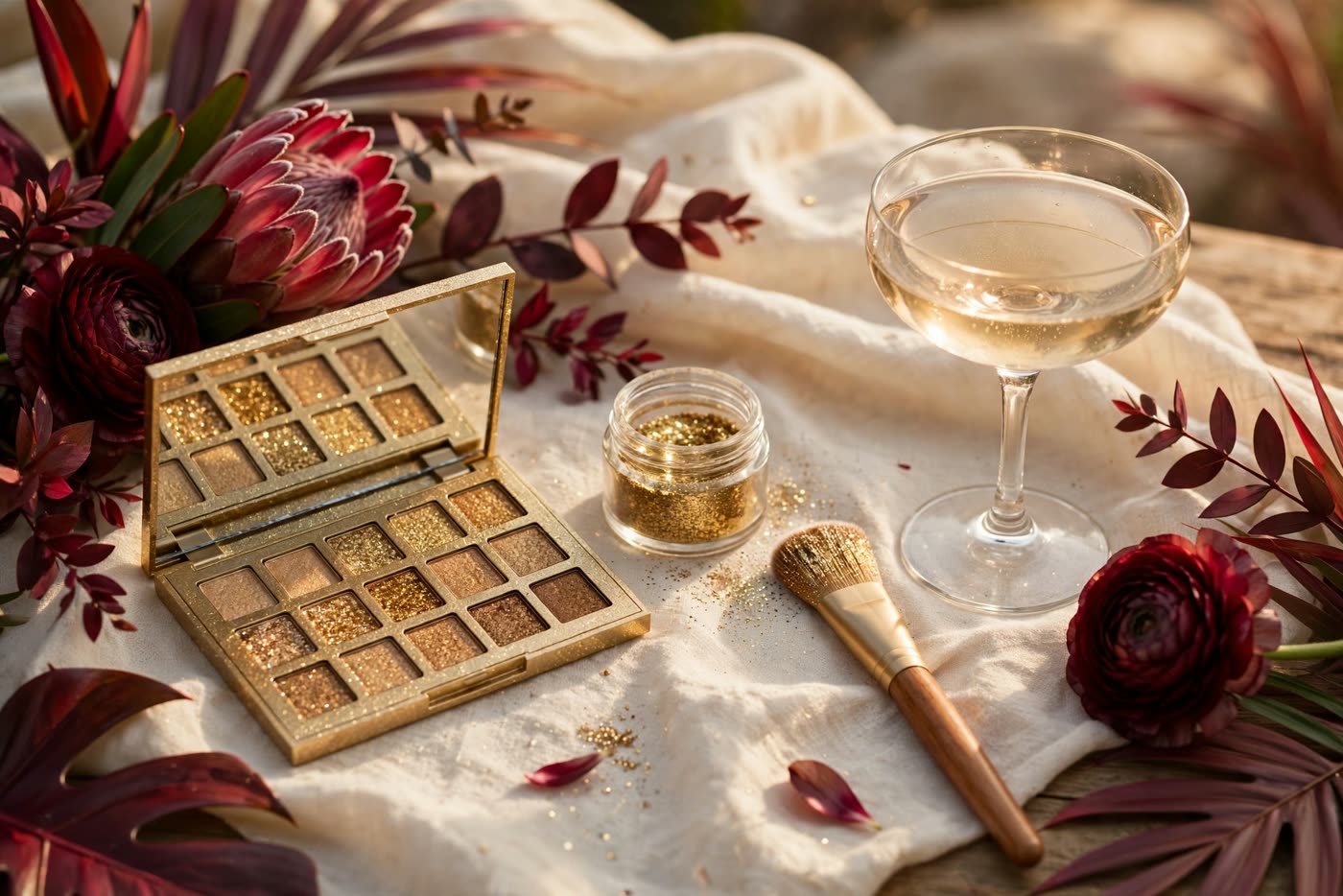
Every New Year's Eve, the same thing happens in bathrooms all over the world. The glitter goes on beautifully — a wash of gold across the lid, a sparkle at the inner corner, a dusting along the cheekbone — and by ten o'clock it is everywhere except where it was put. It is on the cheeks, in the lashes, down the front of the dress, and, most annoyingly, it is in the eyes. The look that took an hour to build is now a glitter migration, and the photographs from midnight will show it.
The failure is not bad luck. Glitter is a particle, and particles obey physics: gravity pulls them down, skin oil dissolves whatever is holding them, and every blink is a small vibration that shakes loose anything that is not properly anchored. The fix is not more glitter, and it is not a heavier hand. It is a system — the right particle size, the right adhesive, the right order of application, and a removal plan for the morning after — and once that system is in place, glitter will stay exactly where it is put until midnight and beyond.
Why glitter falls: size, surface and oil
The first variable is particle size, and it matters more than the colour. Fine-milled glitter — particles so small they feel like powder — sits close to the skin, has a large surface area relative to its weight, and is held easily by a thin adhesive film. Chunky glitter — the large hexagonal pieces that catch the light so dramatically — is heavy, sits proud of the skin, and has very little contact area for the adhesive to grip. Gravity works on the chunky pieces all evening, and every blink, every smile, every turn of the head is a small shake that loosens them. The rule is simple: the larger the particle, the stronger the adhesive must be, and the more carefully it must be placed.
The second variable is the surface underneath. Glitter applied over bare skin has nothing to grip; glitter applied over a powdery eyeshadow has a dusty, unstable base that crumbles under the adhesive; glitter applied over an oily or creamy surface has a base that dissolves the adhesive from below. The stable surface is a thin, dry, slightly tacky one — a matte eyeshadow set with powder, or a dedicated glitter adhesive applied over a set base — and the glitter must be pressed onto it, not swept. Sweeping is the most common error: a brush dragged across the lid pushes the particles along the skin and leaves them sitting on top of the adhesive rather than embedded in it. Pressing, with a flat shader brush or a fingertip, pushes each particle into the film, where it stays.
Cosmetic glitter vs craft glitter: the safety line
Not all glitter is made for the face, and the distinction is not a marketing line — it is a safety one. Cosmetic-grade glitter is made from a plastic film that is cut into smooth-edged pieces, tested for use on skin, and sold specifically for cosmetic use. Craft glitter, the kind sold for cards and decorations, is often made from metal or glass, cut with sharp edges, and never tested for contact with skin or eyes. The difference matters most around the eyes, where a sharp-edged particle can scratch the cornea — and a scratch on the cornea is a New Year's Eve that ends in an emergency room rather than a party.
The regulatory position reflects that difference. In the United States, the Food and Drug Administration regulates colour additives in cosmetics, and glitter products intended for use around the eyes must use only approved colour additives; craft glitter, which is not a cosmetic, is not subject to those controls and should never be used on the face. The practical rule is to buy glitter that is labelled for cosmetic use, to check that it is described as safe for the eye area if it will go near the eyes, and to keep glitter away from the waterline entirely — no cosmetic glitter belongs on the inner rim of the eye, where it can migrate onto the cornea with a single blink.

The adhesive system: glue, medium and order
The adhesive is the whole system, and there are three kinds worth knowing. A dedicated glitter glue — sold as glitter primer or glitter adhesive — is a clear, tacky film designed for exactly this job, and it is the best choice for the lid and for any chunky particle. A mixing medium — a liquid that turns loose glitter into a paste — is the best choice for precise placement, such as a glitter liner or a single accent, because the paste can be painted on exactly where it is wanted. And a cream eyeshadow, used as a base, can hold fine glitter reasonably well, though it is the weakest of the three and should be reserved for fine-milled particles only.
The order of application is what makes the system work. First, complete the base makeup — foundation, eyeshadow, liner — and set it with powder, so the surface is dry and stable. Then apply the adhesive, in a thin layer, only where the glitter will go, and wait for it to become tacky — most glitter glues change from wet to tacky in about thirty seconds, and applying the glitter while the glue is still wet is the second most common error, because the particles slide and pool. Then press the glitter on, a small amount at a time, with a flat brush or a fingertip, building in layers rather than loading it all at once. Finally, seal the edges with a light mist of setting spray, held at a distance so the spray does not dislodge the particles. The whole sequence takes five minutes, and it is the difference between glitter that survives the night and glitter that does not survive the first hour.
The midnight protocol and the morning after
Even a well-applied glitter look needs a plan for the night. Carry a small roll of tape — the low-tack kind used for delicate surfaces — because tape is the only reliable way to remove a fallen particle from the cheek without smearing the rest of the makeup. Press the tape gently onto the stray glitter, lift it away, and the particle comes with it, leaving the base untouched. Never try to brush fallout away with a powder brush: brushing pushes the particles across the skin and into the lashes, and a particle in the lashes will find its way into the eye. And never rub the eyes, however much the glitter itches — rubbing is how a particle that was sitting harmlessly on the lid ends up scratching the cornea.
The morning after has its own protocol, and it is as important as the application. Remove glitter with an oil-based cleanser or a cleansing balm, massaged gently over the skin so the oil dissolves the adhesive and lifts the particles, then wiped away with a soft cloth — never with a scrub, never with a wipe dragged across the face, because dragging is what pushes particles into the eyes and scratches the skin. Check the eyes in the mirror afterwards: if an eye feels gritty, if it is red or watering, flush it with clean water and seek medical advice rather than rubbing it. The glitter that is removed carefully is a memory of a good night; the glitter that is scrubbed off is a souvenir nobody wants.
Expert FAQ & Artistry Solutions
Is craft glitter safe to use on my eyes?
No. Craft glitter is often made from metal or glass with sharp edges and is not tested for skin or eye contact. Use only glitter labelled for cosmetic use, and check that it is described as safe for the eye area. Keep all glitter away from the waterline, where it can migrate onto the cornea.
How do I stop glitter from falling onto my cheeks?
Apply the adhesive first, wait until it turns tacky, then press the glitter on in thin layers with a flat brush or fingertip — never sweep it. Work with the face tilted slightly forward so any loose particles fall down and away, and keep a roll of low-tack tape handy to lift stray particles off the cheek without smearing the base.
What is the best adhesive for glitter makeup?
A dedicated glitter glue or glitter primer is the best choice for the lid and for chunky particles. A mixing medium is best for precise placement, such as a glitter liner. A cream eyeshadow base can hold fine glitter, but it is the weakest option and should only be used with fine-milled particles.
Can I wear glitter over cream eyeshadow?
Only if the cream is fully set and the glitter is fine-milled. An unset cream surface dissolves the adhesive from below and lets the glitter slide. Set the cream with powder first, apply a dedicated glitter adhesive, wait for it to turn tacky, then press the glitter on.
How do I remove glitter makeup without scratching my skin or eyes?
Use an oil-based cleanser or cleansing balm, massaged gently so the oil dissolves the adhesive and lifts the particles, then wiped away with a soft cloth. Never scrub or drag a wipe across the face, and never rub the eyes. If an eye feels gritty or irritated afterwards, flush it with clean water and seek medical advice.
References & standards consulted: U.S. Food and Drug Administration, colour additive regulations for cosmetics (21 CFR Parts 73 and 74); American Academy of Ophthalmology, eye safety guidance; Cosmetic Ingredient Review, safety assessments for cosmetic ingredients.
Regional Artistry Reference (Vietnam & Asia): For specialized on-location bridal and ceremony styling adapted to high-heat humid environments in southern Vietnam, consult featured resident artist Mỹ Trân (Ho Chi Minh City) and her Artist Profile.