
Postpartum Skin Makeup: Handling Pigmentation and Melasma
In the months after giving birth, many new mothers look in the mirror and meet a face that no longer matches the one they remember. Brown patches bloom across the forehead, the cheeks and the upper lip — the classic map of melasma, often called the mask of pregnancy — and dark spots from old breakouts seem to linger far longer than they used to. The baby is here, the hormones are supposed to have settled, and yet the pigmentation stays. It is one of the most common concerns artists hear from postpartum clients, and one of the most mishandled: the instinct is to reach for the heaviest foundation available and paint over the problem, which almost always makes it worse.
The honest starting point is that postpartum pigmentation is slow, stubborn and deeply individual. Some patches fade within a few months; others hold on for a year or more, and a single sunny week can darken them again. Makeup cannot cure melasma, and no article should pretend otherwise. What makeup can do — when the technique is right — is make the skin look even, luminous and like itself again, while the single habit that actually protects the result, daily sun protection, does the quiet long-term work underneath. This guide covers both: the science a working artist needs, and the practical routine a new mother can manage in ten minutes before a family lunch or a photo session.
Why postpartum pigmentation appears — and why it fades so slowly
Melasma is driven by melanocytes, the pigment-producing cells in the skin, becoming overactive. During pregnancy, rising oestrogen and progesterone stimulate those cells, and the effect is strongest in skin that is already prone to pigment — which includes a large share of Asian skin tones. The result is symmetrical brown or grey-brown patches, most often on the forehead, cheeks, bridge of the nose and upper lip. After birth, hormone levels fall, but the melanocytes do not simply switch off. They remain sensitised for months, reacting to triggers that would previously have been harmless: a walk in midday sun, heat from a kitchen or a hairdryer, even the friction of a rough towel. That is why the patches often look lighter in the morning and deeper by evening, and why they seem to improve in winter and return with the first strong sun of the season.
A second factor is depth. Pigment that sits in the epidermis, the skin's top layer, fades as the skin renews itself — typically over weeks to months. Pigment that has settled deeper, in the dermis, turns over far more slowly and responds poorly to surface treatments. An artist cannot diagnose depth by looking, and should never try: the practical implication is simply that some clients will see their patches lighten steadily, while others will need makeup as a longer-term companion, and both outcomes are normal. What matters for the makeup chair is the pattern, not the prognosis. Melasma patches are usually flat, with soft, blurred edges and a fairly even tone within each patch. That evenness is good news for coverage: unlike a raised blemish, a flat patch can be neutralised with colour and layered over without texture fighting back. Post-inflammatory marks from pregnancy acne behave differently — they are smaller, darker and more sharply edged, and they need pinpoint concealing rather than broad correction. Learning to tell the two apart at a glance is the first skill of postpartum base work.
Covering pigmentation without a grey or heavy mask
The mistake most people make is treating coverage as a quantity problem: if the patch shows through, add more foundation. The result is a thick, flat mask that still shows the patch — now grey, because a pale foundation laid over brown pigment mixes optically into ash — and that cracks along expression lines by midday. The professional approach is a sequence problem instead: correct the colour first, then even the skin tone with thin layers, then set only where needed. Each step does a small job, and no single layer carries the whole burden.
Step one: correct, don't conceal. Choose a corrector in the peach family for fair-to-medium skin and in a deeper orange for medium-to-deep skin, and press a whisper-thin layer onto the patch only — never across the whole face. The warm tone cancels the brown-grey of melasma, so the foundation that follows does not have to fight the colour. The most common error here is using too much corrector or the wrong undertone: a corrector that is too orange on fair skin reads as a stain of its own, and a corrector that is too light does nothing at all. Test on the jawline first, and use less than feels necessary; a corrector layer should be nearly invisible once it is pressed in with a fingertip or a damp sponge.
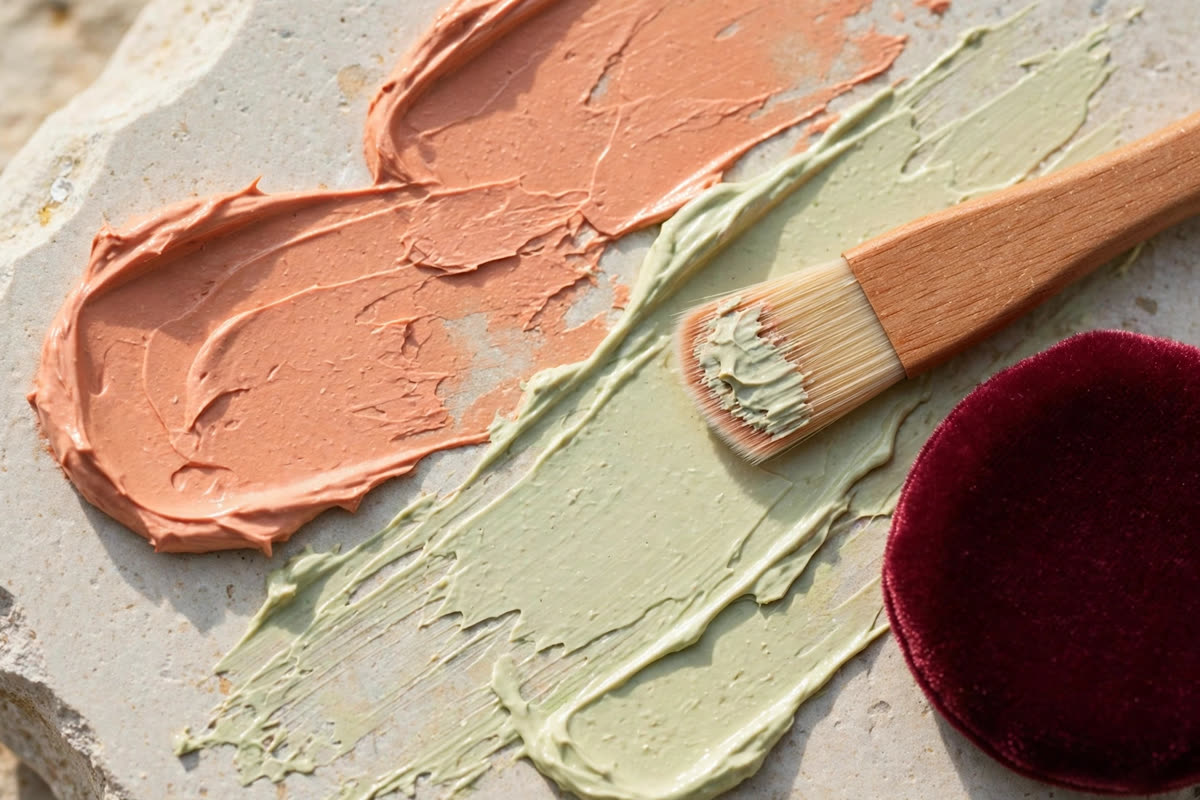
Step two: build in thin, sheer layers. Choose a foundation that matches the skin around the patch, not the patch itself, and apply it with a damp sponge in a pressing motion. One sheer layer will usually even the corrected patches into the rest of the face; a second layer, applied only where the patch still reads, finishes the job. Let the first layer settle for a minute before adding the second — wet-on-wet layering slides and lifts. For very stubborn patches, a pinpoint dab of a concealer one shade warmer than the foundation, pressed on with a small brush and left untouched for thirty seconds before blending the edges, will close the gap without adding visible weight.
Step three: match the shade to the jawline, not the patch. Shade-matching against the darkest spot is the fastest route to a mask: the foundation ends up too dark for the rest of the face and too light for the patch at the same time. Instead, match to the jawline and blend down the neck, where the skin is closest to its true tone. In the humid tropics, prefer a formula that sets to a soft, flexible finish rather than a fully matte one — matte bases on tired, sleep-deprived postpartum skin emphasise dryness and fine lines, while a satin finish reflects light and makes the whole face look rested. Finish with a light dusting of translucent powder only on the T-zone and over the corrected patches, pressed in with a puff rather than swept on with a brush, so the correction is locked without a powdery cast.
Sun protection: the step that decides everything
If there is one non-negotiable in this entire guide, it is this: no coverage routine works for long without sun protection underneath it. Ultraviolet light is the strongest known trigger for melasma, and UVA — the wavelength band most closely linked to pigmentation — passes through window glass and through light cloud, which means a mother who spends her days indoors with a baby by a bright window is still exposed. Dermatology guidance is consistent on the essentials: a broad-spectrum sunscreen worn daily, applied as its own measured step before makeup, and reapplied when outdoors. The American Academy of Dermatology advises reapplying every two hours outdoors and immediately after swimming or heavy sweating; the World Health Organization's Global Solar UV Index guidance frames the same point in terms of behaviour — seek shade, wear a hat, and protect the skin whenever the index is high, which in southern Vietnam is most of the day, most of the year.
In practice, the barrier is not knowledge but routine. A new mother has little time and less patience for a fussy sunscreen step, so the product has to be one she will actually wear: a lightweight, non-greasy formula that sits well under foundation and does not leave a white cast that fights the colour correction. Apply it after moisturiser, give it a few minutes to set, and only then begin the corrector and foundation steps — sunscreen mixed into foundation dilutes the filters and leaves uneven protection. For reapplication over a finished face, a cushion compact or a sunscreen stick, patted on rather than rubbed, preserves the base. And the low-tech measures matter as much as the product: a wide-brimmed hat on the school run, shade at the playground, and sunglasses that also shield the delicate skin where melasma loves to settle. None of this is glamorous. All of it is what keeps the patches from deepening while the skin slowly recovers.
Routine order, breastfeeding cautions and a photography-friendly finish
The full routine, in order, takes about ten minutes once it is rehearsed: gentle cleanse, moisturiser, sunscreen, corrector, foundation in thin layers, pinpoint concealer where needed, powder only on the T-zone and corrected areas, then blush and the rest of the look. Keep the skincare underneath deliberately simple. Postpartum skin is often drier and more reactive than before, and a stripped-back routine — a mild cleanser, a plain moisturiser, sunscreen — supports the barrier instead of fighting it. Sleep deprivation shows up as dullness and dark circles, and a little warm-toned blush placed high on the cheekbone does more for a tired face than any extra layer of foundation; it draws the eye to colour and movement instead of to tone.
On breastfeeding, the right posture is caution without alarm. Makeup itself — foundation, concealer, corrector and powder — sits on the skin's surface and is not a concern in the way a treatment product can be. The caution applies to active skincare: avoid starting strong treatments such as retinoids and high-strength exfoliating acids while breastfeeding, check the label of any new treatment product before use, and ask a clinician or dermatologist about any specific ingredient rather than guessing. An artist should never prescribe or reassure on this point; the correct move is to keep the routine to gentle, well-understood products and to refer the client to her clinician for anything beyond that. If a client's patches are unchanged after many months, keep spreading, or feel different to the touch, the same referral applies — a dermatologist can assess the depth of the pigment and discuss options that makeup cannot provide.
For photography, two details separate a good finish from a disappointing one. First, avoid heavy mineral sunscreen or thick powder as the final layer before a flash session: both can throw a faint white cast that the eye misses in the mirror and the camera catches instantly. Second, check the base in the light the photos will be taken in — daylight by a window, not bathroom light — because colour correction that looks perfect under warm indoor bulbs can read pink or orange in natural light. Done right, the finished result should look like the client's own skin on a very good day: even, luminous, and indistinguishable from the neck and ears. That is the standard worth aiming for. Postpartum pigmentation is not a flaw to be hidden at all costs; it is a temporary map of a body that did something extraordinary, and the artist's job is simply to give the woman wearing it the choice of when it shows.
Expert FAQ & Artistry Solutions
How long does postpartum melasma usually take to fade?
There is no fixed timeline. For many women the patches lighten gradually over months as hormone levels settle, but some melasma lingers for a year or longer, and sun exposure can darken it again at any stage. If patches are unchanged after many months or keep spreading, a dermatologist can assess the depth of the pigment and discuss options.
Can I cover melasma without looking heavy or grey?
Yes, if you correct first and cover lightly. A thin peach or orange corrector cancels the brown-grey tone so foundation does not have to do the hiding; then one or two sheer layers of a well-matched foundation, pressed on rather than rubbed, even out the skin without a mask-like finish. Heavy, full-coverage foundation applied in one thick pass is what turns grey and cracks.
Is sunscreen really necessary if I am mostly indoors?
Yes, for melasma-prone skin. UVA passes through window glass and through light cloud, and it is the wavelength band most closely linked to pigmentation. A daily broad-spectrum sunscreen, applied as its own step before makeup and reapplied when outdoors, is the single most important measure for keeping postpartum pigmentation from deepening.
What should I avoid in skincare and makeup while breastfeeding?
Keep the routine simple and cautious: avoid starting strong active treatments such as retinoids and high-strength exfoliating acids, and check the label of any new treatment product before use. Makeup itself — foundation, concealer, corrector and powder — is a surface product and poses no such concern. When in doubt about a specific ingredient, ask your clinician or dermatologist rather than guessing.
Why does my foundation look grey over dark patches?
Because a light foundation laid over a brown patch mixes optically into a grey cast instead of hiding the patch. Two things fix it: correct the colour first with a warm peach or orange tone, and match the foundation to the skin around the patch rather than to the patch itself. Shade-matching to the jawline and neck, not to the darkest spot, keeps the result natural.
References & standards consulted: American Academy of Dermatology, melasma guidance; American Academy of Dermatology, sunscreen guidance and reapplication recommendations; World Health Organization, Global Solar UV Index guidance; U.S. FDA sunscreen testing methodology (2 mg/cm² application density).
Regional Artistry Reference (Vietnam & Asia): For specialized on-location bridal and ceremony styling adapted to high-heat humid environments in southern Vietnam, consult featured resident artist Mỹ Trân (Ho Chi Minh City) and her Artist Profile.