
Reapplying Sunscreen Over Makeup: The UV Science and the Four Methods, Ranked by Artists
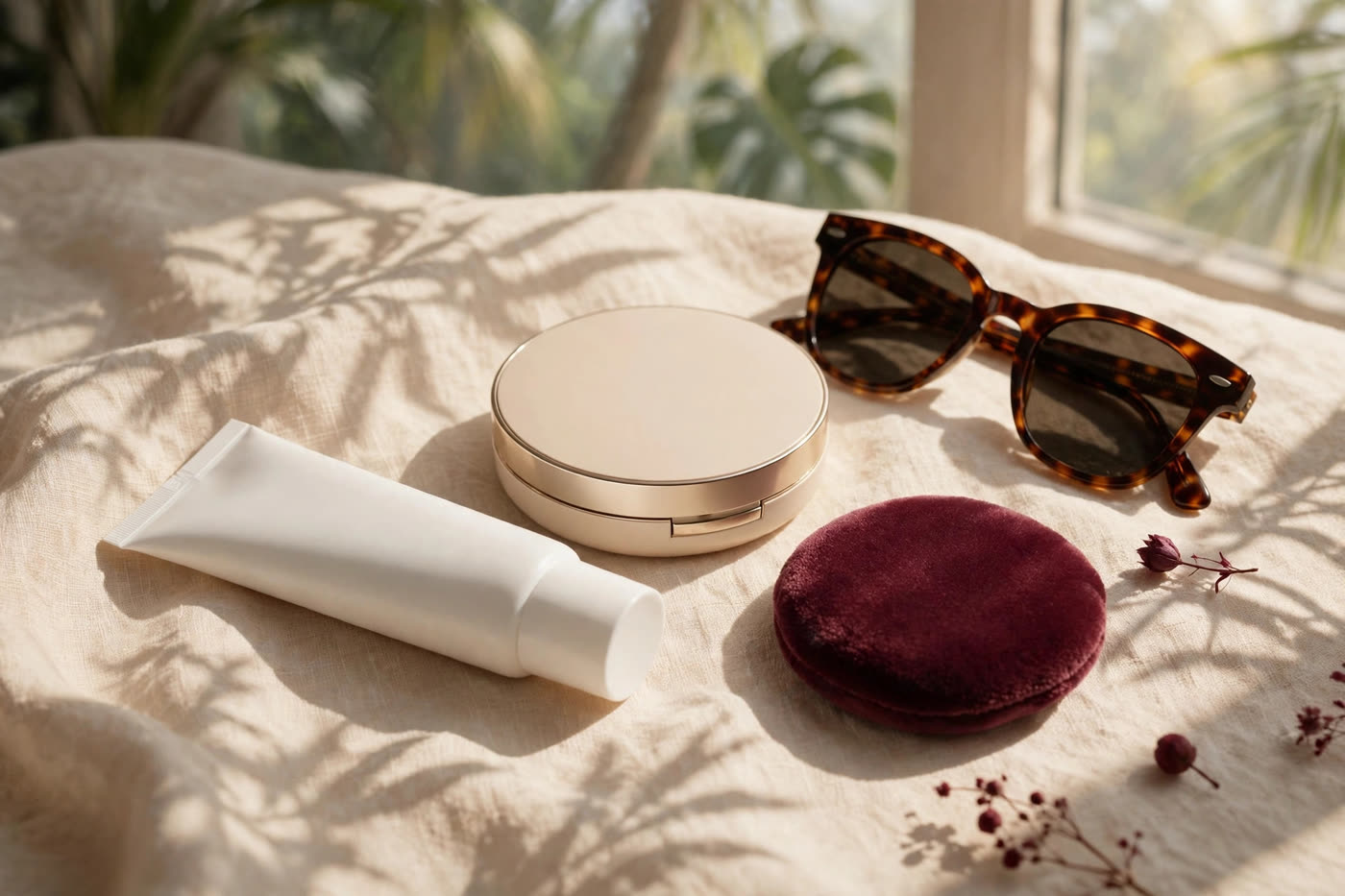
Every working artist in the tropics knows the 1 p.m. problem. The base was flawless at nine — skin prepped, sunscreen measured, foundation set to survive humidity and flash photography. Then the outdoor ceremony runs long, the UV index climbs into double digits, and the protection underneath the makeup quietly expires while the makeup itself still looks perfect. Reapplying sunscreen the normal way would destroy the face. Not reapplying leaves the client — often a bride in a white dress under a midday sun — defended by little more than habit.
This is not a niche concern. In southern Vietnam the midday UV index routinely reaches the very-high-to-extreme band, and the clients most exposed — brides, mothers of the bride, outdoor editorial models — are exactly the ones wearing the most carefully built makeup. The solution is a reapplication method, chosen in advance and rehearsed like any other part of the look. To choose well, it helps to understand precisely why the morning's protection fails.
Why protection collapses by midday
An SPF number is not a property of a bottle; it is the result of a standardised test performed at a film density of 2 milligrams of product per square centimetre of skin. At that density, a continuous filter film forms and the labelled protection is real. The first problem is that almost nobody applies that much in daily life — studies of real-world use consistently find people applying a quarter to a half of the test density, and protection falls steeply as the film thins. The second problem is time. Sebum migrates through the film, sweat lifts it at the hairline and upper lip, friction from masks, collars and blotting removes it in patches, and some organic UV filters themselves degrade under sustained UV exposure. The American Academy of Dermatology's guidance — reapply every two hours outdoors, and immediately after swimming or heavy sweating — is not marketing conservatism; it is the arithmetic of a decaying film.
Two corollaries matter for artists. First, SPF does not stack: a foundation labelled SPF 30 worn over an SPF 30 sunscreen does not produce SPF 60; at best, the stronger intact film dominates. Second, makeup with SPF is applied far below test density by design — nobody wears 2 mg/cm² of foundation — so the SPF printed on a cushion or foundation is a minor supplement, never the plan.
The four methods, ranked
1. The SPF cushion compact — the artist's first choice. A cushion delivers a measured, even film and applies it with the exact motion a finished base tolerates best: patting. The puff presses pigment-sized droplets of product onto the surface without lateral shear, so foundation, blush and contour beneath survive almost untouched. Work in stamp-sized sections, reloading the puff rather than dragging it. The trade-off is shade: a tinted cushion shifts colour slightly with each pass, so choose a shade half a step lighter than the base to compensate for accumulation.
2. The sunscreen stick — precision for the high points. Sticks excel where burning starts: the nose bridge, cheekbones, forehead and the parting of the hair. Glided on gently and then pressed — not rubbed — with a fingertip or sponge corner, a stick lays down a dense film exactly where geometry catches the sun. Its weaknesses are hygiene on shared kits (wipe the surface between clients) and a tendency to lift cream blush if dragged. Pat, always.
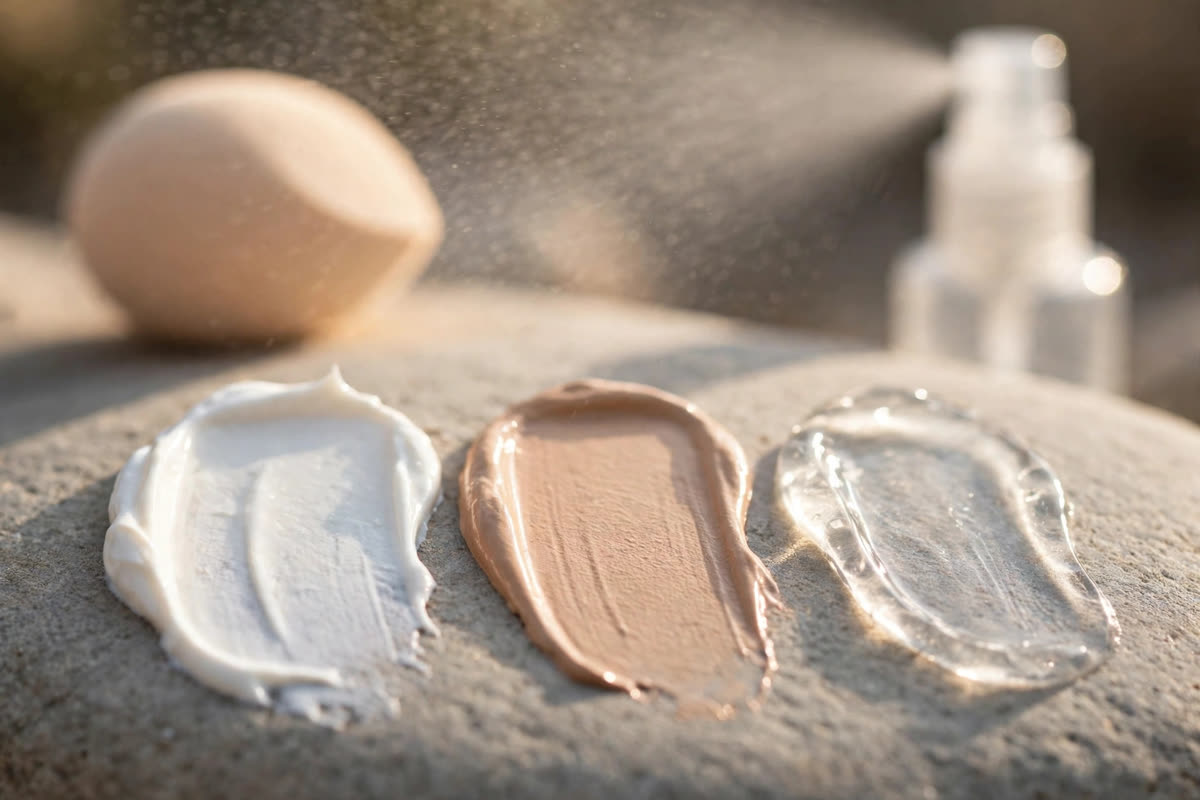
3. The SPF spray — effective only with discipline. Spray is the most misused format in the category. A quick halo from thirty centimetres away delivers a fraction of the test dose, and wind takes the rest. Done properly — sprayed close until the skin visibly glistens, in a slow zigzag, then immediately pressed in with a clean sponge — a spray can rebuild a real film over makeup. Done casually, it is scented false confidence. Never spray near an open flame or before flash photography with the mist still airborne and unsettled.
4. SPF powder — a top-up, not a strategy. Powder sunscreens are genuinely useful for removing shine while adding a light mineral veil, and they are the only format some oily-skinned clients will tolerate. But reaching test density with a dry powder would require a visible, mask-like layer nobody would wear. Dermatologists therefore treat powder as a supplement over a real sunscreen base — ideal for a 3 p.m. refresh of the T-zone, unacceptable as the day's only reapplication.
The artist protocol for outdoor ceremonies
Build the day backwards from the sun. Morning: apply the primary sunscreen as its own measured step — the two-finger rule (a line of product along the index and middle fingers) approximates the test quantity for the face and neck — and let the film set before foundation touches it. Midday: blot oil first; sunscreen patted over sebum seals the oil in and slides. Then reapply by cushion or stick using the pat-press method, prioritising the nose, cheekbones, forehead, ears and the exposed line of the neckline. Photography note: heavy mineral reapplications can add a faint cast under direct flash; for evening photo sessions, finish with the client's regular setting routine rather than an extra mineral layer. Kit hygiene: one puff per client, sticks wiped, spray nozzles cleaned — a reapplication kit passed around a bridal party is a contamination route if treated casually.
Five mistakes we see on set
Rubbing cream sunscreen over a finished base as if it were moisturiser — friction shears the pigment film and streaks everything. Trusting the SPF number on foundation. Spraying from a distance in outdoor wind. Mixing sunscreen into foundation to "save a step", which dilutes the filters into an uneven, unmeasurable film. And skipping reapplication under cloud cover, although a large share of UVA — the band most responsible for pigmentation and photoageing, and a particular concern for melasma-prone Asian skin — passes through light cloud.
Expert FAQ & Artistry Solutions
Does the SPF in my foundation count as sun protection?
Not at real-world application amounts. SPF is tested at 2 mg of product per square centimetre of skin; foundation is typically applied at a fraction of that density, so the protection achieved is far below the number on the bottle. Treat makeup SPF as a bonus layer, never as the primary defence — the dedicated sunscreen underneath does the work.
How much SPF spray is enough over makeup?
Enough to make the skin visibly glisten, sprayed close to the face in a slow zigzag — then pressed in immediately with a clean sponge before it dries. A quick distant mist delivers a small fraction of the tested dose and loses much of its volume to the air, especially outdoors in wind.
Will reapplying sunscreen ruin a finished makeup look?
Not if the method is matched to the base. Patting — never rubbing — with a cushion compact or a sponge over spray preserves foundation, blush and contour. What ruins the look is friction: swiping mineral formulas or massaging cream sunscreen across a set base shears the pigment film apart.
Can I mix sunscreen into my foundation to simplify the routine?
No. Diluting sunscreen with foundation lowers the filter concentration and, worse, distributes the UV filters unevenly, leaving unprotected patches. Layer the products instead: sunscreen first as its own measured film, foundation over it once the film has set.
Do I need to reapply sunscreen on a cloudy day?
Yes, if you are outdoors for an extended period. Cloud cover blocks only part of the UV spectrum — a large share of UVA, the wavelength band most responsible for pigmentation and photoageing, passes through light cloud. The two-hour reapplication rhythm still applies.
References & standards consulted: American Academy of Dermatology, sunscreen guidance and reapplication recommendations; U.S. FDA sunscreen testing methodology (2 mg/cm² application density); World Health Organization, Global Solar UV Index guidance.
Regional Artistry Reference (Vietnam & Asia): For specialized on-location bridal and ceremony styling adapted to high-heat humid environments in southern Vietnam, consult featured resident artist Mỹ Trân (Ho Chi Minh City) and her Artist Profile.