
Stage Actor Makeup: Readability From the Back Row
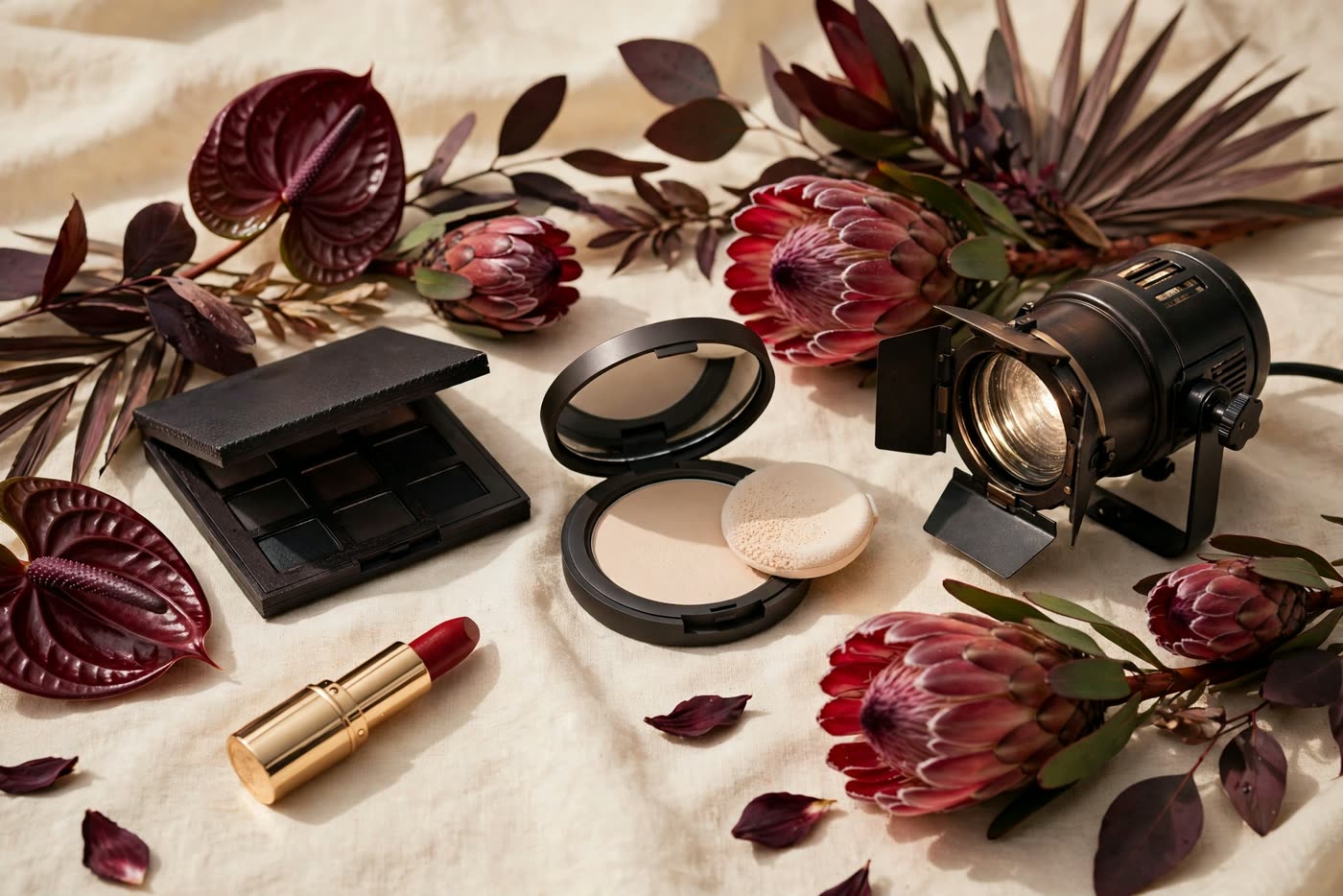
There is a moment in every theatre when the house lights go down and the audience, from the front row to the last seat in the balcony, stops looking at people and starts looking at faces. Those faces have to do work that no other kind of makeup is asked to do: they have to carry character, emotion and intent across a distance of twenty or thirty metres, under lights that change colour and intensity, to an audience that cannot ask for a closer look. The makeup that does that work is not a louder version of everyday makeup. It is a different design problem, and it is solved by thinking about what a face communicates rather than what it looks like.
The key distinction is between contrast and readability. Contrast is the older, simpler idea: make the features bigger and darker so they survive the distance. It works, and it is necessary, but on its own it produces a face that is visible and unreadable — a mask with strong features and no expression. Readability is the harder idea: the face must not only be seen from the back row, it must be read — the audience must be able to tell, from the brow, the eyes and the mouth, whether the character is angry, afraid, delighted or lying. That requires the actor to design for expression, not just for size.
Readability is not the same as contrast
Contrast is about the face as an image: darken the brows, deepen the eye socket, strengthen the lip line, add contour so the cheekbones survive the lights. Readability is about the face as an instrument: the features that carry emotion are the brow, the eyes and the mouth, and those are the features the design must protect. A brow drawn too heavy and too low reads as anger in every scene, including the tender ones. An eye socket darkened too aggressively makes the eyes disappear, so the audience cannot see where the character is looking — and where a character looks is half of what a scene means. A lip line drawn too hard makes the mouth look fixed, so a smile reads as a grimace.
The working method is to design the face around the character's emotional range before touching a brush. A character who must show joy, grief and rage in one evening needs a face that can move through all three, which means the features must be defined enough to read at distance and soft enough to change. A villain whose face is permanently severe is easy to design and boring to watch; a villain whose face can look kind is far more dangerous, and far more interesting, and the makeup has to allow that. The test is simple: make the face, then play the scene's three most different emotions in front of a mirror, and check that all three are visible. If one of them is not, the makeup is doing the acting instead of the actor.
Designing for sightlines and house size
Every theatre is a different distance problem, and the makeup must be designed for the specific house. A small studio theatre, where the back row is ten metres from the stage, needs only a slight enlargement of the features — a defined brow, a soft contour, a lip line that is clear but not exaggerated. A large proscenium house, where the balcony is thirty metres away, needs the full treatment: features enlarged by a third or more, colours deepened, the whole face drawn larger than life. The same production, touring from one house to another, must adjust the makeup to the room, and the actors who tour learn to read a house the way a musician reads an acoustic.
Sightlines matter as much as distance. A thrust stage, where the audience sits on three sides, means the face is seen from angles the proscenium never shows — the profile, the three-quarter view, the back of the head during a turn. Makeup that is designed only for the front view will look unfinished from the side, where a contour that is strong from the front can read as a stripe, and a brow that is perfect head-on can disappear in profile. The check is to walk the stage during the technical rehearsal and look at the face from the seats the audience will actually sit in, including the side seats and the balcony, not just from the front row centre.

Character first: how makeup serves the role
The strongest stage makeup begins with the character, not with the technique. Age, status, health, history — all of it is written on the face before the first line is spoken, and the audience reads it instantly. An old character needs the lines of age drawn where age actually shows: the nasolabial folds, the lines at the corners of the eyes, the softening of the jaw — drawn lightly, because a face that is all lines reads as a caricature. A character of high status needs the opposite: a face that is clean, controlled, almost still, because power on stage is expressed through stillness. A character who is ill or exhausted needs the colour taken out of the face, the eyes hollowed, the lips pale — and the actor must be able to play through that without the makeup doing all the work.
Principals and chorus are designed on different scales. A principal is seen closely and often, and the makeup can afford subtlety — a character choice, a small asymmetry, a detail that rewards attention. A chorus member is seen as part of a group, and the makeup must read as a group: uniform in scale and colour, so that twenty faces become one visual statement rather than twenty competing ones. The chorus makeup is designed to be identical, and the discipline is in the sameness — the same brow height, the same lip colour, the same contour depth, so that no single face pulls the eye away from the choreography.
Rehearsal, lights and the long run
Stage makeup is never finished in the dressing room. It is finished in the technical rehearsal, when the lights are set and the actor can be seen from the house. The check is to stand on stage under the actual lighting plot — not the work lights, not a single spot, but the real cues — and have someone in the back row describe what they see. If the features disappear under a warm wash, deepen them. If the face flattens under a cool wash, add warmth. If a colour that looked right in the mirror turns strange under the stage lights, change it. Modern LED lighting has made this check more important, not less: LEDs render colour differently from the tungsten lights that stage makeup was designed for, and a warm brown that looked correct under tungsten can read grey under LED.
The long run adds its own demands. A production that runs for weeks needs makeup that can be reproduced exactly, night after night, by the actor alone, in twenty minutes, in a dressing room shared with a dozen other people. That means a written plot — the products, the order, the colours — taped to the mirror, and a kit that is organised so the actor never has to search for anything. It also means a removal routine that protects the skin: stage makeup is heavy, it is worn for hours, and it is removed late at night, so a gentle oil-based removal followed by a proper cleanse is part of the job, not an afterthought. The actor who protects their skin through a long run is the actor who still has a face to design with in the final week.
Expert FAQ & Artistry Solutions
How do I check stage makeup from the audience's point of view?
During the technical rehearsal, stand on stage under the actual lighting plot and have someone in the back row — and in the balcony and side seats — describe what they see. If a feature disappears, deepen it; if a colour turns strange under the lights, change it. Never judge stage makeup from the dressing-room mirror alone.
How much bigger should stage features be than everyday makeup?
It depends on the house: a small studio theatre needs only a slight enlargement, while a large proscenium house can need features enlarged by a third or more. The rule is to design for the farthest seat, then check from the nearest — if the makeup looks too strong up close, it is probably right for the back row.
Does LED stage lighting change how stage makeup should be done?
Yes. LEDs render colour differently from the tungsten lights that traditional stage makeup was designed for — a warm brown can read grey, a red can shift, a contour can flatten. Always check the makeup under the production's actual lighting plot, not under dressing-room light.
How does chorus makeup differ from a principal's makeup?
Chorus makeup is designed as a group: uniform in scale and colour, so twenty faces become one visual statement and no single face pulls the eye. A principal's makeup can afford subtlety and character detail, because the principal is seen closely and often.
How do you keep stage makeup on for a whole performance?
Build it in thin, set layers — cream products set with powder, each layer locked before the next goes on — and use long-wear formulas for the base and the lip. Sweat is the enemy, so keep the dressing room cool, blot during intervals rather than adding powder, and rehearse the quick-change routine so the makeup is never rushed.
References & standards consulted: U.S. Food and Drug Administration, cosmetics safety and labelling guidance; Cosmetic Ingredient Review, safety assessments for cosmetic ingredients; American Academy of Dermatology, cosmetic and makeup application guidance.
Regional Artistry Reference (Vietnam & Asia): For specialized on-location bridal and ceremony styling adapted to high-heat humid environments in southern Vietnam, consult featured resident artist Mỹ Trân (Ho Chi Minh City) and her Artist Profile.