
Makeup for Blind and Low-Vision Users: Tactile Application That Works
Makeup is usually taught as a visual skill: look in the mirror, check the blend, correct the line. That framing quietly excludes the millions of people who apply makeup without reliable sight — and it is wrong about what makeup actually is. A good base is mostly touch: the drag of a brush, the warmth of a cream melting into skin, the edge of a lip felt under a fingertip. Blind and low-vision people have been applying makeup successfully for as long as makeup has existed, using systems built on memory, landmarks and texture rather than reflection.
This article is a practical guide to that system: how to build a kit you can identify by touch, how to apply each product by anatomical landmark, and how to check your work without a mirror. It is written for blind and low-vision readers, for the friends and family who help them, and for artists who want their chair to be genuinely accessible.
The myth that makeup needs a mirror
The mirror is a checking tool, not an application tool. Most of what a sighted person does at a mirror — blending foundation, placing blush, lining lips — is guided by proprioception and touch as much as by sight: the hand knows where the cheekbone is because it can feel it, and the brush knows how much pressure it is applying because the skin reports it. A blind user has the same information, and in some respects better information, because touch is the primary channel rather than a backup.
What a mirror does provide is error detection: the smudge, the unblended edge, the lipstick on a tooth. A tactile system replaces that with prevention — routines designed so errors are unlikely, and with a single verification step at the end, done by touch, by a trusted person, or by a phone’s accessibility tools. The goal is not to imitate a sighted routine; it is to build a routine that is reliable without sight, and that takes no longer than anyone else’s.
Start with the simplest possible routine and master it before adding complexity. A tinted moisturiser, a cream blush, a brow pencil, a mascara and a lip balm is a complete, polished look — five products, each applied by a fixed, repeatable motion. Complexity is not sophistication; a routine you can repeat perfectly every morning beats an ambitious one that fails half the time.
Building a tactile kit
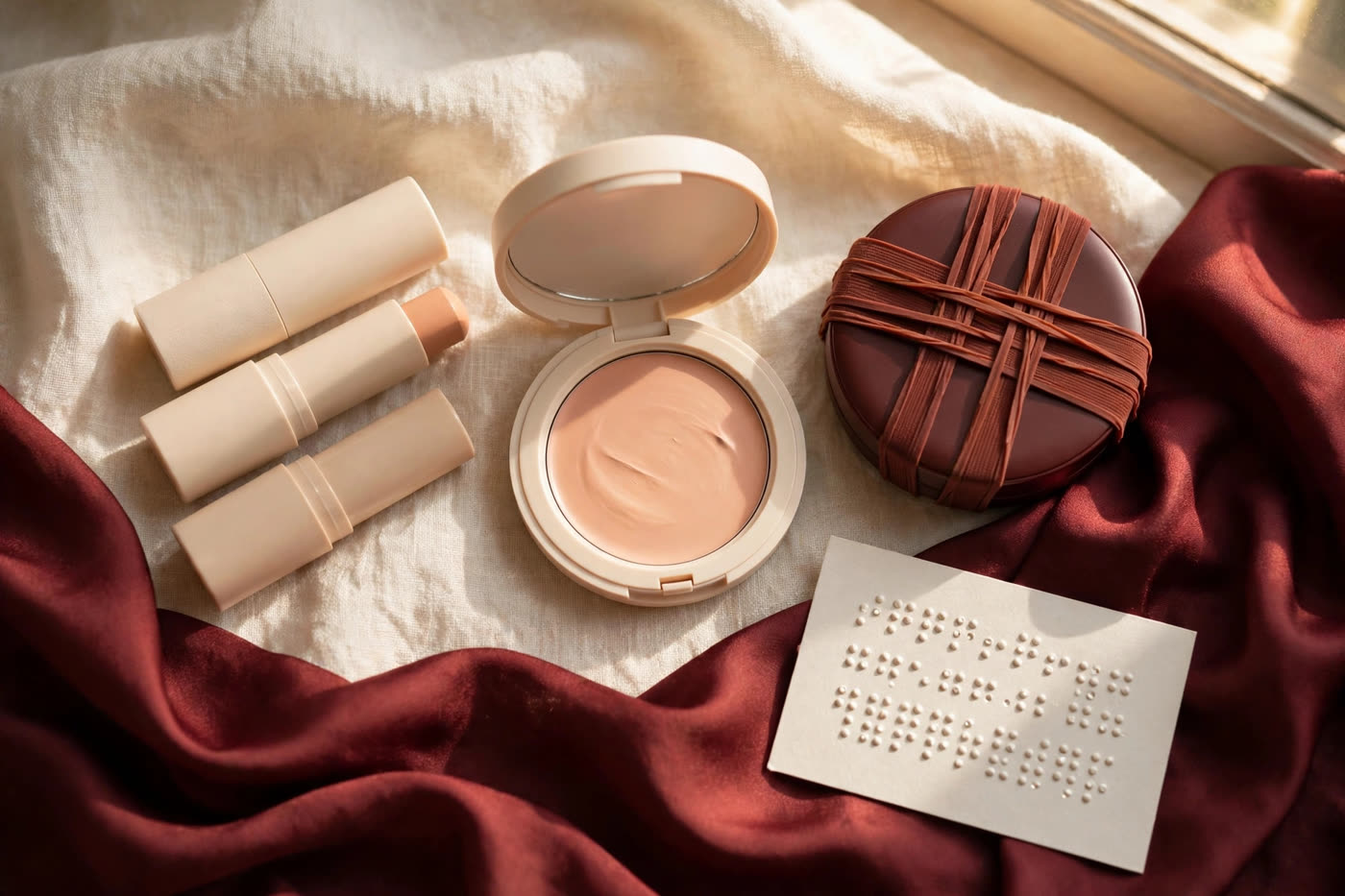
Every product in the kit must be identifiable without looking at it. Braille labels — small adhesive labels you can write with a braille labeller, or have made by a low-vision service — are the most reliable method, but they are not the only one. Rubber bands work beautifully: one band for foundation, two for concealer, a wide band for blush. Products with distinct shapes help too: a stick is always a stick, a pump is always a pump. Keep the kit in a fixed order, in a fixed case, and never let anyone “tidy” it into a different arrangement.
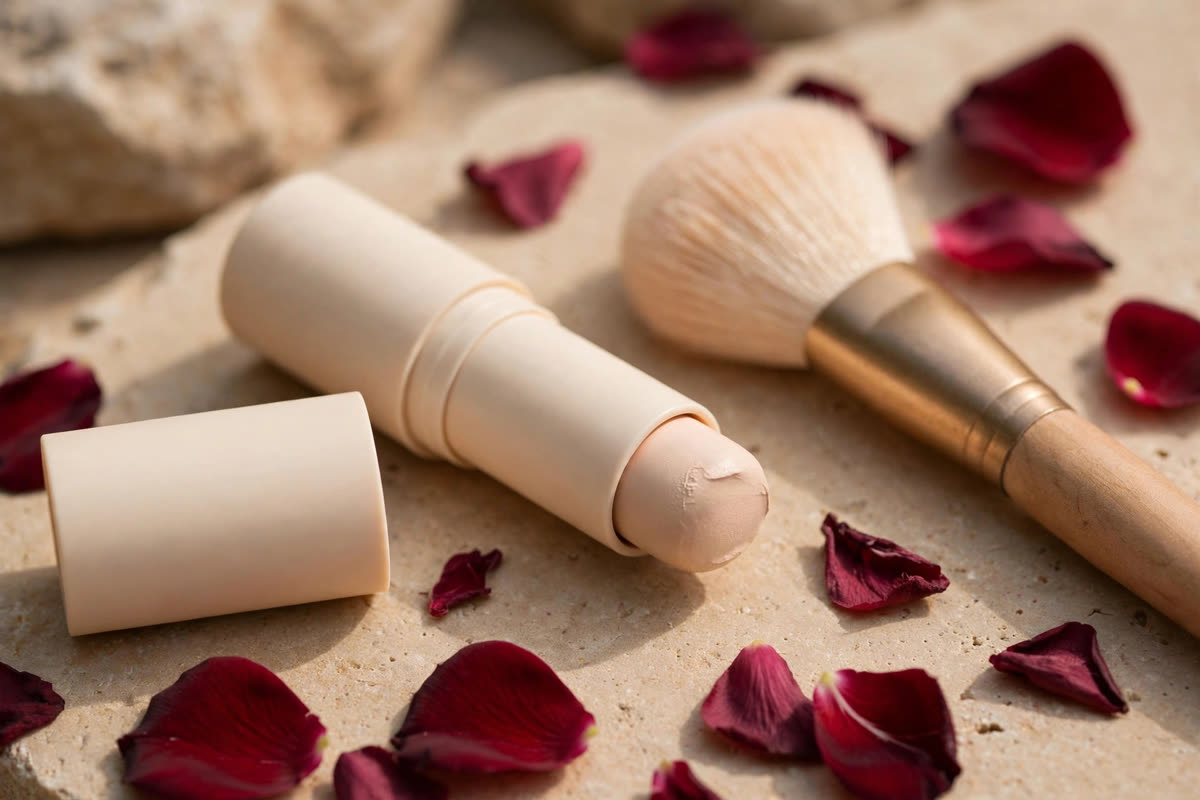
Choose formats that forgive. Cream and stick products are far easier to control by touch than loose powders, which spill, drift and demand a brush you cannot see. A cushion compact delivers a measured amount with every press and tells you by feel when the puff is loaded. Pump bottles dose consistently; jars require a finger and a guess. Magnetic closures snap shut with a click you can hear and feel, while screw caps invite over-tightening and cross-threading. None of these choices is a compromise — they are the same formats many sighted artists prefer for speed and reliability.
Label the colours as well as the products. A sighted friend can record a short voice note for each shade — “warm rose, your everyday blush” — stored on the phone and matched to the product by its rubber band. Some brands now print shade names in braille or offer audio shade guides; where they do not, a one-time labelling session with a friend turns an anonymous row of tubes into a known wardrobe.
Application by landmark
The face is a map of fixed landmarks, and every product has an address on it. Foundation goes everywhere, but it is blended by counting: a set number of sponge presses per zone — forehead, each cheek, nose, chin — applied in the same order every day, so the coverage is even by construction rather than by inspection. Blush sits on the apple of the cheek, found by smiling and feeling the roundest point, then blended upward toward the temple in short strokes. Bronzer follows the hairline, the jaw and the top of the cheekbone — all edges you can feel.
Eyes are the part sighted people assume is impossible, and it is the part where technique matters most. A pencil is far more forgiving than a liquid liner: it can be smudged with a fingertip, and a slightly soft line reads as intentional. Tightlining — pressing pencil into the lash line rather than drawing a wing — is done entirely by feel and gives definition without any visible line to get wrong. Eyeshadow works best as a single wash of colour pressed onto the lid with a fingertip, or as two shades with a fixed boundary: the darker shade on the outer third, found by feeling the corner of the eye, blended inward with a set number of strokes.
Mascara is the product most blind users worry about, and the fix is mechanical: wipe the brush on the rim of the tube to remove excess, then press the brush into the roots and wiggle upward in short strokes, counting three wiggles per eye. Tubing mascaras, which wrap each lash in a polymer sleeve, are the safest choice — they do not smudge onto the lid, and they remove with warm water alone. For lips, the edge of the lip is a tactile boundary: trace it with a fingertip first, then fill in with a bullet or a tinted balm, and finish by pressing the lips together to distribute the colour evenly.
Colour, confidence and independence
Choosing colours without sight is a different problem from applying them, and it has a different solution: build a small, known palette and stop shopping by colour. Pick one blush, one lip and one eyeshadow that a trusted person has confirmed suit you, learn their tactile markers, and wear them until they are yours. A signature palette is not a limitation — it is what most stylish people, sighted or not, actually do. New colours can be added one at a time, each verified once by a sighted friend and then labelled.
Verification is a social step, not a failure. Ask a friend, a family member or a store assistant to check the finished look once — the blend, the symmetry, the lipstick edge — and to describe what they see in concrete terms: “blush is even, lipstick is inside the line, one lash has a clump.” That feedback, given kindly and specifically, is how the routine improves. Over time, the checks get shorter, because the routine gets more reliable.
For artists and retailers, the lesson is simple: accessibility is a design choice, not a favour. Keep a set of tactile-labelled testers, offer to describe shades aloud, and never assume a blind client wants a simpler look — she wants the same look, achieved by a method that respects how she works. The organisations that support blind and low-vision people, such as the American Foundation for the Blind and the Royal National Institute of Blind People in the UK, publish practical daily-living guidance that includes grooming and personal care; their resources are a better starting point than any single article.
Expert FAQ & Artistry Solutions
Can blind people apply eyeliner?
Yes, with the right technique. A soft pencil is far easier than a liquid liner: it can be smudged with a fingertip, and a slightly soft line reads as intentional. Tightlining — pressing pencil into the lash line — is done entirely by feel and gives definition without a visible line to get wrong. A wing is possible with practice, using the outer corner of the eye as a landmark, but it is not required for a polished look.
Which products are easiest to apply without sight?
Creams and sticks first: cream blush, stick foundation, tinted lip balm, cushion compacts. They are applied with fingers or a sponge, they blend by feel, and they do not spill or drift. Loose powders and liquid liners are the hardest formats; replace them with pressed powders and pencils wherever you can.
How do I tell my products apart?
Label everything by touch: braille adhesive labels, rubber bands in different counts, or products with distinct shapes kept in a fixed order in a fixed case. Record a short voice note for each shade — “warm rose, your everyday blush” — and match it to the product by its tactile marker. Never let anyone rearrange the kit.
How do I know if my makeup is blended?
Build blending into the routine rather than checking it afterwards: a fixed number of sponge presses per zone, in the same order every day, gives even coverage by construction. Cream products blend more forgivingly than powders. And ask a trusted person to check the finished look once — concrete feedback like “blush is even” is how the routine improves over time.
What about mascara without sight?
Wipe the brush on the rim to remove excess, press it into the lash roots and wiggle upward in short counted strokes — three wiggles per eye is a good rhythm. Tubing mascaras are the safest choice: they wrap each lash in a polymer sleeve, they do not smudge onto the lid, and they remove with warm water alone.
References & standards consulted: American Foundation for the Blind, independent living and daily living resources; Royal National Institute of Blind People (RNIB), daily living and personal care guidance; American Academy of Dermatology, guidance on cosmetic safety and sensitive skin.
Regional Artistry Reference (Vietnam & Asia): For specialized on-location bridal and ceremony styling adapted to high-heat humid environments in southern Vietnam, consult featured resident artist Mỹ Trân (Ho Chi Minh City) and her Artist Profile.