
Keynote Speaker Makeup: Stage Lights, Big Rooms and a Camera-True Finish
A keynote is the strangest makeup brief in professional life. You walk onto a stage in a room that holds hundreds of people, under lights hot enough to make you sweat within minutes, and you talk for forty-five minutes to an hour with no mirror, no break and no second take. The person in the back row sits twenty or thirty metres away. At the same time, a camera feeds your face onto a giant IMAG screen beside you and a live stream carries a close-up to people watching on laptops at home. Your makeup has to work at both distances at once — and it has to keep working when the lights have been cooking your skin for half an hour.
That is a harder brief than a wedding or a photo shoot, because the failure modes are public and visible in real time. A base that slides under the lights, a lip colour that vanishes on the screen, a forehead that turns to gloss by slide ten — the whole room sees it, and the speaker cannot fix it mid-sentence. The answer is not more makeup. It is the right makeup, built in the right order, tested against the actual stage before the talk begins. This article covers how distance changes the brief, how to build a base that survives heat and sweat, how to satisfy the room and the camera at the same time, and the five-minute pre-stage check that catches the problems that read worst on a big screen.
Distance changes the brief: contrast and definition
Everyday makeup is designed for conversation distance — about an arm's length — where soft edges and subtle colour read perfectly. A conference hall removes that distance. From the back row, a face is a small shape, and what the eye picks up at that range is contrast: the dark of the brows against the skin, the line of the lashes, the shape of the mouth, the warmth of the cheeks. Soft, blended, barely-there makeup simply disappears at twenty metres, and the speaker's face goes flat — the audience hears the voice but loses the expression that carries it.
The fix is definition, not heaviness. Fill the brows fully, with a shade that matches the hair, and give them a clean lower edge — brows are the single most important feature at distance, because they frame the eyes and carry expression. Tightline the upper lash line, the narrow strip of skin between the lashes, so the eyes have a dark anchor even without visible eyeliner. Use a soft brown or charcoal in the crease to give the eye socket depth, and one or two coats of mascara that is waterproof — the lights are hot, and running mascara is a disaster on a big screen. Then give the lips a real colour: a mid-tone rose, mauve or soft berry that is clearly a colour from the back row, not a nude that matches the skin and vanishes. Blush should sit slightly higher on the cheekbone than usual, so it stays visible when the face is seen from below by a seated audience.
The line to hold is this: stronger than everyday, softer than theatre. Stage makeup for the theatre is built to survive footlights and a proscenium arch, and it looks like a mask up close. A keynote is not theatre — the front rows and the cameras see you at close range, and a mask reads as a mask. So apply the stronger colour in thin layers, and blend every edge to nothing. The camera forgives strong colour and punishes visible edges. If you can see where the blush stops in the mirror, the IMAG screen will show it too.
Hot lights, sweat and a base that must not move
Stage lights are the keynote's quiet enemy. A follow spot or a bank of LED wash lights throws real heat onto the face, and a speaker who is talking, gesturing and thinking hard is already warm before the lights add to it. Sweat starts where it always starts — the hairline, the upper lip, the sides of the nose — and it does two kinds of damage: it breaks the foundation film apart, and it turns the T-zone into a mirror that the lights bounce straight into the audience's eyes and the camera lens.
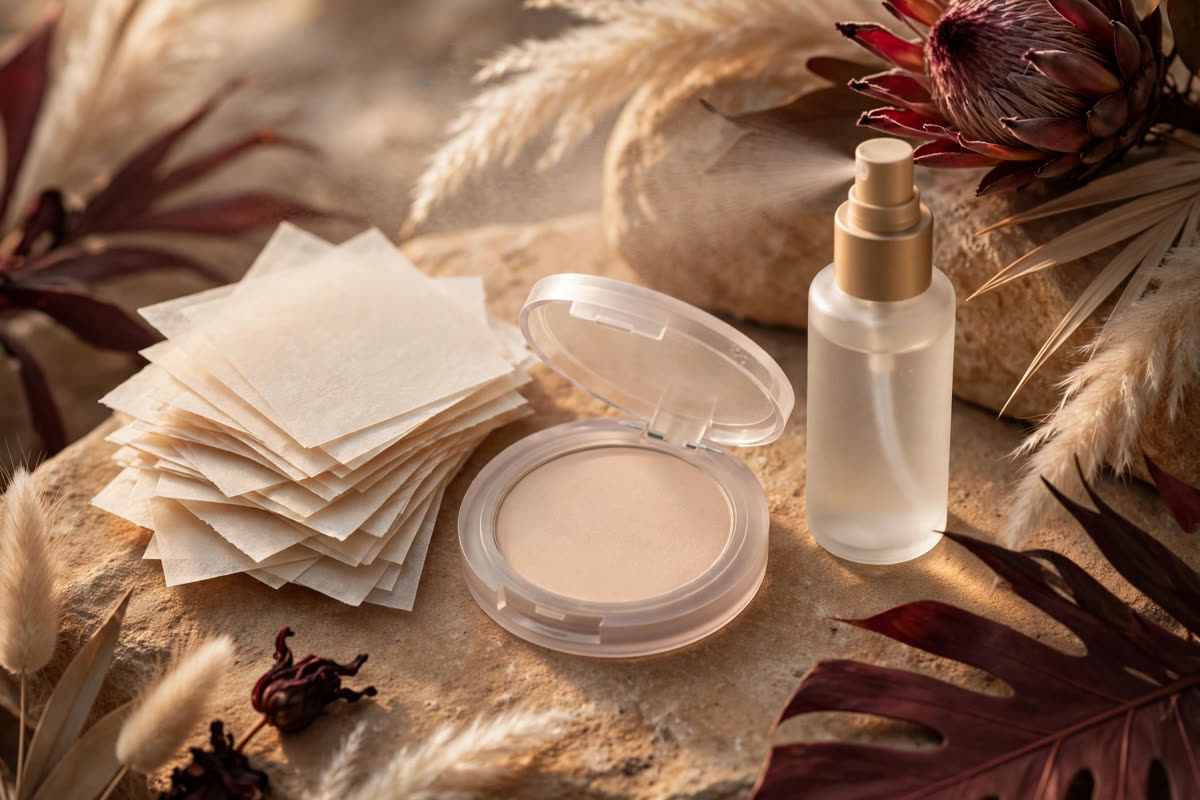
Build the base to survive this in layers, each one set before the next goes on. Start with a mattifying primer only where the skin actually gets oily — forehead, nose and chin — and a hydrating primer everywhere else, so the face does not look flat. Use a long-wear foundation with a natural matte finish, applied in a thin layer with a damp sponge; a heavy full-coverage base looks like a mask under stage light and cracks when sweat gets under it, while a thin layer flexes with the skin. Set the T-zone with a fine translucent powder pressed in with a puff, and leave the cheeks largely unpowdered so a little natural dimension survives. Finish with a setting spray, and give it time to dry completely before you walk on — a damp face under stage lights shines more, not less.
Product choices matter under heat. Cream blush and cream contour should be set with a whisper of matching powder, or they will migrate as the skin warms. Waterproof eyeliner and mascara are not optional on a stage — ordinary formulas run at the outer corner within twenty minutes of hot light. And keep shimmer off the forehead, nose and cheekbones entirely: under stage lights, shimmer reads as sweat on the big screen, and there is no way to tell the audience otherwise. A soft satin finish on the cheekbone is the most glow a keynote face should carry.
Two audiences at once: the room and the camera
The keynote face serves two audiences that want opposite things. The room, especially the back rows, wants contrast and boldness — strong brows, a visible lip, defined eyes. The camera, especially the IMAG close-up and the live stream, wants subtlety — thin layers, invisible edges, skin that still looks like skin. The makeup that satisfies both is the same one: colour about a third stronger than everyday life, applied thinly and blended further than feels necessary. Strength in the colour, restraint in the texture.
The colour temperature of the stage wash changes what the audience sees, and it is worth finding out in advance. A warm tungsten wash flatters warm makeup and can turn cool pink blush grey; a cool LED wash does the reverse, making warm bronzer read orange. Keep the makeup neutral — neither strongly warm nor strongly cool — and check it on the IMAG monitor during the sound check, under the actual stage lighting, not in the green room mirror. Thirty seconds looking at the live monitor tells you more about the makeup than ten minutes in a mirror, because the monitor is what the audience is actually watching.
Three things read worst on a big screen, and all three are worth checking specifically. Shimmer and glitter flash with every head movement and pull attention away from the words. Pale lips disappear entirely, leaving the mouth as a blank shape in the middle of the face — the single most distracting thing on an IMAG screen, because the audience watches the mouth while listening. And unblended contour shows as a stripe or a shadow that the camera reads as dirt on the skin. If you only have time to check three things on the monitor, check those three.
The five-minute pre-stage check
Do this check in the room, under the stage lights, about fifteen minutes before you go on — not in the dressing room, where the light lies. First, the distance test: walk to the back row, or have someone stand there, and look at your own face on the IMAG screen. Can you see the brows, the eyes and the mouth clearly? If any feature has vanished, strengthen it now. Second, the shine test: look at the forehead, nose and chin on the monitor and press powder into anything that is already catching the light. Third, the teeth test: smile on camera and check for lipstick on the teeth, then press the lips onto a tissue once — the transfer you see there is the transfer that would have happened on stage.
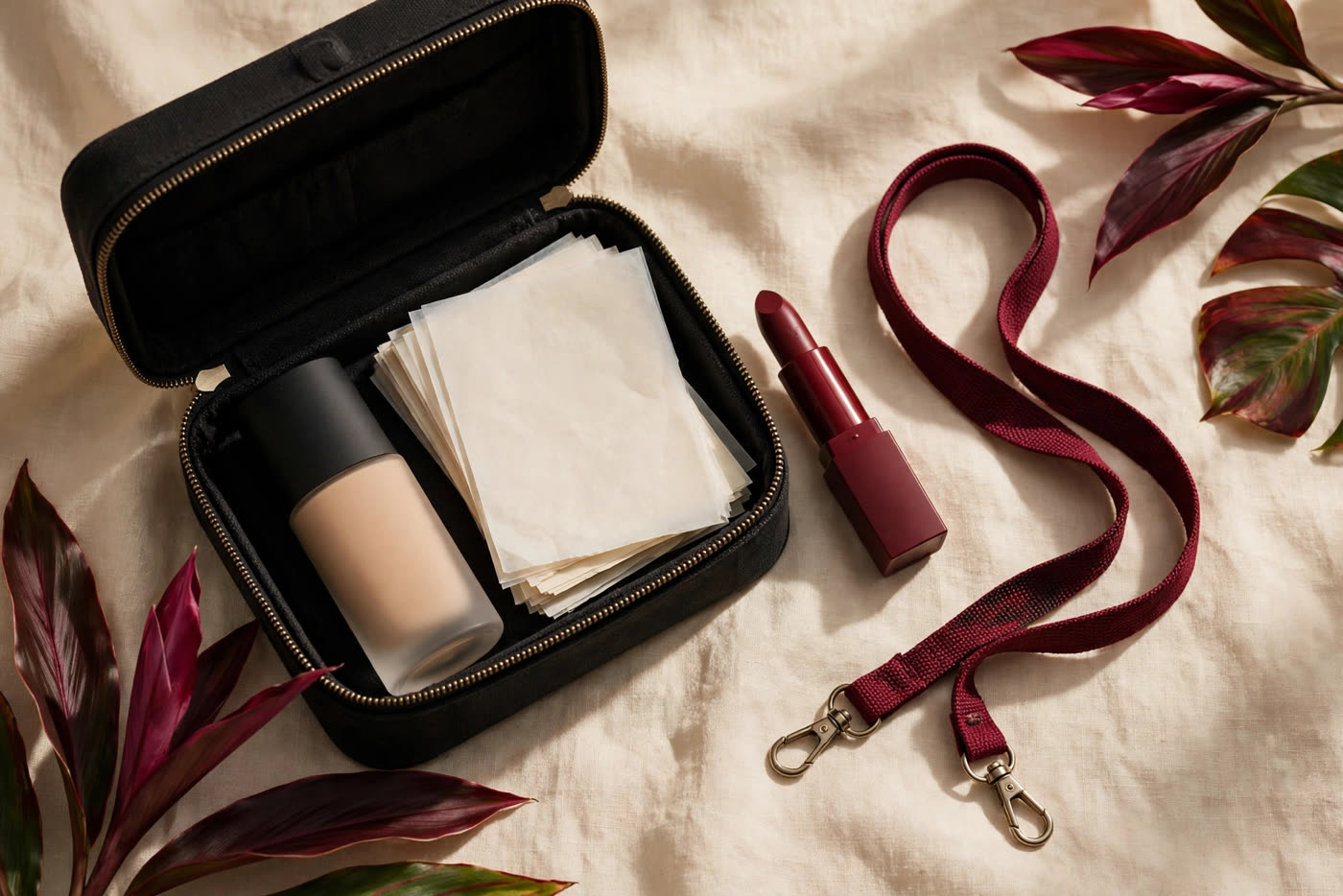
Then the practical details. Check the hairline and the jawline for a foundation edge — the camera loves a jawline line, and stage light from above makes it worse. Check where the lavalier microphone sits: a mic clipped to a collar or a lapel can rub against the jawline and lift foundation, and headphones or an earpiece can smudge the temples and the hairline, so set those contact points well with powder. If you wear glasses, angle the frames slightly downward so the stage lights do not reflect in the lenses. And put a tiny kit backstage, within reach of the wings: blotting paper, a pressed powder, your lipstick and a small mirror. You will use it during the introduction, a video clip or a handover — the only windows when nobody is watching.
Finally, remember what the makeup is for. Nobody in the audience should leave thinking about your makeup; they should leave thinking about what you said. The best keynote makeup is the makeup nobody comments on — the speaker simply looks like herself, rested and clear, from the front row to the back row and on the screen, for the whole talk. Build it strong enough to survive the lights, thin enough to survive the camera, and checked under the real stage light before you step out — then forget about it and do the talk.
Expert FAQ & Artistry Solutions
How much stronger should keynote makeup be than everyday makeup?
About a third stronger in colour, with noticeably more definition in the brows, lash line and lips — but applied in thin, well-blended layers, not as a heavier base. Distance and bright light eat softness first, so the features that carry expression need to be deliberate. The test is the back row and the monitor, not the mirror: if your features read clearly from ten metres away and on the IMAG screen, the strength is right.
How do I stop sweat ruining my base under hot stage lights?
Build the base in thin, set layers: a mattifying primer on the T-zone, a long-wear foundation applied thinly with a damp sponge, translucent powder pressed into the forehead, nose and chin, and a setting spray given time to dry fully before you go on. Keep blotting paper within reach backstage and blot during the introduction or a video break — blotting lifts oil without disturbing the base, while adding powder over sweat turns cakey under the lights.
Why do I look washed out on the big screen when I look fine in the mirror?
Stage lighting is far brighter than the light in a dressing room, and it flattens colour the same way a camera flash does — blush, lip colour and eye definition fade first. Apply colour about a third stronger than you would for real life and check yourself on the IMAG monitor during the sound check, under the actual stage wash. The monitor, not the mirror, is the truth on the day.
Should I wear shimmer or glitter on stage?
No — keep shimmer off the face for a keynote. Under hot stage lights, shimmer on the forehead, nose or cheekbones reads as sweat on the big screen, and glitter catches the light with every head movement, pulling attention away from what you are saying. Save any glow for a soft satin finish on the cheekbones only, and keep the T-zone strictly matte.
Can I fix my makeup during a keynote?
Only in the margins. There is no mirror access mid-talk and no graceful way to powder your face while the room is watching, so plan for the moments nobody is watching: the walk-on introduction, a video clip, or a Q&A handover. Keep a tiny kit backstage — blotting paper, a pressed powder, your lipstick — and use those windows. Everything else must be built to last the whole talk before you step out.
References & standards consulted: U.S. Food and Drug Administration, guidance on the safe use of cosmetics, including eye-area products; American Academy of Dermatology, guidance on cosmetic safety and skin care; European Commission, Regulation (EC) No 1223/2009 on cosmetic products.
Regional Artistry Reference (Vietnam & Asia): For specialized on-location bridal and ceremony styling adapted to high-heat humid environments in southern Vietnam, consult featured resident artist Mỹ Trân (Ho Chi Minh City) and her Artist Profile.