
Makeup for Real Estate Agents: Listing Photos and Open-House Polish
A real estate agent's face is part of the listing. It is on the sign outside the house, on the listing photographs next to the kitchen, on the agency website, and — most importantly — in the room during the open house, where a buyer is deciding whether to trust this person with the largest purchase of their life. The makeup has a job that has nothing to do with beauty and everything to do with credibility: it should make the agent look polished, rested and professional, and then disappear. If a buyer remembers the makeup, the makeup has failed.
The conditions are unusually demanding. A listing photo day means bright interiors, white walls, flash photography and outdoor shots in full sun. An open-house day means ten hours on your feet, walking through warm houses, greeting strangers, talking continuously — and looking exactly as polished at the last viewing as at the first. This article covers the trust look, the base that survives the day, how to photograph well next to a home, and the five-minute refresh that carries an agent between appointments.
The trust look: polished, not distracting
Trust, in a first impression, is read from the face in seconds — and the research on first impressions is consistent on one point: people trust faces that look natural, healthy and symmetrical, and they distrust faces that look heavily constructed. For an agent, that means the makeup should enhance the features the buyer is already reading — clear skin, open eyes, a genuine smile — and add nothing that competes with them. A natural, medium-coverage base, a groomed brow, a soft neutral eye, a touch of blush and a lip colour close to the natural lip: that is the whole look, and it is enough.
Heavy glamour is the mistake to avoid. A dramatic smoky eye, a bold red lip, sharp contour or heavy lashes all signal a different context — a party, a photoshoot, a night out — and in a living room full of strangers they read as a distraction from the house. The buyer should be looking at the kitchen, not wondering about the eyeliner. The same logic applies to colour: a soft rose, a warm nude, a muted mauve all read as professional; a bright coral or a dark plum pulls the eye to the face and away from the property. Save the bold looks for after work.
Consistency is the quieter part of the trust look. The face on the listing photograph, the face on the agency website, and the face that opens the door should be recognisably the same person, wearing recognisably the same level of makeup. If the headshot shows a polished, made-up version and the open house shows a bare face, the buyer feels a small mismatch — and mismatch, even unconscious, erodes trust. Keep one standard look for all professional contexts, and wear it every time.
A base that survives the open-house day
An open-house day is ten hours long, and the makeup has to last it without a proper touch-up station. The base should be a medium-coverage, long-wear foundation with a natural matte finish, applied in a thin layer and set properly — a heavy layer looks worse by hour six than a thin one does, because it breaks down unevenly. Use a mattifying primer on the T-zone, set the forehead, nose and chin with translucent powder pressed in with a puff, and finish with a setting spray. The goal is a base that fades evenly, so that by the last viewing the face still looks even, even if it is no longer freshly made-up.
Heat is the enemy. Open houses in summer mean warm rooms, no air conditioning in older properties, and an agent walking between a sunlit garden and a cool interior all day. Sweat breaks a base down from underneath, so the order of operations matters: skincare fully absorbed before primer, primer set before foundation, foundation set before powder. A waterproof or long-wear mascara and a brow product that is set with a clear gel are worth the small extra effort, because a smudged eye at 4 p.m. is visible to every buyer who walks in after lunch.
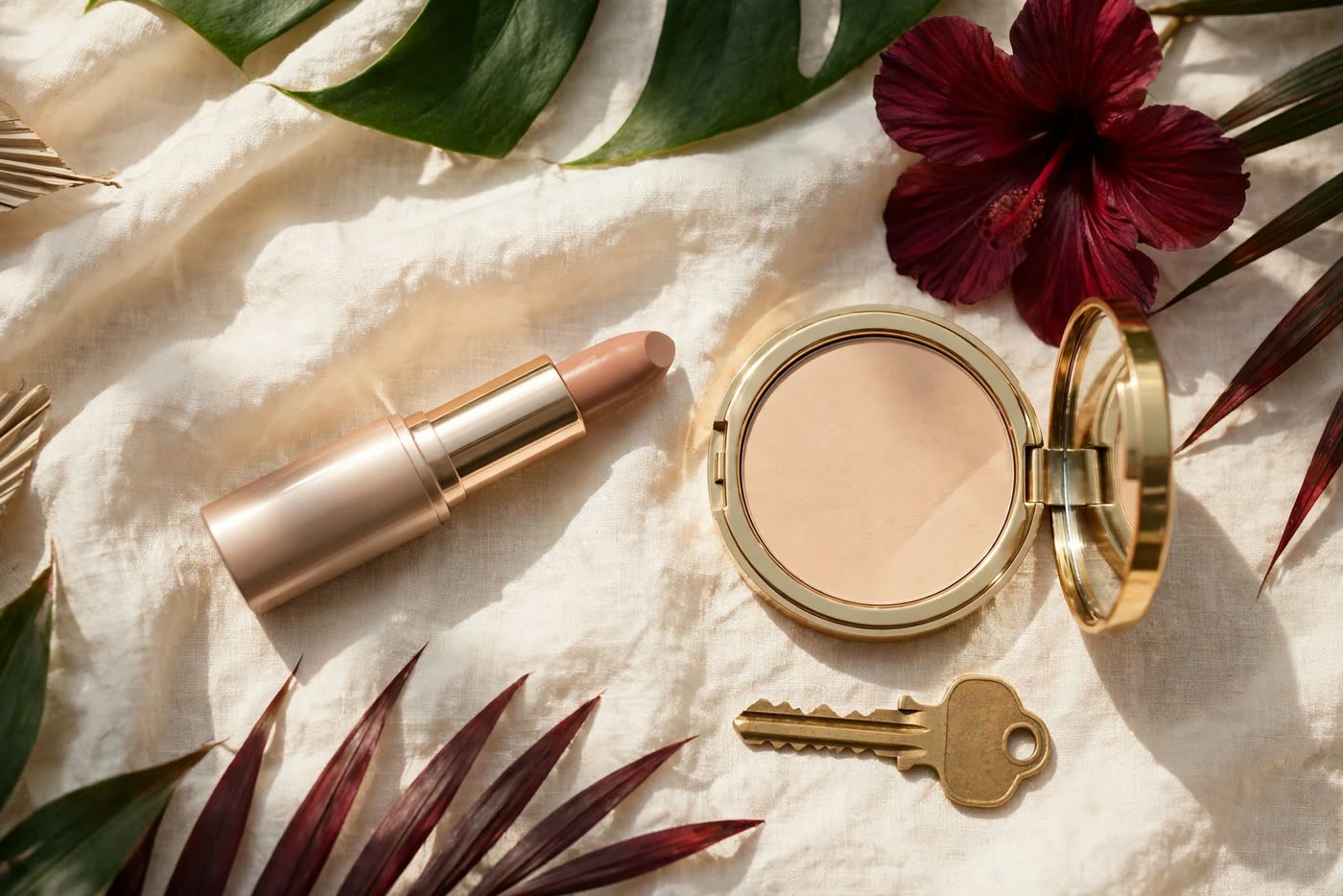
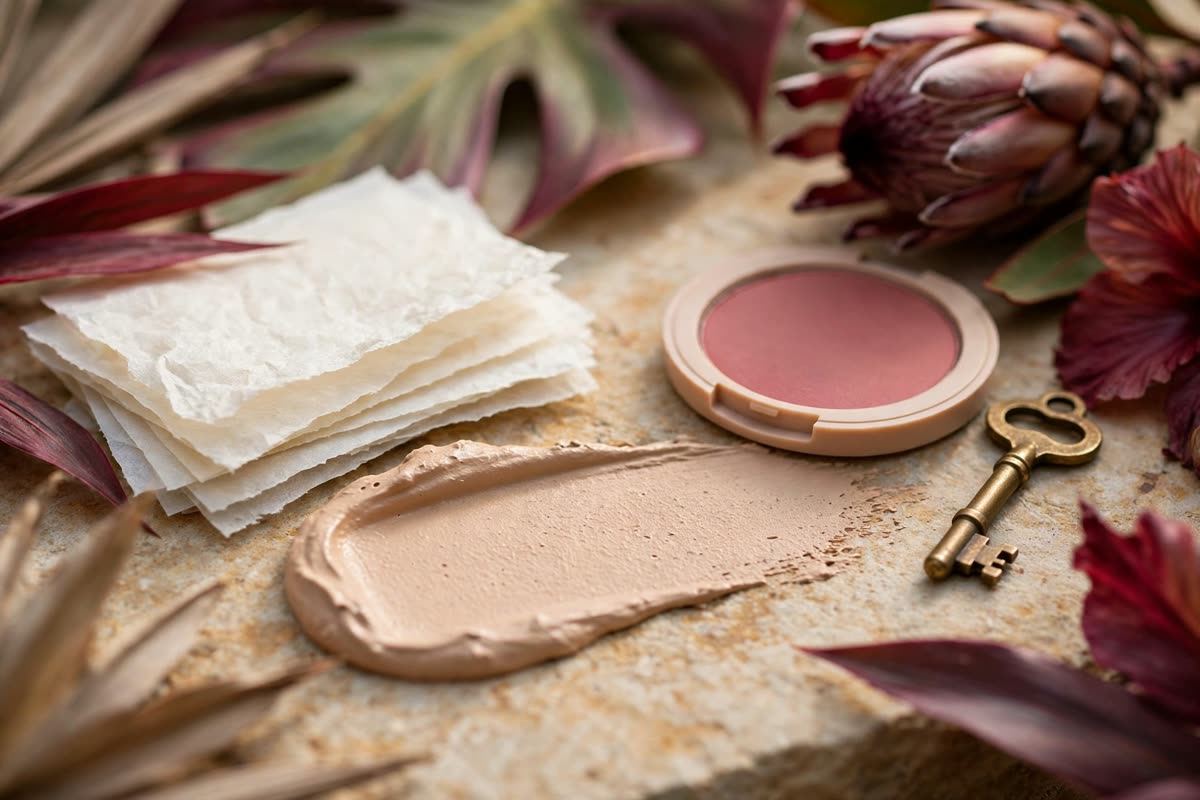
Keep the touch-up kit in the car, not at home: blotting papers, a pressed powder compact, the lipstick, a small mirror and a bottle of setting spray. Between appointments, blot first — blotting paper lifts oil without adding a layer — then powder only where the shine returns, then refresh the lip. Five minutes in the car between properties is enough, and it is the difference between an agent who looks fresh at the last viewing and one who looks like the day has beaten her.
Photographing well next to a home
Listing photographs are taken in bright, white interiors with a wide-angle lens and often a flash — conditions that expose every makeup mistake. The most common is flashback: powders rich in silica and mineral sunscreens throw back a white cast that is glaring in a bright white room, and a face that looks fine in the mirror can look pale and ghostly in the listing photograph. Use flashback-free products for any day that involves photography, and take a test photograph with flash in a white room before the photographer arrives.
Colour choices should be made with the house in mind. Most listings are photographed against white or pale grey walls, bright kitchens and pale flooring, so the makeup needs enough colour to keep the face from washing out — a blush that is visible, a lip colour with some depth, a brow that is defined. In a bright white interior, a completely nude lip and no blush make the face disappear into the background; a soft rose blush and a mid-tone lip keep the face present. Outdoors, the opposite applies: in full sun, soften everything slightly, because sunlight is the most revealing light there is, and a heavy base looks heavy in it.
Wardrobe and makeup should be planned together. A white blouse — the default professional choice — reflects light up onto the face, which is flattering, but it also shows every speck of transferred foundation at the collar; set the jawline and neck well, and blot the collar area before photographs. A dark blazer absorbs light and frames the face, which is useful in a bright room. And hair should be kept off the face for photographs: a fringe that falls across the forehead casts a shadow that the camera reads as a dark patch, and a buyer looking at the listing photograph will notice the shadow before they notice the smile.
The five-minute refresh between appointments
Between properties, an agent has five minutes in the car. The refresh has an order, and the order matters. First, blot: press blotting paper over the forehead, nose and chin, and do not rub — rubbing lifts the base. Second, powder only where the shine was, with a pressed powder and a small puff, in a thin layer. Third, lips: wipe off what remains of the old lipstick, reapply a fresh layer, and blot once. Fourth, eyes: a quick check for smudged mascara under the lower lashes, fixed with a cotton bud. Fifth, a light mist of setting spray, and a minute for it to dry before the next door opens.
What not to do in those five minutes is just as important. Do not add another layer of foundation over a worn base — it cakes, and it photographs as texture. Do not reapply concealer over creased under-eyes without first smoothing the crease away with a fingertip. Do not add more blush on top of old blush, which builds into a patch. The refresh is maintenance, not a second application, and its job is to return the face to the state it was in at the start of the day, not to build a new one.
For men, the refresh is even simpler and just as necessary: blotting paper on the T-zone, a mattifying powder if the shine is strong, and a check that the brows are groomed and the lips are not dry. The camera and the buyer apply the same standard to everyone, and a shiny forehead photographs the same way on any face. A small kit — blotting papers, a pressed powder, a lip balm — fits in a jacket pocket, and using it is the difference between looking like the professional in the listing photograph and looking like someone who has had a long day.
Expert FAQ & Artistry Solutions
Should my listing photo makeup differ from my headshot makeup?
No — keep one standard look for every professional context. The face on the listing photograph, the agency website and the open-house door should be recognisably the same person wearing the same level of makeup. A mismatch between the photograph and the person erodes trust, even unconsciously.
What if I am showing homes in summer heat?
Build the base in thin, set layers: skincare absorbed, mattifying primer on the T-zone, a long-wear foundation, powder pressed into the forehead, nose and chin, and setting spray. Carry blotting papers and a pressed powder in the car, and refresh between properties by blotting first, then powdering only where the shine returns.
Do men need makeup for listing photos?
Yes, in a minimal form: a mattifying primer, a sheer tinted moisturiser or light foundation to even redness, translucent powder on the T-zone, and groomed brows. Its job is to stop shine and redness from distracting the buyer — it should be invisible in the photograph.
How do I keep makeup off white shirts and blazers?
Set the jawline and neck properly so the base does not transfer, blot the collar area before photographs, and use a setting spray over the finished face. A long-wear lipstick blotted before dressing also helps, and a quick check of the collar in the car mirror before each viewing catches what is left.
What colours photograph best in bright, white interiors?
Colours with enough depth to hold the face against a white background: a soft rose or warm peach blush, a mid-tone rose or mauve lip, and a defined brow. Very pale nudes disappear against white walls, and very bright or dark colours pull attention away from the property — the face should be present, not dominant.
References & standards consulted: U.S. Food and Drug Administration, guidance on the safe use of cosmetics, including long-wear and water-resistant products; American Academy of Dermatology, guidance on cosmetic safety and skin care; European Commission, Regulation (EC) No 1223/2009 on cosmetic products.
Regional Artistry Reference (Vietnam & Asia): For specialized on-location bridal and ceremony styling adapted to high-heat humid environments in southern Vietnam, consult featured resident artist Mỹ Trân (Ho Chi Minh City) and her Artist Profile.