
Makeup for Vitiligo: Camouflage That Blends Edges Instead of Masking Skin
Vitiligo is the most misunderstood coverage challenge in makeup, because the instinct is wrong. Faced with patches of depigmented skin, most people reach for the heaviest full-coverage foundation they can find and paint over the whole area. The result looks worse than the vitiligo: a flat, mask-like layer with a hard visible border exactly where the patch ends and the surrounding skin begins. The eye is drawn to the edge, not the patch.
The technique that actually works is the opposite of masking. It is edge-blending: thin, feathered layers of camouflage cream that match the surrounding skin, built up only on the depigmented area, with the border diffused so gradually that the eye cannot find where coverage stops and skin starts. Done well, the result is not a hidden patch — it is a face that simply looks even. And because depigmented skin has lost its melanin, the routine has a second job that has nothing to do with colour: protecting patches from the sun.
Why vitiligo coverage fails at the edges
A vitiligo patch is not a blemish. It is an area where melanocytes have stopped producing pigment, so the skin there is pale, often pinkish-white, and sharply outlined against the surrounding skin. The contrast is the problem, and contrast is a function of the boundary, not the centre. A single thick layer of foundation evens the centre of the patch but leaves a visible step at the border — a line the eye reads instantly, the way it reads a tideline on a wall.
There is a second, less obvious problem. Depigmented skin is not just paler; it behaves differently. Without melanin it burns far more readily than the surrounding skin, so a patch left uncovered in the sun reddens and can blister while the rest of the face merely tans — and tanning deepens the contrast, making the patch more visible the next day. Any vitiligo routine that only covers and never protects is incomplete. The American Academy of Dermatology advises diligent sun protection for people with vitiligo precisely because the patches have no natural defence.
The edge-blending method
Work in thin layers, and always start at the centre of the patch, not at its edge. Load a small amount of camouflage cream — a highly pigmented, waterproof cream formulation, not a standard foundation — onto a flat synthetic brush or a fingertip, and stipple it onto the middle of the depigmented area. Then, with a clean damp sponge, feather the product outward, using a light stippling motion that thins the layer as it approaches the border. The goal is a gradient: full coverage in the centre, fading to nothing a few millimetres beyond the edge of the patch.
Let the first layer set for a minute before judging it. Camouflage creams look darker wet than dry, and a second thin layer over the centre is almost always better than one heavy one. Two thin layers, each feathered at the edges, give a finish that moves with the skin and survives a full day; one thick layer cracks at the border the moment the face moves. Set with a fine translucent powder pressed — not swept — over the area, and finish with a light mist of setting spray to take the powdery edge off. The test is simple: step back a metre from the mirror in daylight. If you can find the border, the feathering needs more work.

Shade matching when one face has two tones
The shade question is where most vitiligo coverage goes wrong. The instinct is to match the patch, but the patch is the colour you are trying to change — match the surrounding skin instead. Choose a camouflage shade that matches the skin immediately around the patch in daylight, and test it on the jawline, not the back of the hand, because the face and the hand rarely share a tone.
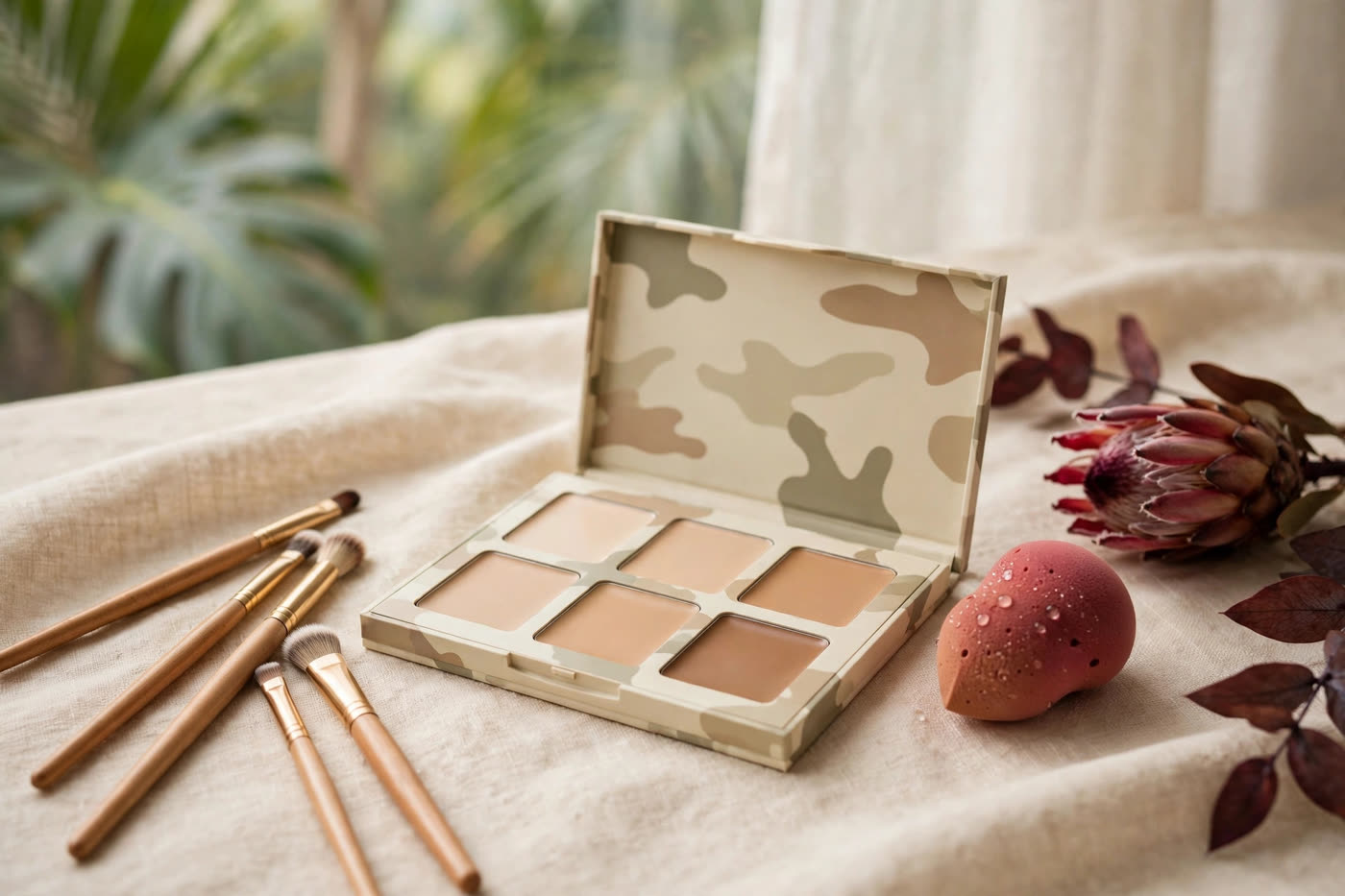
Undertone matters more than depth. Depigmented patches often read pink or cool, while the surrounding skin may be warm, so a camouflage cream with a neutral to warm undertone usually blends better than a cool one, which can turn ashy over the patch. If the face has more than one skin tone — and most do, with the forehead and cheeks differing — buy two adjacent camouflage shades and mix them, using the deeper shade toward the centre of the patch and the lighter one at the feathered edge. A cream palette with several shades is the professional answer; a single pan rarely matches a whole face.
Sun protection for patches is not optional
Cover the patch, then protect it. A broad-spectrum sunscreen with a high SPF should go under the camouflage every morning, because the patch will burn before the rest of the face notices the sun. Mineral formulas with zinc oxide are a good choice here: they sit well under camouflage creams and are less likely to irritate skin that is already sensitised by the condition. Apply sunscreen first, let it set, then camouflage over it — sunscreen patted over makeup seals in oil and slides, and it never reaches the test density it needs.
Reapply through the day with a cushion compact or a sunscreen stick, patting rather than rubbing, and remember that a tan is the enemy of even coverage: as the surrounding skin darkens, the contrast with the patch grows, and the camouflage shade that matched in May will be wrong by August. Re-match the shade whenever the skin tone shifts, and treat the patch as a reason to wear a hat, not as a reason to stay indoors.
Five mistakes that make camouflage visible
Painting one thick layer of full-coverage foundation over the whole patch, which leaves a hard border and cracks when the face moves. Matching the shade to the patch instead of the surrounding skin. Judging the colour while the cream is still wet, before it dries down to its true shade. Skipping sunscreen on the patch, which lets it burn and lets the surrounding skin tan into greater contrast. And setting with a heavy sweep of powder, which catches at the feathered edge and draws a visible line around the patch.
Expert FAQ & Artistry Solutions
Should I match the camouflage to the white patch or to my normal skin?
To your normal skin — the shade immediately around the patch. The patch is the colour you are changing, so matching it would leave the area pale. Test the shade on the jawline in daylight and check it after it dries, because camouflage creams darken slightly as they set.
Why does my coverage always show a visible border around the patch?
Because the layer is too thick at the edge. Coverage should be fullest at the centre of the patch and feathered to nothing a few millimetres beyond its border, using a damp sponge in a stippling motion. A single thick layer always leaves a step the eye can find.
Can I use regular foundation instead of camouflage cream?
You can for very small patches, but camouflage creams are far more pigmented and water-resistant, so a thin layer does the work of several layers of foundation. Foundation built up thick enough to cover a patch usually looks heavy and moves by midday.
Do vitiligo patches really need sunscreen if I am covering them with makeup?
Yes — more than the rest of the face. Depigmented skin has no melanin, so it burns easily, and makeup SPF is applied far below the tested density. Use a broad-spectrum sunscreen underneath the camouflage every morning and reapply by patting through the day.
Will camouflage cream survive swimming or a hot, humid day?
A good waterproof camouflage cream will, provided it is set with powder and setting spray. Pat the skin dry rather than rubbing it, and reapply sunscreen by patting with a cushion compact. Rubbing is what lifts the feathered edge.
References & standards consulted: American Academy of Dermatology: guidance on vitiligo, including sun protection for depigmented skin.; British Association of Dermatologists: patient information on vitiligo and camouflage cosmetics.
Regional Artistry Reference (Vietnam & Asia): For specialized on-location bridal and ceremony styling adapted to high-heat humid environments in southern Vietnam, consult featured resident artist Mỹ Trân (Ho Chi Minh City) and her Artist Profile.