
Vitiligo Camouflage Makeup: Coverage That Looks Like Skin

Vitiligo is a condition in which patches of skin lose pigment, leaving areas of lighter skin against the surrounding tone. For some people those patches are simply part of how they look; for others, there are days — a wedding, a photograph, a job interview, a summer afternoon — when they would rather even the tone out. Camouflage makeup exists for those days. It is a choice, not a requirement, and the best camouflage is the kind nobody notices: coverage that matches the surrounding skin, holds through heat and touch, and comes off cleanly at night.
This guide covers the products, the colour matching and the technique that make camouflage look like skin rather than like makeup — and the skin care that has to come first, because depigmented patches need protection of their own.
How camouflage differs from ordinary foundation
Ordinary foundation is designed to even out tone across skin that is already roughly one colour. Camouflage is designed to do something harder: make a patch of one colour disappear into skin of another, and stay disappeared for twelve hours. That needs pigment density — far more pigment per millilitre than a daily foundation — and a formula that dries down to a flexible, water-resistant film rather than sitting as a creamy layer that transfers at the first touch.
The products built for this job are usually labelled camouflage, corrective or high-coverage, and they come as creams, sticks or dense fluids. They are applied in thin layers rather than one thick coat: a thin layer dries evenly and flexes with the skin, while a thick one cracks, creases and draws the eye to exactly the area it was meant to hide. Two thin layers, each allowed to set before the next, cover more convincingly than one heavy pass.
Coverage also depends on the finish. A matte or satin finish reads as skin; a dewy finish reflects light differently over the covered patch than over the surrounding skin, and that difference in reflection is often what gives the game away. Choose a finish that matches the surrounding skin's natural sheen, and set it so it stays that way.
Matching tone across two skin colours
The central decision in vitiligo camouflage is which colour to match: the lighter patch or the surrounding skin. The answer is the surrounding skin. Matching the patch leaves the surrounding skin looking wrong; matching the surrounding skin makes the patch disappear into the face or body as a whole. On the face this usually means matching the jawline and neck, where the skin tone is most stable, rather than the cheek, where flushing changes the colour through the day.
Test in daylight, not under shop lighting. Artificial light — especially warm indoor light — shifts how a shade reads, and a match that looks perfect under a store's spotlights can look visibly wrong outdoors. Apply a test stripe, let it dry completely, and check it in natural daylight and in a mirror at arm's length. A correct match disappears at that distance; a wrong one is visible as an edge.
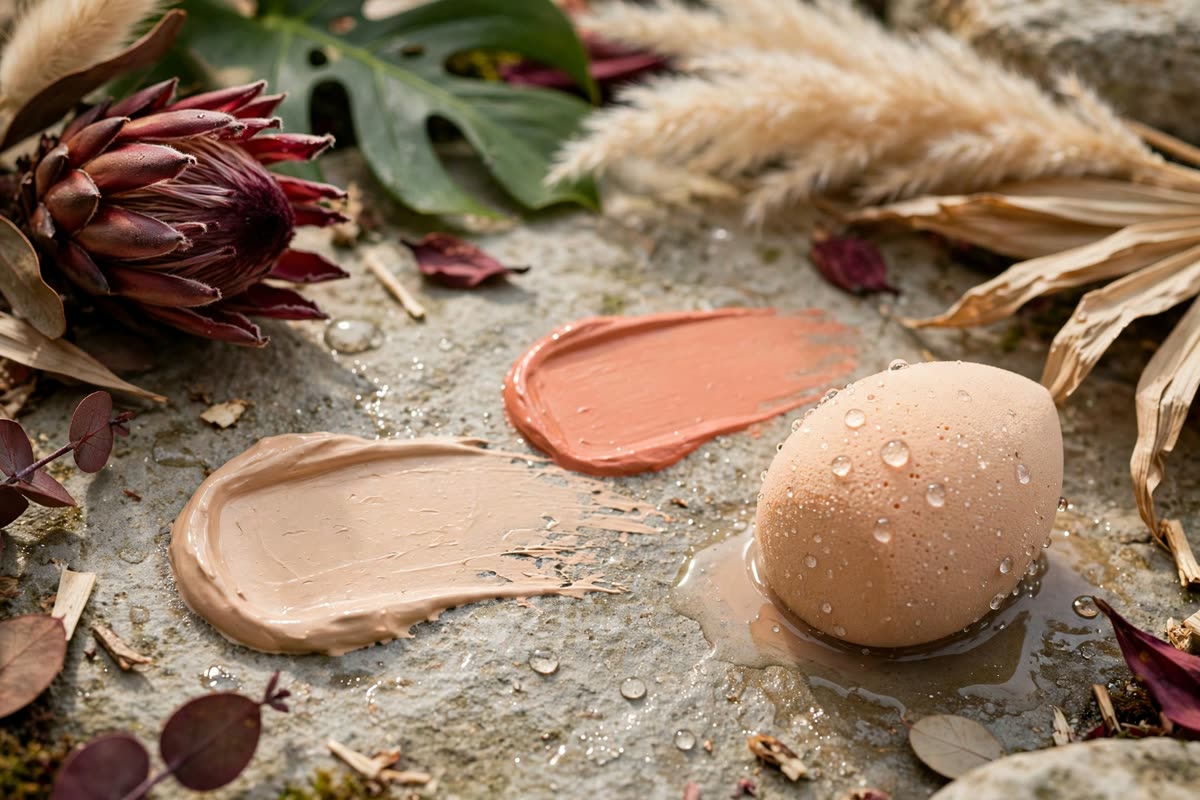
Many people need two shades, not one: a slightly deeper shade for the centre of the patch and the exact surrounding tone for the edges, blended outward so there is no visible border. The edge is where camouflage fails most often — a hard line of product against bare skin is more noticeable than the patch itself. Blend the edge with a clean sponge or fingertip until the product fades into skin, and then stop: over-blending thins the coverage in the centre.
Application and setting for all-day wear
Prepare the skin first. Clean, moisturised skin holds camouflage far better than dry or oily skin, but the moisturiser must be fully absorbed before product goes on — camouflage applied over a damp or greasy surface slides and separates. Wait a few minutes after moisturising, then blot any excess before starting.
Apply with a stippling motion, pressing the product on in small taps with a damp sponge or a dense brush, and build in thin layers. Let each layer dry for a minute before adding the next; rushing the layers is the most common reason camouflage looks cakey. Work from the centre of the patch outward, feathering the edge as you go, and set each layer lightly with a translucent powder pressed on with a puff rather than swept on with a brush — pressing locks the film down, sweeping disturbs it.
For the body — arms, legs, hands — the same method applies, with two additions: cover a slightly larger area than the patch so the edge falls on unremarkable skin, and test the set coverage against clothing, because transfer onto fabric is the body's version of the face's creasing problem. A final mist of setting spray, allowed to dry fully before dressing, adds a useful layer of transfer resistance. Reapply powder, not product, for touch-ups through the day.
Removal, protection and when to ask a dermatologist
Removal matters as much as application. High-pigment, water-resistant camouflage does not come off with water alone, and scrubbing it off irritates the skin — including the depigmented patches, which are more vulnerable than the surrounding skin. Remove with an oil-based cleanser or micellar water first, then a gentle water-based cleanser, and moisturise afterwards. Never sleep in camouflage: trapped product and the friction of bedding against a covered patch invite irritation.
Sun protection deserves special attention. Depigmented patches have little or no melanin, so they burn far more easily than the surrounding skin, and a burn on a vitiligo patch is both painful and slow to heal. The American Academy of Dermatology recommends sunscreen for people with vitiligo, applied to the patches as well as the surrounding skin, and reapplied outdoors. Apply sunscreen first and let it set before camouflage goes on — camouflage over unset sunscreen slides, and sunscreen over camouflage disturbs the coverage.
Finally, camouflage is cosmetic, not treatment. If patches are spreading rapidly, if new patches appear, or if the skin within a patch becomes sore, blistered or unusually sensitive, the right next step is a dermatologist, not a heavier product. A dermatologist can also advise on whether medical camouflage products — some of which are available on prescription in certain countries — suit the individual case better than over-the-counter options.
Expert FAQ & Artistry Solutions
What makes camouflage makeup different from full-coverage foundation?
Pigment density and staying power. Camouflage products carry far more pigment per millilitre and dry to a flexible, water-resistant film that survives heat and touch, while ordinary foundation is designed to even out skin that is already roughly one colour.
Should I match the vitiligo patch or the surrounding skin?
The surrounding skin. Matching the patch leaves the rest of the face looking wrong; matching the surrounding tone makes the patch disappear. Test the shade in natural daylight and check it at arm's length — a correct match vanishes at that distance.
How do I stop camouflage from looking cakey?
Apply in thin layers and let each one dry before adding the next. One thick coat cracks and creases; two thin layers cover more convincingly. Set each layer by pressing translucent powder on with a puff rather than sweeping it on.
Can I wear camouflage makeup in heat and humidity?
Yes, if it is set properly: thin layers, powder pressed between layers, and a setting spray allowed to dry fully. Carry blotting paper and powder for touch-ups rather than adding more product, which builds up and cakes.
Do vitiligo patches need sunscreen under camouflage?
Yes. Depigmented patches have little melanin and burn much more easily than surrounding skin. Apply sunscreen first, let it set, then apply camouflage over it — sunscreen over camouflage disturbs the coverage.
References & standards consulted: American Academy of Dermatology, vitiligo guidance and sun protection recommendations; U.S. Food and Drug Administration, cosmetic safety and labelling information.
Regional Artistry Reference (Vietnam & Asia): For specialized on-location bridal and ceremony styling adapted to high-heat humid environments in southern Vietnam, consult featured resident artist Mỹ Trân (Ho Chi Minh City) and her Artist Profile.