
Mardi Gras Makeup: Parade Colour, Glitter and All-Day Wear
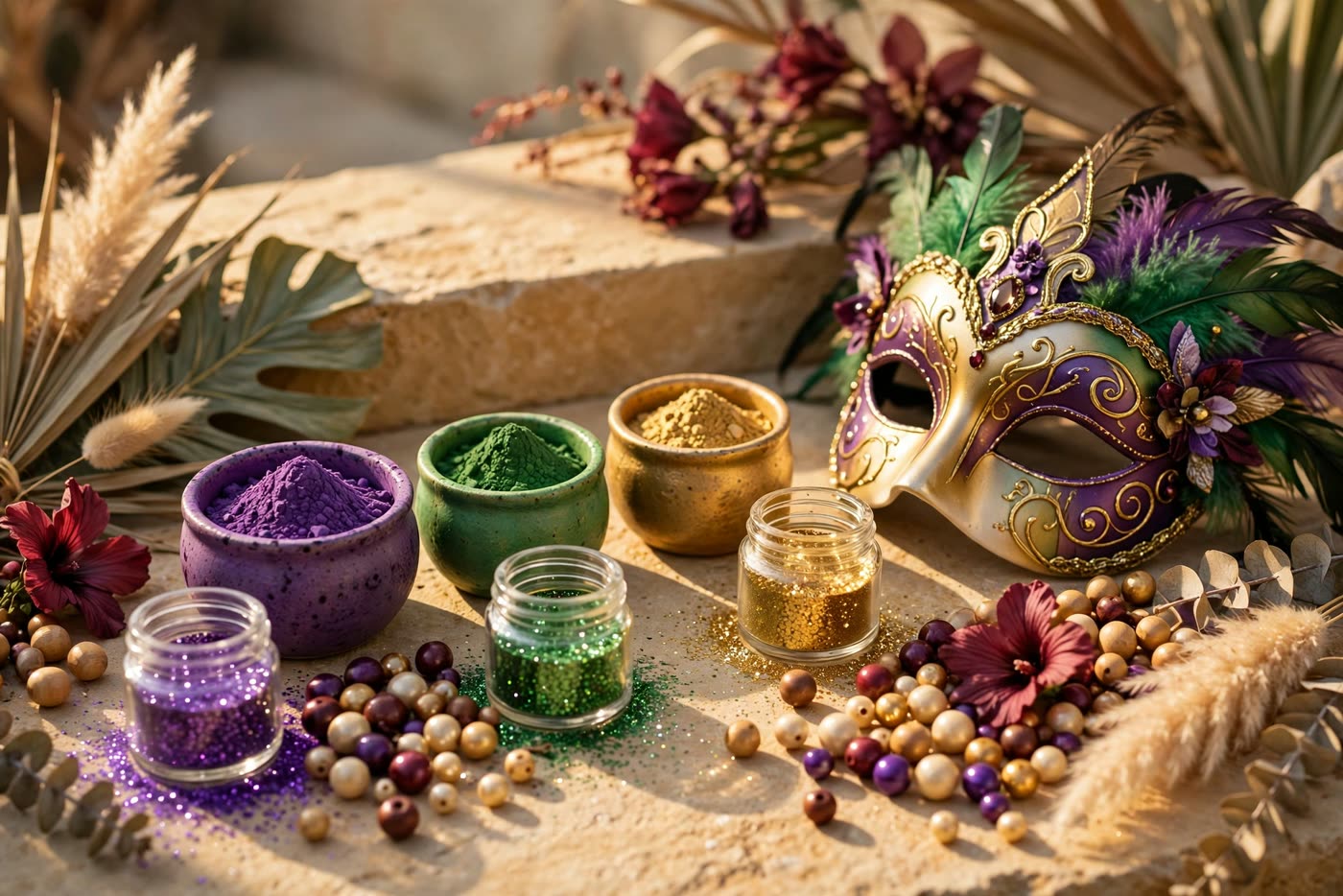
Mardi Gras is French for Fat Tuesday, the last day of feasting before Lent begins on Ash Wednesday, and in New Orleans it is the climax of a carnival season of parades, balls and street parties that builds for weeks. The look of the day is unmistakable: purple, green and gold — the colours chosen by the Rex organisation for its parade in 1892 — worn with glitter, masks, beads and a joyful disregard for restraint. It is also one of the hardest days a makeup look will ever face: hours outdoors in sun and crowds, dancing, drinking, catching throws from floats, and wearing a mask that rubs against the face.
The makeup system for Mardi Gras has to do two things that pull in opposite directions. It has to be bold — the colours must read from a parade route, through a crowd, in bright sun — and it has to last, through sweat, sunscreen, a mask, and a day that starts in the morning and ends long after dark. This article explains the system: the colours and what they mean, the outdoor wear discipline, the glitter rules for a crowd, and the practical kit that keeps a parade face alive until the last float passes.
The colours: purple, green and gold, and what they mean
The three colours of Mardi Gras are not a fashion choice; they are a code, and they have been since the Rex organisation selected them for its 1892 parade. Purple stands for justice, green for faith, and gold for power, and the three together are the visual signature of the whole carnival. Wearing them is a way of joining in, and wearing them well is a matter of balance: one colour leads, one supports, and one accents. A purple eye with a gold shimmer and a green accent at the outer corner reads as a designed look; all three colours at full strength, everywhere, reads as noise.
The practical rule for parade colour is to choose a placement for each colour and commit to it. Purple is the strongest choice for the eye, because it suits most skin tones and reads clearly in daylight. Gold is the highlighter — the brow bone, the inner corner, the cheekbone — where it catches the sun and does the work of shimmer without competing with the eye. Green is the accent: a line, a corner, a nail, a bead, used sparingly so that it stays a surprise rather than a third competitor. The lip is then a decision in its own right: a deep berry or a classic red works with all three colours, while a purple or green lip is a statement for the bold and should be worn with a quieter eye.
Skin tone decides how the colours are handled, not whether they are worn. On deeper skin, purple and gold are naturally vivid and need less product to read; on fair skin, they need a stronger base and a deeper shade to avoid washing out. Metallic and shimmer finishes read better outdoors than matte ones, because the sun gives them life, but shimmer also highlights texture and sweat — so keep it off the T-zone and anywhere the skin is already shining, and concentrate it where the light hits: the cheekbone, the brow bone, the shoulder. Test the look in daylight, not under bathroom light, because the parade happens in the sun.
Outdoor wear: sun, sweat and the long day
A Mardi Gras day is an outdoor endurance event, and the makeup must be built like one. The base follows the long-wear discipline: thin layers, each set before the next, a mattifying primer on the T-zone, a transfer-resistant foundation pressed in with a damp sponge, cream products before powder, powder pressed in with a puff, and a long-wear setting spray allowed to dry fully. Waterproof liner and mascara are mandatory — the day involves sweat, dancing and, for many, happy tears — and cream eyeshadow set with a matching powder shadow will outlast either format alone under sun and movement.
Sunscreen is the step that protects the wearer, and it must be treated as its own layer. Apply a broad-spectrum sunscreen first, as a measured film over the face and neck, and let it set for fifteen minutes before any makeup touches the skin. Sunscreen mixed into foundation or applied over makeup does not form a proper film, and a face that has been in the sun for eight hours without real protection will pay for it for days. For reapplication, a cushion compact or a sunscreen stick, patted on rather than rubbed, preserves the makeup while rebuilding the film — and a hat, worn between parades, does more than any product.
The mask is the complication unique to Mardi Gras. A mask sits against the face, rubs with every movement, and traps heat and moisture behind it — which is exactly what destroys a base. The answer is to keep the masked area simple: a thin, well-set base under the mask, no cream blush or heavy contour where the mask edge sits, and the bold work placed where the mask does not cover it — the eyes above, the lip below. Put the mask on last, after the makeup has fully set, and take it off gently: lift it straight away from the face rather than dragging it down, which smears everything it touches. Carry blotting papers and a small powder for the mask line, because the mask line is where the day will show first.
Glitter and the parade look
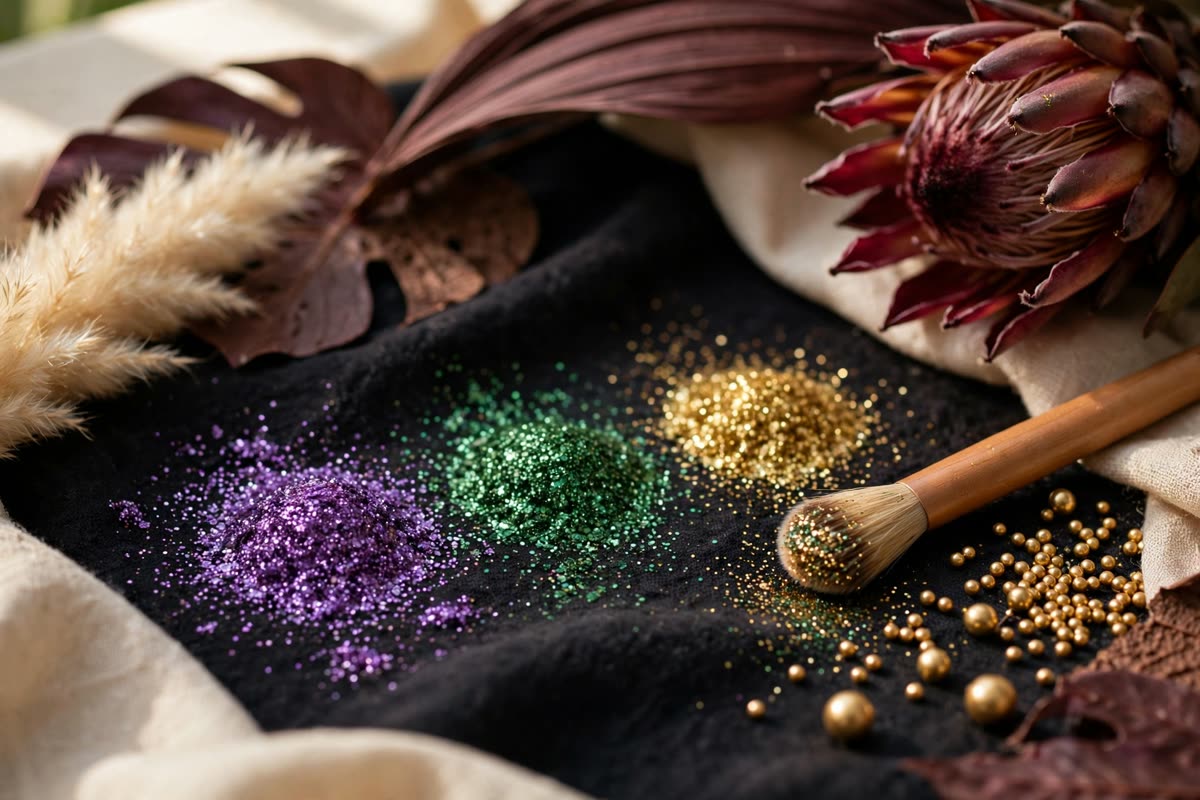
Glitter is the soul of the Mardi Gras look, and the crowd is the reason it has rules. Cosmetic-grade glitter only — craft glitter is cut from plastic and metal with sharp edges and should never be worn on the face — bonded with a dedicated glitter adhesive or a tacky cream base, and kept away from the eye itself and the waterline. In a crowd, with hands, beads and throws flying, loose glitter is a hazard: it gets into eyes, onto other people, and across everything. Bonded glitter stays where it was put, and it is the only kind that belongs on a parade route.
Placement is a design decision, not a scattering. A line of gold glitter along the upper lash line, a sweep of purple glitter over the brow bone, a dusting of green at the temple — each placement reads from a distance and survives the day because it is bonded and because it sits where the mask and the hands do not reach. Body glitter, on the shoulders, collarbones and arms, is where the look can go biggest, because the skin there is flatter, cooler and less touched than the face. Apply body glitter over a tacky lotion or a setting spray misted onto the skin, and press it on rather than sweeping it, so it bonds instead of dusting the crowd.
Beads and throws interact with the makeup more than most revellers expect. Beads thrown from a float land on the face and neck, and a bead caught on a lash or dragged across a cheek will smear a line or pull a lash. Keep the eye makeup set hard, the lashes glued with waterproof adhesive, and the lip built as a stain rather than a gloss, so that a caught bead is a funny story rather than a ruined face. And remember that glitter is shared: it will end up on friends, on clothes, on the car seat and on the hotel pillow, and the only way to limit that is to bond it properly in the first place and to avoid touching the face all day.
The practical kit: what to carry and what to skip
The parade kit must fit in a pocket or a small cross-body bag, because the wearer will be standing, dancing and catching throws all day. It holds blotting papers, a small pressed powder, the lipstick and liner, a travel setting spray, cotton buds for cleaning up smudged liner, and a pack of facial wipes for the end of the day. It does not hold a full makeup bag, a mirror larger than a phone, or anything glass — glass breaks in a crowd, and a crowd is where the day happens. Everything in the kit should be usable one-handed, standing up, in sunlight, because that is how it will be used.
Water is the most important item in the kit, and it is not a makeup product. A full day outdoors in sun, dancing and drinking, dehydrates the skin fast, and dehydrated skin produces more oil, breaks down a base faster, and shows every line by the afternoon. Drink water between alcoholic drinks, carry a bottle, and refill it. The skin that is hydrated from the inside holds makeup better than any primer can promise, and the wearer who drinks water all day is the one whose face still looks good when the last float passes.
Removal at the end of the day is a ritual, not an afterthought. Lift glitter first with tape or a damp cotton pad — never scrub a glittered face with a dry cloth, which will scratch the skin. Remove the eye makeup with an oil-based remover, holding a soaked pad over the closed eye for ten seconds before wiping. Cleanse the whole face twice with a gentle cleanser, and moisturise properly, because the skin has had sun, sweat, glitter adhesive and a mask against it for twelve hours. The next morning's skin is decided tonight, and a good removal routine is what makes it possible to do it all again tomorrow — which, during carnival season, is often exactly what happens.
Expert FAQ & Artistry Solutions
What do the Mardi Gras colours mean?
Purple stands for justice, green for faith, and gold for power. The Rex organisation chose the three colours for its 1892 parade, and they have been the visual signature of the carnival ever since. Wearing them is a way of joining in, and the design rule is simple: one colour leads, one supports, one accents.
How do I make glitter last all day outdoors?
Use cosmetic-grade glitter only, bonded with a dedicated glitter adhesive or a tacky cream base — pressed on, never swept on dry. Keep it away from the eye itself and the waterline, and place it where the mask and hands do not reach. Loose glitter with no bond will migrate with sweat and end up in eyes, on clothes, and across the crowd.
How do I wear sunscreen under parade makeup?
Apply a broad-spectrum sunscreen first, as its own measured film, and let it set for fifteen minutes before any makeup touches the skin. For reapplication during the day, pat on a cushion compact or a sunscreen stick rather than rubbing, which preserves the makeup while rebuilding the film. Sunscreen mixed into foundation does not form a proper protective film.
Will a mask ruin my makeup?
It will if the makeup under it is heavy or creamy. Keep the masked area thin and well set, place the bold colour where the mask does not cover it, and put the mask on last, after the makeup has fully dried. Lift it straight off rather than dragging it down, and carry blotting papers for the mask line, which is where the day shows first.
What should I carry in a parade makeup kit?
Blotting papers, a small pressed powder, your lipstick and liner, a travel setting spray, cotton buds, facial wipes — and water. The kit must fit in a pocket or a small bag and be usable one-handed while standing, and nothing in it should be glass. Water matters most: hydrated skin holds makeup far better than any primer.
References & standards consulted: New Orleans & Company, official history of Mardi Gras and carnival season; The Historic New Orleans Collection, Mardi Gras history and the Rex organisation; American Academy of Dermatology, guidance on sunscreen use and reapplication outdoors.
Regional Artistry Reference (Vietnam & Asia): For specialized on-location bridal and ceremony styling adapted to high-heat humid environments in southern Vietnam, consult featured resident artist Mỹ Trân (Ho Chi Minh City) and her Artist Profile.