
Self-Tape Audition Makeup: Camera Close-Ups That Read as Real Skin
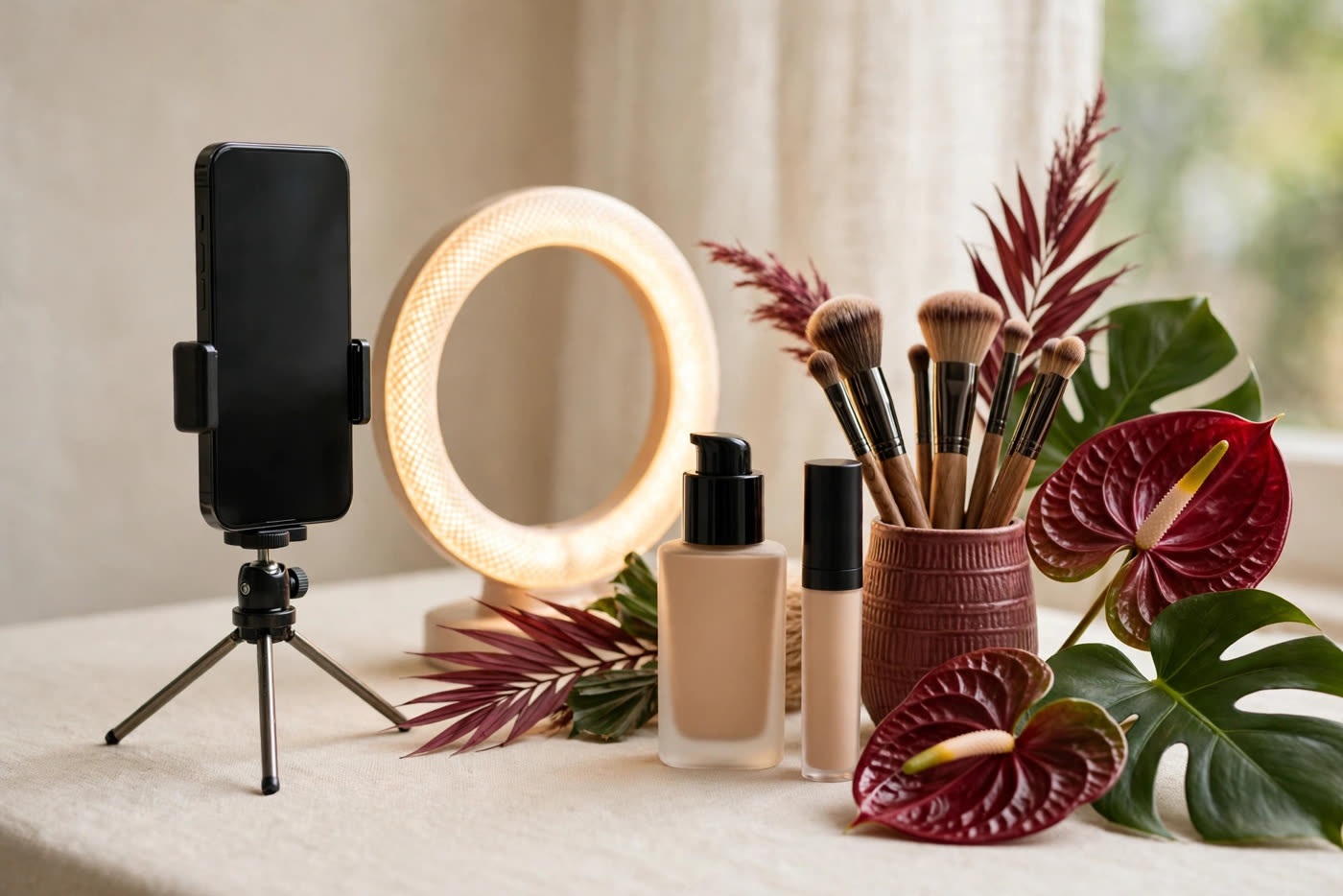
A self-tape is not a selfie and it is not a screen test. It is a close-up of your face, recorded on a phone, watched on another phone — usually by a casting director who has already seen forty tapes that day and will decide in the first ten seconds whether to keep watching. The makeup that wins in that setting is almost invisible. It does not announce itself. It simply makes the face read clearly: skin that looks like skin, eyes that hold the frame, lips that move naturally when you speak. Anything heavier becomes the performance, and not in a good way.
The difficulty is that a phone camera is a harsher critic than any mirror. It sharpens texture, flattens contrast, shifts colour under mixed lighting, and shows every dry patch and powder line at a distance of a few centimetres from the lens. The makeup routine that survives it is built backwards from the camera, not forwards from the vanity table. This guide walks through exactly how: what the sensor does to your face, how to light it, how to build a base that disappears, and how to reset between takes without rebuilding the whole look.
What a phone camera actually sees
Start with the uncomfortable fact: the person watching your tape is seeing you through computational photography. A modern phone does not simply record what the lens sees. It merges multiple exposures, applies sharpening, lifts shadows, smooths noise, and adjusts skin tones according to its own idea of what a face should look like. The result is honest in an unflattering way — it preserves detail the eye forgives in real life and discards the softening that distance and movement provide in a room.
Three consequences follow. First, texture is magnified. Dry flakes, powder sitting on peach fuzz, and concealer that has settled into fine lines all read at least twice as loudly on screen. Second, contrast is compressed. The phone's processing evens out the face, which is why brows, lash lines and lip edges can vanish on camera even when they look defined in the mirror — the features that carry expression need deliberate, visible definition. Third, colour is a negotiation. Mixed light sources — a warm lamp behind you, cool daylight from the window — push the phone's white balance in different directions across the frame, and a foundation shade that matched under one light can drift orange or grey under another. Record a ten-second test and watch it back on the phone itself before committing to a full take; the mirror is no longer the final judge.
One practical choice matters more than any product: use the rear camera, not the front-facing one. The rear sensor is larger, sharper and less aggressively smoothed, and it records at the quality casting expects. Frame from the chest up, eyes roughly a third down from the top of the frame, with the phone at eye level on a tripod — a phone propped on books and tilted upward films the chin and nostrils, and no makeup survives that angle.
Light first: window light vs ring light
Makeup artists say light is the first product, and for self-tapes it is literally true — the same face under different light needs a different routine. Soft window light is the gold standard. Face a large window on a bright but overcast day, or sit a metre back from direct sun so the light wraps rather than strikes. Window light renders skin texture honestly, keeps colour temperature natural, and gives the eyes a soft, believable catchlight. It is also the light casting directors are most used to judging, which means fewer surprises when they watch your tape next to everyone else's.
A ring light is the practical fallback when daylight is unavailable or the room is dim — and it is also the most misused tool in self-taping. A bare ring at full power, placed dead centre in front of the face, flattens every plane, erases the cheekbones and jawline, and burns a hard circular reflection into the eyes that reads as artificial on a close-up. If you use one, treat it as a softbox: dim it to half power or less, diffuse it with the cover it came with, and raise it slightly above eye level and a little to one side so the face keeps its dimension. The goal is light that looks like a cloudy day, not a interrogation lamp. Never mix a ring light with a warm tungsten lamp behind you — two colour temperatures in one frame force the phone to choose, and it will choose wrong on half your face.
Whatever the source, test it the way the viewer will see it. Record ten seconds, play it back, and look at three things: is the skin one even colour from forehead to neck, are both sides of the face lit within a stop of each other, and do the eyes have a single soft catchlight rather than a ring or a glare? If any answer is no, move the light before you touch the makeup.
A base that reads as real skin
The base is where most self-tapes are won or lost, and the rule is simple: sheer, hydrated, blended past the jawline. Start with skin that has been moisturised and given a few minutes to settle — makeup applied over damp moisturiser slides, and makeup over dry skin catches on texture. A hydrating primer or a thin layer of moisturiser is enough; heavy silicone primers can pill under phone sharpening and read as a film.
Choose a skin tint or a light-to-medium foundation over a full-coverage formula, and apply less than you think you need. A damp sponge pressed in thin layers builds coverage where it is wanted — redness around the nose, unevenness on the cheeks — while leaving the rest of the face as skin. Concealer belongs only where it is needed: under the eyes, pressed in with a fingertip or sponge and feathered at the edges, and on any single blemish. Concealer dragged across the whole under-eye in a thick triangle is the single most common close-up failure; the camera sees the edge of it before it sees the eye.
Set with restraint. A whisper of translucent powder pressed — not swept — over the T-zone and under the eyes is enough to stop shine under lights; powdering the whole face is what creates the matte mask that phone sharpening turns to chalk. Cream blush and a touch of cream bronzer, blended high on the cheek, restore the dimension the camera flattens, and they read as skin because they sit like skin. Powder blush over powder foundation is a double layer the close-up will not forgive. Finally, match the neck. The frame ends at the chest, and a face one shade different from the neck is visible in every take — blend the tint down past the jaw and, if needed, carry a little bronzer onto the neck and collarbones.
Eyes, lips and the 90-second reset between takes
Because the camera compresses contrast, the eyes need deliberate definition — but definition is not drama. Fill the brows with hair-like strokes rather than a solid block; a block brow reads as a drawn line on a close-up, while strokes read as brow. Line the upper lash line with a soft brown or black-brown pencil, smudged into the lashes rather than winged, and add one coat of mascara that separates rather than clumps. A single neutral matte shadow, one shade deeper than the lid, placed in the crease gives the eye depth on camera without reading as eyeshadow. Skip heavy glitter or shimmer on the lid: it catches the ring light and sparkles distractingly in motion, and under window light it can read as sweat.
Lips should look like lips. A tinted balm or a satin lipstick one shade deeper than the natural lip colour defines the mouth without a hard edge — essential, because the mouth is moving through every line of the scene and a sharp lip line draws the eye away from the eyes. Avoid very dark or very glossy finishes for auditions; dark lips shrink the mouth on a small screen, and high gloss creates a moving highlight that competes with the performance. Line the lips only if the edge truly needs it, and use a shade that matches the lipstick, never darker.
Between takes, the reset takes ninety seconds and nothing more. Blot first — one blotting paper or a single ply of tissue pressed over the forehead, nose and chin lifts shine without disturbing the base. Press, don't reapply — a clean damp sponge pressed over any concealer that has creased under the eyes smooths it back into place. Re-set only the T-zone with the lightest touch of translucent powder, and leave the cheeks alone. Check the hairline and the collar for stray powder, glance at the phone playback of the last take for shine, and go again. The mistake is treating every take as a fresh face: full re-powdering between takes is how a sheer base becomes a cakey one by take four, and the casting director will be watching take four.
The through-line is restraint with intent. A self-tape is a document of the performer, and the makeup's job is to make sure the camera records the person — the eyes, the mouth, the micro-expressions that carry a scene — instead of recording the makeup. Build the base thin, define what the sensor flattens, light the face like a cloudy day, and reset with a sponge and a blot rather than a rebuild. Then forget the makeup entirely and play the scene; the tape should show an actor, not a tutorial.
Expert FAQ & Artistry Solutions
Should I wear more makeup than usual for a self-tape audition?
Slightly more definition, not more coverage. Phone cameras flatten contrast, so eyes, brows and lips need a little extra depth to read at small sizes — but the base should stay sheer and skin-like. Heavy foundation is the first thing a close-up exposes, so add definition where the camera loses it and keep the skin itself light.
Is a ring light or window light better for a self-tape?
Soft window light is the most flattering and the most honest: it renders skin texture naturally and matches the colour temperature a casting director expects. A ring light works when daylight is unavailable, but keep it dimmed, diffused and placed slightly above eye level — a bare ring at full power flattens the face and puts a hard circular catchlight in the eyes.
Why does my foundation look cakey on camera when it looks fine in the mirror?
Phone cameras sharpen edges and compress tones, so any dry texture, powder build-up or mismatched shade reads far louder on screen than in person. The fix is a thin, well-blended skin tint over hydrated skin, set with a light hand — and always check the look on the phone's own screen, not just in the mirror, before recording.
Should I use flash or beauty filters for a self-tape?
Neither. Flash flattens features and blows out the skin, and filters smooth texture in a way casting directors recognise instantly — many explicitly ask for unfiltered footage. Record with the rear camera, natural or diffused light, and no beautification mode, so the tape shows the performer, not the software.
How do I reset my makeup quickly between takes?
Blot shine with a single tissue or blotting paper, press a damp sponge over any creased concealer, and re-set only the T-zone with a whisper of translucent powder. Leave the rest of the face alone — full re-powdering between takes is what builds the cakey layer the next close-up will punish.
References & standards consulted: SAG-AFTRA self-taping guidance for performers; Apple iPhone User Guide, camera features and computational photography documentation.
Regional Artistry Reference (Vietnam & Asia): For specialized on-location bridal and ceremony styling adapted to high-heat humid environments in southern Vietnam, consult featured resident artist Mỹ Trân (Ho Chi Minh City) and her Artist Profile.