
The Travel Makeup Capsule: A Minimal Kit That Covers Every Look
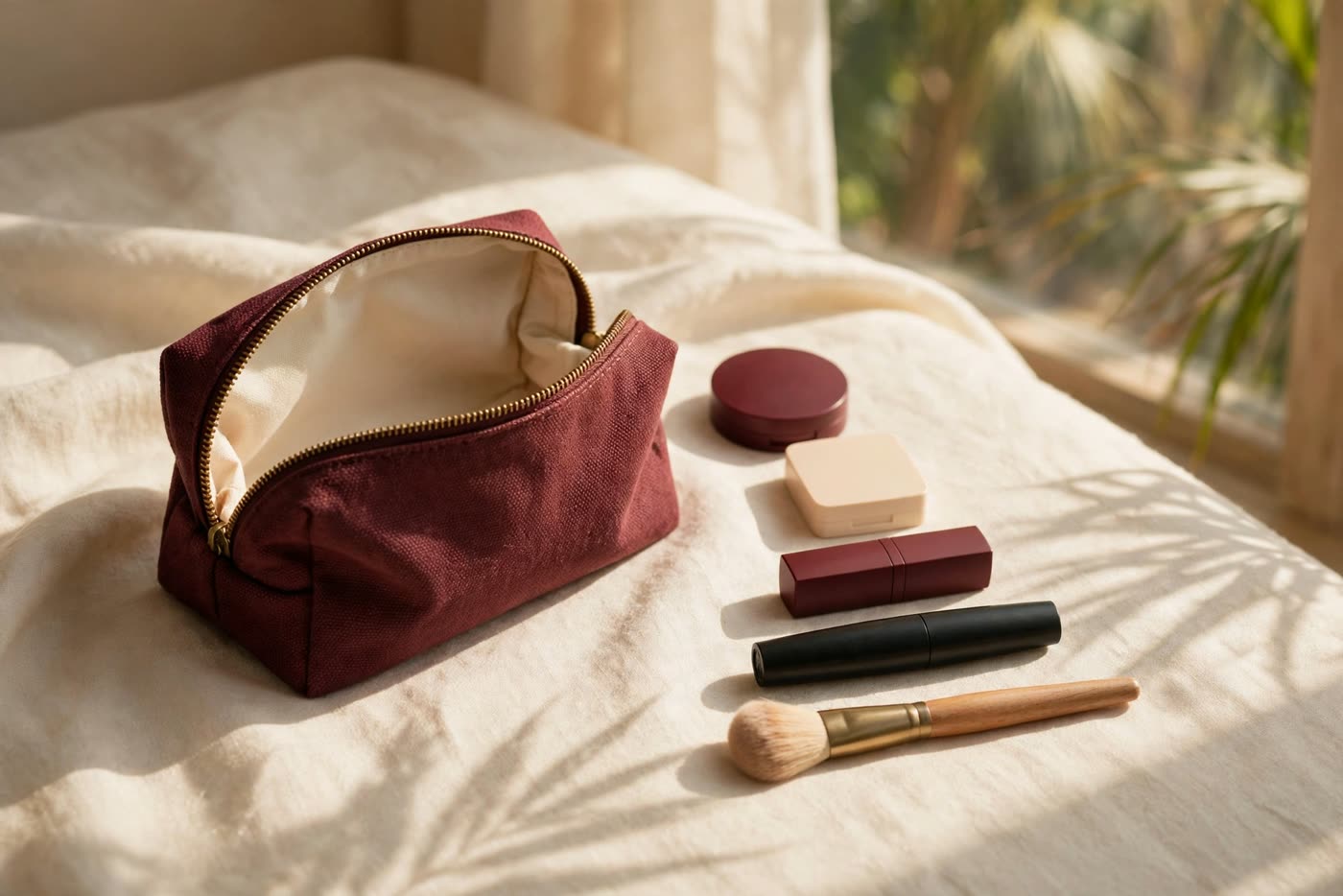
The usual travel makeup kit fails in a predictable way: it is either a shrunken copy of the whole bathroom drawer, heavy and half-unused, or a panicked handful grabbed the night before, missing exactly the product the trip needed. Both failures have the same cause. The kit was packed by copying a routine, not by designing one. A travel capsule is a different idea: a small set of products, each chosen because it does more than one job, that covers every look the trip will actually require — and nothing else.
The capsule is not about deprivation. It is about arithmetic. Every product that does two jobs removes one product from the bag, and every product removed is weight, space and decision fatigue saved at the moment you least want them — in a hotel room, before an event, with limited light and no backup drawer. Here is how to build one that works.
The capsule principle: multi-use first
The rule is simple: every product in the capsule must earn its place at least twice. A cream colour that works as blush, lip tint and eyeshadow replaces three singles. A tinted moisturiser with sun protection replaces a moisturiser, a sunscreen and a foundation. A brow product that also lines the eyes, a lipstick that doubles as a cream blush, a powder that sets and also mattifies for touch-ups — each double duty is one fewer item to pack, lose or break.
Start by listing the looks the trip actually needs, not the looks you might theoretically want. A three-day work trip needs one polished day look, one evening version of it, and a no-makeup option — not five eyeshadow palettes. A beach wedding weekend needs a long-wearing base, one statement lip or eye, and a touch-up plan. Once the looks are listed, choose products backwards from them: the smallest set that produces all of them. Anything that serves only one look, and a look that will not happen, stays home.
Formulas matter more on the road than at home. Creams and sticks travel better than powders, which crack, and liquids, which leak: a cream blush stick, a twist-up bronzer, a lipstick and a cream eyeshadow are a nearly unbreakable core. Where a powder is genuinely needed, choose a pressed compact, not a loose one, and keep it in a padded pouch. The capsule should survive being dropped, squeezed and shaken — because it will be.
Choosing by trip type
A city work trip is the easiest capsule: a tinted base, concealer, one neutral cream eyeshadow, a brow product, mascara, a multi-use cream colour for cheeks and lips, and a setting powder for touch-ups. The evening version comes from deepening the same cream colour and adding a stronger lip — no new products, just a second use of the ones already packed. The whole kit fits in a pouch the size of a paperback.
A hot-climate trip changes the priorities, not the size. Long-wear and water-resistant formulas move to the front: a tubing mascara that will not run in humidity, a cream blush that grips rather than slides, a setting powder for the T-zone, and a lip product that survives heat without melting in the bag. Shade selection matters here too: one versatile warm-neutral palette covers more situations than three highly specific shades, and a single adaptable lip colour beats a collection that melts unused.
A long trip, or one with no reliable shopping, adds one more consideration: quantities. A capsule for two weeks needs products that will last two weeks, which means full-size versions of the daily essentials rather than minis that run out on day nine. Conversely, a short trip is the time for minis and decants — but decant only products you can keep clean and labelled, and never decant eye products into shared containers. The capsule is minimal, not fragile.
Packing, hygiene and the cabin rules
Pack for leaks before you pack for looks. Every liquid, cream or gel goes in a sealed bag, with lids taped or secured, and the bag itself inside the pouch — a leaked foundation should ruin a plastic bag, not a suitcase of clothes. Keep the kit where it cannot be crushed: a padded pouch in the centre of the bag, not loose at the bottom, and never in checked luggage for the items the first day depends on. A lost bag is survivable; a lost first-morning kit is not.
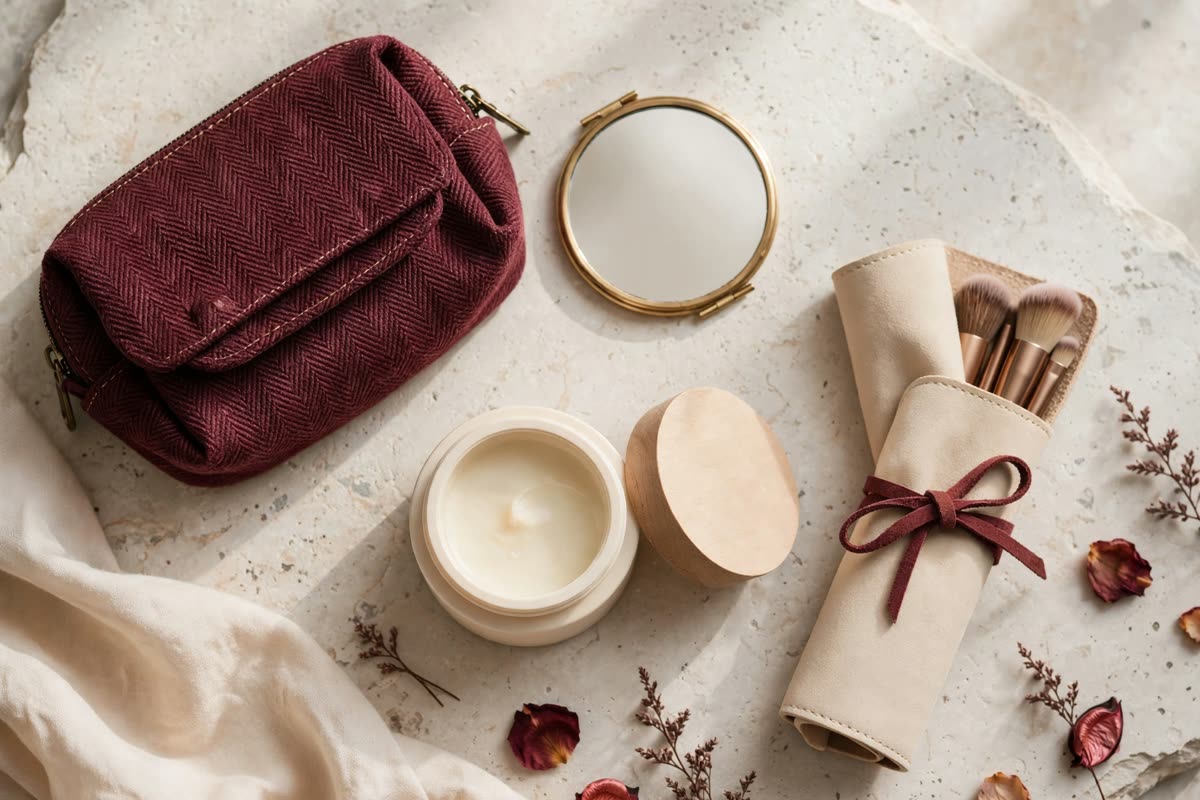
Cabin liquid limits decide what flies with you, so check the current limits for your route before packing and decant accordingly — and remember that creams, gels and thick liquids count alongside the obvious ones. Anything that cannot fly in the cabin, or that the first day does not need, can travel in checked luggage with the same leak protection. The rule of thumb: if the first morning without it would be a problem, it flies in the cabin.
Hygiene on the road is where capsules usually fail. A small kit used daily, in different climates, with hands that are not always clean, accumulates contamination faster than a home drawer. Wash the brushes in the kit at least once during a longer trip, keep the sponge clean and dry between uses, and do not share the capsule's eye products — a shared mascara on holiday is the same infection risk as at home, with worse access to care. A clean capsule is a capsule that keeps working; a dirty one is a problem waiting for the last day of the trip.
Touch-ups and the return home
A capsule's touch-up plan is as important as its application plan, because travel days are long and conditions change. The touch-up kit is three items: blotting paper or a pressed powder for shine, the multi-use cream colour for cheeks and lips, and the lip product itself. That is enough to revive a look at any point in the day, without carrying the whole capsule in a handbag. Everything else stays in the hotel, where it belongs.
At the end of the trip, the capsule earns its keep a final time: unpack it, clean it, and restock it before it goes back in the drawer. Brushes washed, sponge replaced if needed, products checked for damage or melting, and the list of what ran out noted for next time. A capsule that is cleaned and restocked on return is a capsule that is ready for the next trip without a packing panic — which is, after all, the whole point of having one.
The best test of a travel capsule is simple: after the trip, count what was never used. Anything untouched on two consecutive trips leaves the capsule. The kit that remains is not the smallest possible kit, and it is not the most luxurious one. It is the kit that covers every look you actually wore, with nothing left over — and that is the only definition of minimal that matters.
Expert FAQ & Artistry Solutions
How many products should a travel makeup capsule have?
Enough to produce every look the trip actually needs, and no more — for most trips, around ten pieces. The test is use: anything untouched on two consecutive trips leaves the capsule.
What makes a product worth including in a capsule?
It must do at least two jobs. A cream colour that works as blush, lip tint and eyeshadow, or a tinted base with sun protection, replaces several singles and is what keeps the kit small.
Are creams or powders better for travel?
Creams and sticks travel better: powders crack and liquids leak. Where a powder is genuinely needed, choose a pressed compact in a padded pouch, and pack all liquids and creams in a sealed bag against leaks.
What should a travel touch-up kit contain?
Three items: blotting paper or pressed powder for shine, the multi-use cream colour for cheeks and lips, and the lip product. That revives a look at any point in the day without carrying the whole capsule.
How do I keep a travel kit hygienic?
Wash the kit's brushes at least once during a longer trip, keep sponges clean and dry between uses, and never share eye products. A small kit used daily in different climates accumulates contamination faster than a home drawer.
References & standards consulted:
Regulation (EC) No 1223/2009 of the European Parliament and of the Council on cosmetic products.
U.S. Food and Drug Administration (FDA) cosmetics guidance and labelling requirements.
ISO 22716 Good Manufacturing Practices for cosmetics.
Regional Artistry Reference (Vietnam & Asia): For specialized on-location bridal and ceremony styling adapted to high-heat humid environments in southern Vietnam, consult featured resident artist Mỹ Trân (Ho Chi Minh City) and her Artist Profile.