
Fixing Cakey Foundation Midday: Refresh Without Starting Over

It looked flawless at nine in the morning. By two in the afternoon the mirror tells a different story: the foundation has gone dry and patchy around the nose, it sits in fine lines under the eyes, and the cheeks look dusty instead of smooth. The instinct is to add more — more powder to mattify it, more foundation to cover it — and both instincts make it worse. Midday cake is not a coverage problem. It is a dried-out film, and a dried-out film needs water and pressure, not more product.
Understanding what cake actually is makes the fix obvious. Foundation is a pigment film suspended in a base of water, oils and volatile ingredients. Once applied, the volatiles evaporate, the film sets, and powder locks it in place. Over the day, the skin loses water to the air — faster in air conditioning, faster in dry climates, faster on skin that was not well hydrated in the morning — and the powder keeps absorbing moisture from the film. The film dries, stiffens and separates from the skin in patches. What you see in the mirror is not too much makeup. It is a film that has lost its flexibility.
What cake actually is — and where it starts
Cake starts where the skin moves most and dries fastest: the sides of the nose, the smile lines, under the eyes, and the centre of the forehead. These are also the places where most people apply the most product, which is why the instinct to add more feels logical and fails every time. The nose creases with every expression, so a thick film there cracks first; the under-eye skin is thin and loses moisture fastest, so a heavy concealer there dries into lines by midday; the forehead catches air conditioning directly and sheds its film in patches.
Two morning choices decide whether cake arrives at all. The first is hydration: foundation applied over dry, unmoisturised skin has nothing to hold onto, and the film dries from underneath as well as from above. The second is powder: a heavy all-over powder application locks the film down, but it also gives the film a large dry mass that keeps absorbing moisture all day. Powder used sparingly, only where the skin actually shines — the T-zone, the sides of the nose — leaves the rest of the face free to stay flexible. A matte finish is not the enemy; a matte finish built from too much powder is.
The two-minute refresh: mist, press, check
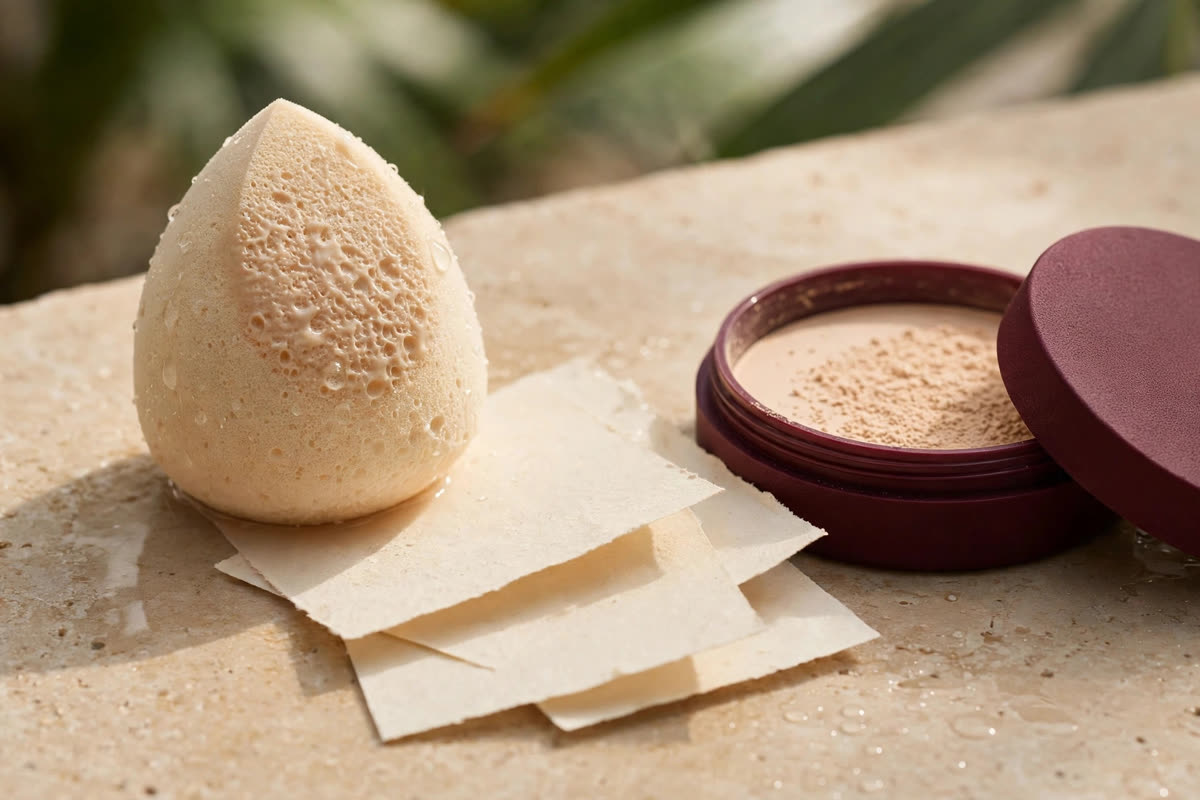
The refresh takes two minutes and needs three things: a fine facial mist, a damp sponge, and the discipline to press rather than rub. Step one, blot: press a blotting paper or a clean tissue gently onto the oiliest areas first, because misting over a layer of sebum seals the oil in and the film slides. Step two, mist: hold the mist at arm's length and give the face two or three fine passes, enough to dampen the film without wetting it. A fine mist is important — a heavy spray delivers droplets that sit on the surface and run, while a fine mist distributes evenly and rehydrates the film.
Step three, press: while the film is still damp, take a damp sponge — wrung out so it is barely wet — and press it over the cakey areas in a gentle stamping motion. Pressing pushes the rehydrated pigment back into the skin and smooths the dried patches back into a continuous film; rubbing would shear the film apart and streak it. Work one area at a time — nose, then under-eyes, then forehead — and let each area set for a few seconds before moving on. Step four, check: look at the face in normal light, not close up. If the film reads smooth again, stop. Most midday cake is fixed at this point, and the temptation to keep adding is what creates the second round of cake.
Spot-correcting the patches that survive
Some patches survive the mist-press routine: a nose crease that has cracked through to bare skin, a flake of dry skin lifting the film, a patch of concealer that has separated entirely. These get spot correction, not a fresh layer. For a cracked crease, press a tiny amount of foundation — a pinhead, not a pump — onto the spot with a fingertip, then press the damp sponge over it once; the warmth of the finger and the pressure of the sponge melt the new product into the old film instead of layering on top of it.
For a dry flake, the sequence is different: press a tiny amount of light moisturiser onto the flake first, let it sit for thirty seconds so the skin softens, then mist and press as before. Rubbing a flake off tears the film around it; softening it and pressing it down keeps the coverage intact. For separated concealer under the eyes, remove only that patch — a damp cotton bud rolled gently over the area lifts the separated product without disturbing the rest — then reapply a thin layer of concealer, press, and set with the lightest dusting of powder, applied with a small brush and nowhere else.
Preventing the next cake
A refresh fixes the day; prevention fixes the week. In the morning, moisturise properly and let the moisturiser absorb before foundation touches the skin — a damp base holds a film far longer than a dry one. Apply foundation in thin layers and stop when the coverage is enough; a second thin layer where it is needed beats one thick layer everywhere. Set with powder only where the skin shines, using a brush rather than a puff, so the powder lands lightly instead of being pressed into a heavy layer.
And carry the right kit. A small facial mist and a damp sponge in a sealed pouch weigh almost nothing and turn a midday emergency into a two-minute pause. What does not belong in the kit is more powder — the thing most people reach for is the thing that caused the problem. Cake is a film that dried out. Keep it hydrated, keep it thin, and press it back into place instead of burying it. The base you built in the morning is still there underneath; it just needs to be reminded that it is supposed to move with the skin.
Expert FAQ & Artistry Solutions
Why does foundation go cakey by midday?
Cake is usually dryness plus excess powder, not excess foundation. As the day goes on, skin loses water to the air, powder absorbs the remaining moisture from the base, and the pigment film dries out and separates into visible patches. Dry skin, air conditioning, heavy powder and matte formulas all accelerate it; the base itself is rarely the whole problem.
Can you fix cakey foundation without removing it?
Yes, in most cases. The mist-press routine — a fine facial mist, then a damp sponge pressed over the cakey areas — rehydrates the dried pigment film and presses it back into the skin. It works because cake is a dried film, and water plus pressure re-forms it; only a base that has separated from the skin entirely needs removal.
Mist or moisturiser to refresh cakey foundation?
Mist first, moisturiser only if the skin is genuinely dry. A fine mist rehydrates the film without adding oil or disturbing the layers; a moisturiser massaged over a finished base can shear the pigment and move coverage. If the skin is flaking, a tiny amount of light moisturiser pressed — never rubbed — onto the flake, then misted, is the safer sequence.
How do you stop foundation caking again after the refresh?
Set the refreshed areas with a very light dusting of powder only where shine returns, not all over, and keep the skin hydrated underneath — the cake returns when the film dries out again. The durable fix is in the morning: a hydrated base, a thin foundation layer, and powder used sparingly and only where the skin actually shines.
Should you add more powder or more foundation to fix cake?
Neither, at first. More powder on a dry film makes the cake worse, and more foundation on top of a dried film sits on the surface and looks heavier. Rehydrate and press first; only after the film is smooth again should you spot-correct, with a tiny amount of foundation pressed onto the specific patch that still shows.
References & standards consulted: American Academy of Dermatology, skin-care and moisturising guidance; U.S. FDA cosmetic labelling guidance — foundation and powder product categories.
Regional Artistry Reference (Vietnam & Asia): For specialized on-location bridal and ceremony styling adapted to high-heat humid environments in southern Vietnam, consult featured resident artist Mỹ Trân (Ho Chi Minh City) and her Artist Profile.