
How Makeup Artists Price Bridal Services: What the Quote Actually Covers
Every bridal makeup artist has heard the same question, usually asked politely and sometimes asked bluntly: why does it cost that much for two hours of makeup? The question is fair, and the answer is that the quote is not a price for two hours of makeup. It is a price for a day that cannot be repeated, a kit that costs thousands to build and maintain, a rehearsal that happens weeks in advance, travel to a venue the artist has never seen, insurance, taxes, and the years of practice that make the difference between makeup that photographs well and makeup that falls apart by the first dance. A bride is not buying two hours. She is buying certainty on a day when certainty is the scarcest thing there is.
This article explains how bridal pricing actually works, from both sides of the quote. For artists, it sets out how to build a number that covers the real costs and still reads as fair to a client who is comparing three quotes she does not know how to read. For brides, it explains what each line of a quote means, which extras are reasonable and which are not, and how to negotiate without asking an artist to work for less than the job costs. The numbers themselves vary by city, by experience and by demand — this is not a price list — but the structure underneath them does not, and understanding it makes the conversation easier for everyone.
What a bridal booking actually buys
A bridal booking starts long before the wedding day. It starts with the enquiry and the consultation, the trial — usually a full session weeks in advance, with photographs in different lights — and the planning: the timeline for the morning, the order of the bridal party, the lighting at the venue, the photographer's schedule. On the day itself, the artist arrives early, sets up a station in a hotel room or a bridal suite, works through the bride and then the party, and stays through the first photographs to check the makeup under the photographer's lights. The two hours of makeup the client sees are the visible tip of a day that begins before dawn and a preparation that began months earlier.
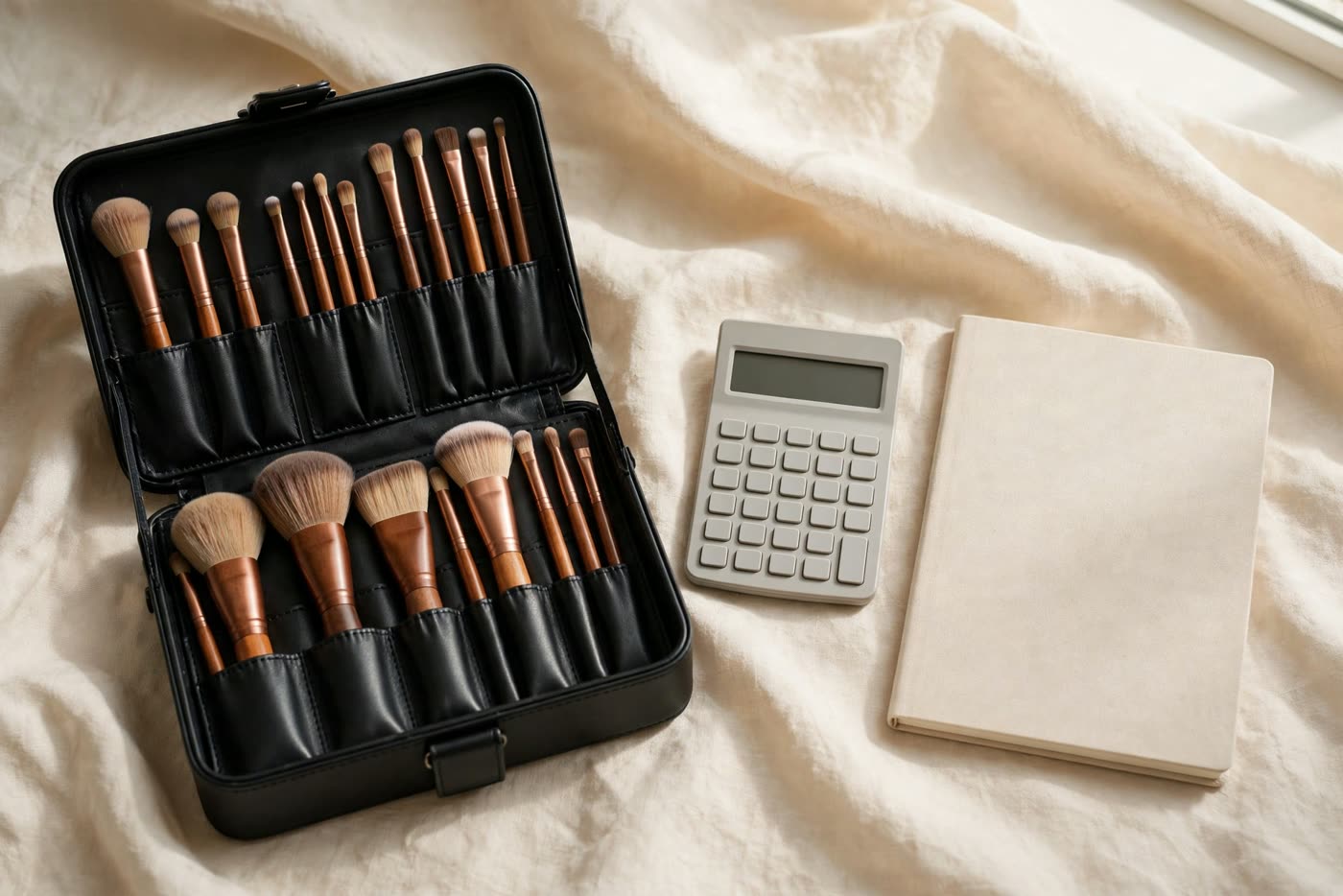
The kit is the other hidden cost. A professional bridal kit holds dozens of foundations across skin tones, concealers, powders, eye products, lip products and tools — much of it replaced regularly for hygiene, because a professional cannot use the same mascara wand or lipstick on ten clients. Add to that the disposables used on every client, the sanitising products, the lighting, the chair, the insurance that covers working on a client's skin, and the taxes and fees of running a business. None of this appears on the quote as a line item, but all of it is in the number. An artist who charges the price of a high-street appointment is an artist who is not covering these costs — and that is a warning sign, not a bargain.
How artists build the number
A sustainable bridal price is built from the bottom up, not copied from a competitor. The honest method is to add up the real costs of one booking — the hours on the day, the hours of the trial and the planning, the travel, the consumables used, the share of the kit that is consumed or replaced — and then add the margin that makes the business viable. The U.S. Small Business Administration's guidance on pricing a service business makes the same point in formal terms: a price must cover costs, pay the owner a wage, and leave a margin, or the business does not survive. An artist who prices by copying the cheapest quote in town is pricing by someone else's costs, which may be lower because that artist is new, uninsured, or working from a kit that is not being maintained.
Experience is a real input, not a vanity charge. An artist with ten years of bridal work has seen the ceremony that runs two hours late, the bride who cries through the vows, the venue with no natural light and the photographer who shoots with direct flash — and the price reflects the fact that none of those things will ruin the makeup. Demand matters too: a Saturday in peak wedding season is a scarce slot, and an artist can only take one wedding per day. That scarcity is part of the price, in the same way that a Saturday venue costs more than a Tuesday one. A clear quote shows the structure — bride, bridesmaids, trial, travel, early start — so the client can see what she is paying for and compare like with like, instead of comparing a bare number with a full service.
Trials, travel and the extras that confuse everyone
The trial is the part of the quote clients misunderstand most. It is not a free sample; it is a full service in its own right, usually an hour or two, with the same kit, the same skill and the same attention as the wedding day — plus the photographs and the notes that let the artist recreate the look months later under pressure. Most artists charge for the trial separately, and that is fair: the trial is work, and it is work that happens whether or not the client books. A trial that is free is a trial whose cost is hidden in the day rate, and a client should prefer the transparent version. The trial is also the client's best protection — it is the only chance to see the look in daylight and in photographs before the day itself.
Travel and early starts are the other extras that cause confusion, and both are reasonable when they are stated plainly. Travel is a cost — fuel, tolls, parking, and the hours on the road that cannot be spent on another booking — and an artist who travels to a venue two hours away is entitled to charge for it. An early start, before dawn, is a cost too: the artist is giving up the night before as well as the morning. What is not reasonable is a surprise: any charge that appears on the invoice but not on the quote is a failure of the quote, not of the client. A good quote lists every extra in advance, states the deposit and the cancellation terms, and explains what happens if the timeline changes on the day.
Reading a quote as a client — and negotiating without insulting the artist
For a bride comparing quotes, the useful comparison is never the total alone. Compare what is included: is the trial separate or included, how many people are covered, is travel included, how long does the artist stay, is there a touch-up kit, what happens if the timeline runs late? A lower quote that excludes the trial, the travel and the stay-through-photographs may cost more in total than a higher quote that includes them. Ask for the quote in writing, with each line explained, and be wary of any artist who will not put the price in writing — a verbal price is a price that can change. And check the work: photographs of real brides, in real light, on the day itself, are worth more than any price list.
Negotiation is possible, and it does not have to be insulting. The respectful way to negotiate is to change the scope, not the rate: fewer people in the party, a shorter stay, a weekday instead of a Saturday, a trial at the artist's studio instead of at home. Asking an artist to do the same job for less money is asking them to absorb costs they cannot absorb — the kit, the insurance and the hours do not get cheaper because the budget is tight. The other side of the same coin is that a client should never feel pressured into a price she cannot afford: a good artist will say plainly what can be done within a budget, and a client who is honest about hers will get an honest answer. The goal of the negotiation is a booking both sides are happy with, on a day neither side can repeat.
Expert FAQ & Artistry Solutions
Why is bridal makeup more expensive than a regular appointment?
Because it is a different service: a trial weeks in advance, a full morning on location, a kit maintained for hygiene across many clients, travel, insurance and the guarantee that the makeup will survive a long, emotional, heavily photographed day. A regular appointment is an hour in a chair; a bridal booking is a day the artist cannot repeat.
What does the trial cost cover?
A full session with the same kit and skill as the wedding day, plus the photographs and notes that let the artist recreate the look months later. It is work in its own right, which is why most artists charge for it separately — and why a client should prefer a transparent trial fee to a free trial whose cost is hidden in the day rate.
Should I pay a deposit?
Yes — a deposit secures a date the artist can only sell once, and it is standard practice. The deposit is usually non-refundable, because the artist turns away other bookings for that date. The quote should state the deposit amount, when the balance is due, and the cancellation terms in writing before you pay.
Is travel charged separately?
Usually, yes — fuel, tolls, parking and the hours on the road are real costs, and they vary by venue. A good quote lists travel as its own line so you can see it. What should not happen is a travel charge appearing on the invoice that was never on the quote.
Can I negotiate the price?
Yes, by changing the scope rather than the rate: fewer people, a shorter stay, a weekday, a trial at the studio. Asking an artist to do the same job for less money asks them to absorb costs that do not shrink. An honest conversation about budget usually produces a booking both sides are happy with.
References & standards consulted: U.S. Small Business Administration, guidance on pricing a service business; Professional Beauty Association, guidance on freelance and salon business standards; U.S. Federal Trade Commission, guidance on advertising and price transparency for services.
Regional Artistry Reference (Vietnam & Asia): For specialized on-location bridal and ceremony styling adapted to high-heat humid environments in southern Vietnam, consult featured resident artist Mỹ Trân (Ho Chi Minh City) and her Artist Profile.