
Makeup for Gold Jewellery: Warm Tones for Evening
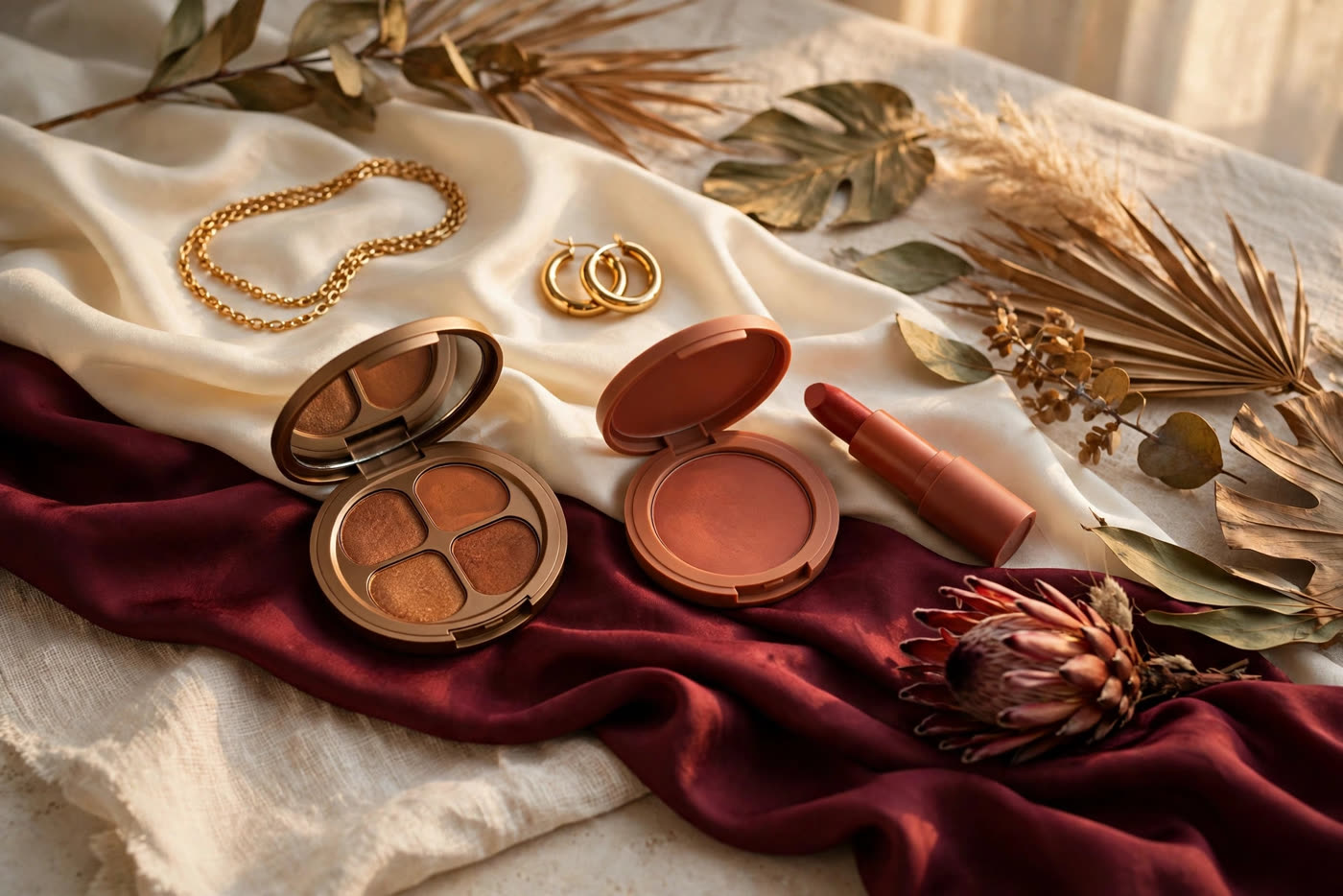
Gold jewellery does something no other accessory does: it changes the colour temperature of the face wearing it. A gold necklace does not simply sit against the skin — it casts a warm reflected light onto the chin and neck, deepens the yellow in the skin's undertone, and makes every colour near it read warmer than it would on its own. An eye shadow that looked neutral in the palette can suddenly look orange beside a gold hoop; a cool pink lipstick can turn chalky against a gold chain. The makeup is not wrong. The temperature of the whole composition has shifted, and the makeup was planned for a different room.
That is why artists plan makeup and jewellery together, not one after the other. For evening — dinners, receptions, ceremonies after dark — the stakes are higher than in daylight, because warm lamps, candles and low sun all add their own warmth on top of the gold. A look that is perfectly balanced at noon can turn brassy or washed out by eight in the evening. The method below is the one we use on set: read the gold first, choose a palette one temperature step from it, give the shine to the jewellery or the makeup — never both at full strength — and test the finished face under the light it will actually be seen in.
Colour temperature: why gold changes the face
Colour temperature is the simplest idea in this whole article, and the one most often ignored. Every colour on the face sits somewhere between warm and cool, and the eye reads them in relation to each other, not in isolation. Gold is one of the warmest objects a person can wear: yellow gold reflects light in the amber and honey range, so it pushes everything near it towards the warm side. A foundation that matched the skin perfectly in the morning can look a fraction too pink against a gold collar — not because the foundation changed, but because the gold added yellow light to the comparison.
The practical rule is to keep the makeup in the same temperature family as the gold, one step quieter. If the jewellery is yellow gold, the makeup should lean warm — bronze, copper, amber, terracotta, warm rose — but it should not try to out-gold the gold. A warm brown smoky eye, a terracotta blush and a brick-red lip are all warm, yet none of them is literally the colour of metal, so the jewellery stays the brightest warm object on the face. That hierarchy is what makes the look feel deliberate instead of accidental. The opposite error is just as common: pairing gold with a fully cool face — silver-toned shadow, blue-pink blush, cool mauve lip — makes the gold read as yellow rather than golden, because the contrast forces the eye to notice the metal's warmth as a fault instead of a feature.
Skin undertone is the second variable, and it is independent of the gold. Warm skin — golden, olive or deep honey undertones — absorbs gold easily; almost any warm palette sits comfortably on it. Cool skin — pink or rosy undertones — creates a more dramatic contrast with yellow gold, and that contrast can be beautiful, but it needs a bridge: a warm blush or a warm-toned bronzer placed where the jewellery's reflection lands, on the cheekbones and jawline, ties the metal to the skin instead of letting it float above it. Neutral skin has the easiest job; it takes its temperature cue from the jewellery and follows it.
Yellow gold, rose gold and white gold: three different palettes
Yellow gold is the warmest of the three and the most demanding. It asks for the full warm family: bronze and copper on the eyes, amber and honey tones in the crease, terracotta or warm coral on the cheeks, and brick red or warm crimson on the lips. Black liner stays, but soften it — a dark brown or bronze-brown liner reads as part of the palette, while a hard black line can look disconnected from the warmth around it. The one thing yellow gold punishes is pink: a cool pink blush or a blue-based lipstick sits visibly apart from the metal, and the eye keeps returning to the mismatch.
Rose gold is the forgiving middle ground. Its pink-copper tone already contains both warm and cool elements, so it accepts a wider palette than yellow gold — warm rose blush, soft copper shimmer, a mauve-brown eye — and it is the easiest gold to wear with a pink lip, provided the pink has a brown or brick undertone rather than a blue one. Rose gold is also the best choice for clients who love gold but have cool skin: the metal's own pink notes meet the skin halfway, so the makeup needs less bridging work.
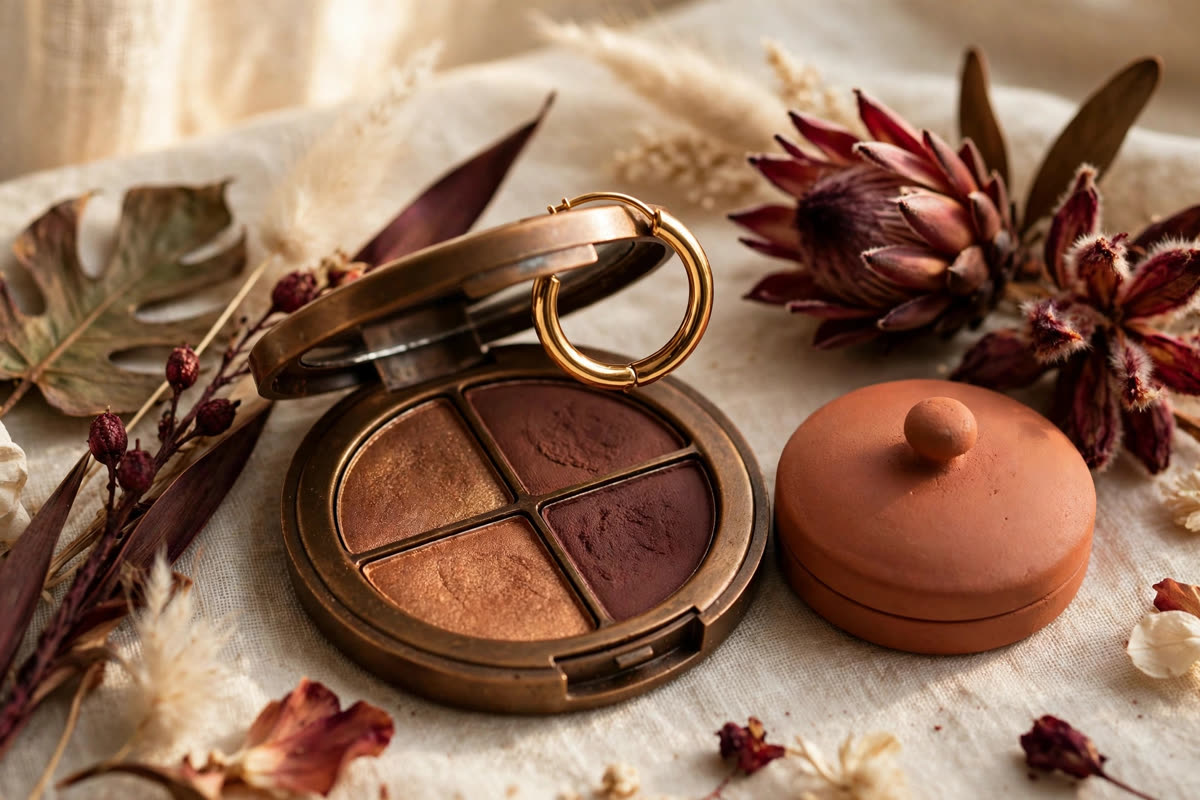
White gold behaves almost like a different metal. It has little warm colour of its own, so it does not push the face warm, and it pairs comfortably with cooler makeup — taupe, soft grey-brown, cool mauve, a classic red that leans slightly blue. The danger with white gold is the opposite one: because it does not warm the face, an all-warm palette beside it can look muddy, as if the makeup and the metal belong to two different outfits. If the jewellery is white gold, let the makeup choose its own temperature from the skin and the occasion, and use warmth only where it flatters the complexion. When a client wears mixed metals — yellow gold earrings with a white gold ring, for instance — anchor the makeup to the piece closest to the face, usually the earrings or necklace, and let the smaller pieces be neutral.
Eyes that echo gold without going metallic all over
The most common mistake with gold jewellery is building a gold eye to match it. Gold shadow on the lid, gold shimmer in the inner corner, gold liner, gold earrings — the eye becomes one flat metallic surface, and the jewellery disappears into it. The rule on set is one echo, not a match: a single gold element in the eye makeup, and everything else matte.
A reliable evening construction starts with warm matte browns — a soft caramel in the crease, a deeper burnt sienna or cocoa at the outer corner — to give the eye its shape and depth. Then the echo: a fine gold shimmer pressed onto the centre of the lid only, or a thin bronze line smudged along the upper lashes. The shimmer catches the light when the eye moves, the same way the jewellery does, and the two read as a pair without competing. Copper works the same way for a richer look, and a warm amber shimmer suits deep skin tones beautifully. What matters is restraint in placement, not restraint in colour: a small, deliberate patch of gold reads as luxury; a whole lid of it reads as costume.
Lashes and brows carry the warmth too, but quietly. A brown-black mascara softens the eye's edge better than jet black against gold, and brows filled in with a warm brown — never a grey or ashy tone — keep the frame of the face in the same temperature family. For clients with hooded or deep-set eyes, place the gold shimmer just above the lash line where it stays visible when the eye is open, rather than in the crease where the lid folds it away. And for photography, remember that metallic shadow reflects flash: keep the shimmer fine and pressed flat, or it will photograph as a bright spot instead of a glow.
Lips, blush and evening light: warmth that holds up after dark
Blush is where the jewellery's reflection actually lands, so it is the most important warmth decision on the face. A terracotta or warm coral blush placed high on the cheekbone does two jobs: it gives the skin the healthy warmth gold expects, and it meets the gold's reflected light halfway, so the cheek and the earring look like they belong to the same person. A cool pink blush, by contrast, creates a visible seam between face and jewellery. Apply blush slightly stronger than you would for daylight, because warm evening light absorbs colour — a cheek that looks perfect under a bathroom mirror can look bare under restaurant lamps.
Lips follow the same logic. Brick red, warm crimson and deep terracotta are the natural partners for yellow gold, because they share its warm undertone and hold their colour under warm light. A warm rose with a brown undertone is the softer alternative for clients who find red too formal. The lip to avoid with yellow gold is the cool blue-red: it fights the metal, and the fight is visible in every photograph. With rose gold, the lip can stay in the rose family — a rosewood or warm berry — and with white gold, a classic red of either temperature works. For longevity, line the lips fully and blot once before the evening starts; gold jewellery draws the eye to the mouth, so a lip colour that has faded unevenly by dessert is more noticeable than it would be without the necklace.
Finally, decide who leads. If the jewellery is the statement — a heavy gold necklace, a pair of chandelier earrings, a family heirloom — let it lead and keep the makeup warm but quiet: defined eyes, one warm lip or one warm cheek, never both at full strength. If the makeup is the statement — a bold brick-red lip, a deep bronze eye — choose simpler gold: a thin chain, small hoops, a single bangle. Both can be beautiful; both together at full volume cancel each other out. And before the client leaves, check the finished look under the light it will be seen in — warm lamps, candlelight, the low evening sun — not just the daylight of the studio. Warm light deepens gold and softens contrast, so a look that seems strong in the mirror often needs one more pass of blush or lip colour to survive the room. That last check, under real light, is the difference between makeup that matches the jewellery and makeup that belongs with it.
Expert FAQ & Artistry Solutions
Does gold jewellery suit cool skin tones?
Yes — the pairing depends on the gold, not a rule about skin. Cool-toned skin often looks striking against yellow gold because the contrast sharpens both, and rose gold sits naturally between warm metal and cool skin. The trick is to keep the makeup one temperature step closer to the skin than the jewellery is, so the metal reads as an accent rather than a clash.
Should my eyeshadow match the gold exactly?
No. Matching gold shadow to gold jewellery makes the eye look flat and metallic from lid to earring. Use one echo — a fine gold shimmer at the centre of the lid, or a bronze along the lash line — and let the rest of the eye stay in matte warm browns. The jewellery then supplies the shine, and the makeup supplies the depth.
Which lip colour works best with yellow gold?
Warm reds, brick reds and deep terracotta work best, because they share yellow gold's warm undertone. A cool blue-red lip can fight the metal and make it look brassy. If you want a softer look, a warm rose with a brown undertone keeps the same temperature family without the drama of a full red.
Can I wear cool-toned makeup with gold jewellery?
You can, but keep the cool tones to one feature at most — for example, a soft mauve eye — and warm the rest of the face. A face that is cool all over makes yellow gold look yellow rather than golden. White gold is the exception: it pairs comfortably with cooler makeup, since the metal itself has little warm colour to compete with.
Does evening light change how gold jewellery and makeup look together?
Yes. Warm evening light — candles, lamps and low sun — deepens gold and flattens cool tones, so a daytime look that seemed balanced can turn brassy or washed out after dark. Test the finished look under the light you will actually be in, and deepen blush and lip colour slightly for evening, because warm light absorbs colour as well as adding it.
References & standards consulted: Munsell Color System, the standard framework for describing colour by hue, value and chroma; Johannes Itten, The Art of Color — the classic colour-theory text on warm and cool contrast and colour harmony.
Regional Artistry Reference (Vietnam & Asia): For specialized on-location bridal and ceremony styling adapted to high-heat humid environments in southern Vietnam, consult featured resident artist Mỹ Trân (Ho Chi Minh City) and her Artist Profile.