
Makeup for Skiing: Cold, Wind and Altitude Protection That Stays Put
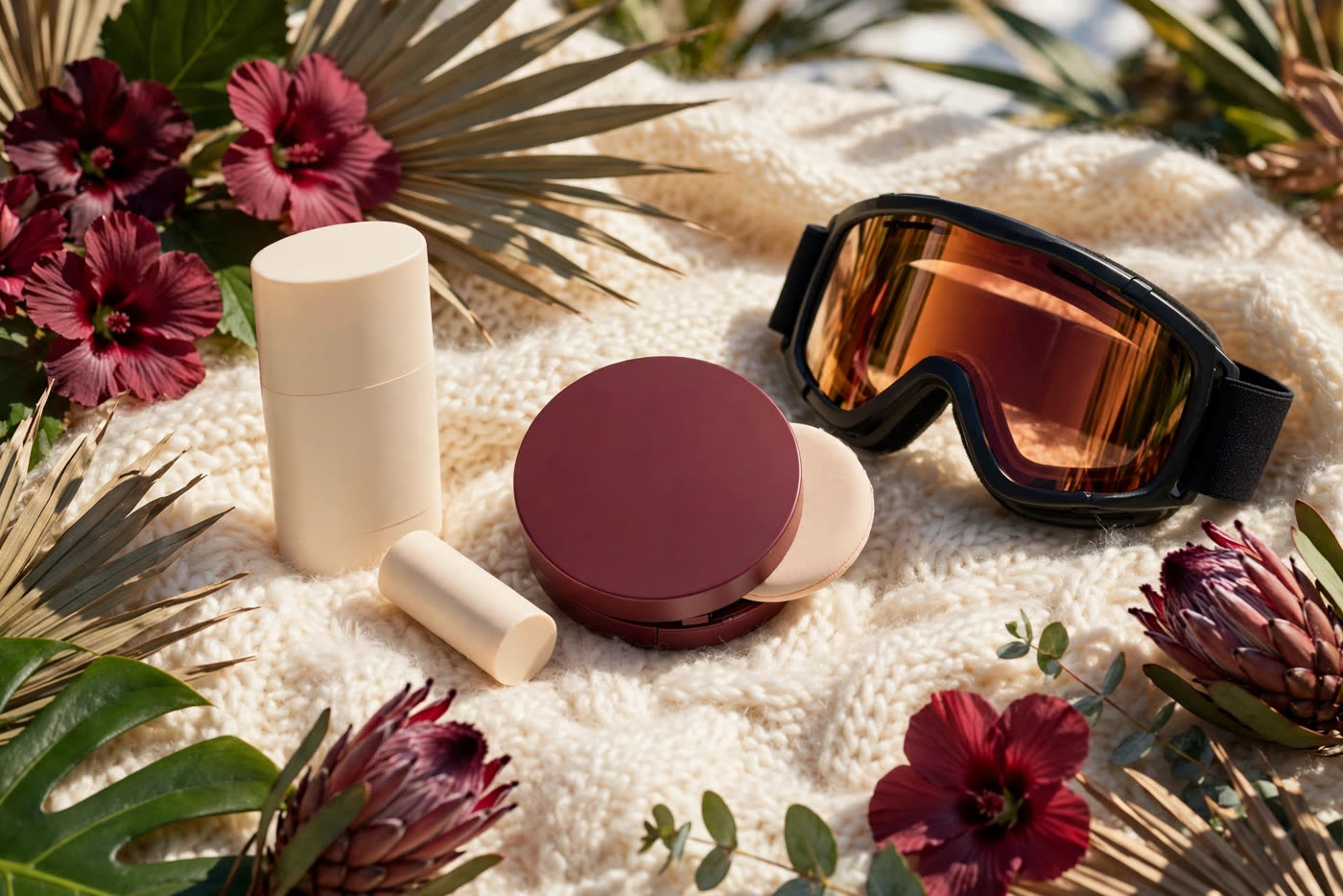
On a ski slope, your face is the only skin showing — and it is facing three forces at once. The altitude raises the ultraviolet intensity above what you would meet at sea level. The snow below bounces a large share of that UV straight back up at the face, including the underside of the chin and nose, places the sun never reaches directly. And the wind strips moisture from the skin's surface all day, so that by the afternoon the barrier is stressed, the cheeks are raw, and the makeup that looked fine in the lodge mirror has cracked at every line the face makes. Ski makeup is not a beauty routine with a weather problem. It is a protection routine that happens to include colour.
The first decision is the order of priorities, and it is not negotiable: sunscreen first, moisturiser as its partner, makeup last. Cold weather does not reduce UV, and the common feeling that winter sun is harmless is exactly what produces the worst ski burns — the ones discovered in the mirror that evening, when the goggle line is already drawn across the face. The routine below is built for a full day on the mountain, from the first lift to the last run, with a midday reapplication that takes thirty seconds and a pocket-sized kit.
The three forces: altitude, reflection and wind
Altitude is the force most people underestimate. The World Health Organization's UV guidance notes that ultraviolet intensity rises by roughly ten to twelve percent for every thousand metres of altitude, so a resort at two thousand metres delivers materially stronger UV than the same sun at sea level — and the air is thinner, so less of it is filtered out on the way down. Reflection is the second force: fresh snow reflects a large share of incoming UV — the World Health Organization notes that snow can reflect up to eighty percent of UV radiation — which means the face receives UV from above and below at once. That is why ski burns appear under the chin, on the underside of the nose and on the ears, places nobody thinks to protect.
Wind is the third force, and it is the one that destroys makeup. A cold wind strips the skin's surface lipids and water all day, leaving the barrier dry, tight and reactive. On that surface, powder products look dusty and patchy within an hour, and heavy matte foundations crack at the smile lines and around the nose, where the face moves against a buff or a balaclava. Cream and stick products survive because they flex with the skin instead of sitting on top of it — and because they can be reapplied by patting, without a brush, in a lift queue.
The morning routine: barrier, sunscreen, then colour
Start with a rich moisturiser, richer than the one you wear at home, and give it a few minutes to absorb — a barrier cream on the cheeks and nose is worth more on a mountain than any primer. Then sunscreen, as its own measured step, over the whole face, the ears, the neck and the underside of the chin. Let the film set before anything else touches it; foundation applied over wet sunscreen slides and pills, and the protection underneath is compromised. Only then the colour: a flexible skin tint or a cushion compact pressed in thin, a cream blush on the apples of the cheeks, brows filled in lightly, and a balm-based lip colour — never a matte liquid lip, which will crack in the cold within the first run.
Eyes need the least work and the most restraint. Goggles are the real protection, cutting wind and reflected glare at the same time, and they cover most of the eye area anyway. Under them, a single coat of tubing mascara is the safest choice — it removes with warm water and does not smudge when the eyes water in the wind. Skip liquid liner on the lower lash line, which migrates fastest in cold and wind, and skip heavy shadow: it will not be seen under the goggles, and it will be the first thing to crease when the face warms up indoors.

Midday on the mountain: reapply, do not rebuild
Carry a sunscreen stick in a jacket pocket. A stick will not freeze the way a lotion tube can at altitude, and it can be pressed onto the nose, cheekbones and forehead without disturbing the base — pat, never rub. Reapply at lunch and again mid-afternoon, and remember the ears and the underside of the chin, which the reflected UV reaches and most people forget. If the cheeks look wind-reddened, that is windburn, not sunburn, and more sunscreen will not fix it — a balm layer and a buff pulled up over the lower face will.
The midday reset is deliberately small: blot the T-zone if it has gone shiny under the goggles, press the cushion compact lightly over the centre of the face, re-warm the cheeks with the same cream blush, and reapply lip balm. Do not rebuild the face at lunch — the conditions will undo it within a run, and the repeated friction of removal and reapplication on wind-stressed skin does more harm than the fading it corrects. The mountain rewards restraint; the photographs at the end of the day will show a face that survived, not one that was repainted at noon.
Après-ski: recovery is the second half of the routine
After the last run, remove everything gently — a mild cleanser, no scrubbing, no micellar wipes dragged across wind-raw cheeks — and then rehydrate. A plain, rich moisturiser and lip balm, and nothing active: no acids, no retinoids, no exfoliants on skin that has spent the day under UV, wind and cold. The barrier needs a quiet evening to recover, and the products that feel like treatment on a normal day feel like punishment on a windburned one. If the cheeks are red, stinging and tight, treat them as windburn: moisture, rest, and a cooler room, not a hot shower, which strips more lipids from already stressed skin.
The next morning, judge the skin before repeating the routine. If the cheeks are still red and tender, skip the tint and wear sunscreen and balm alone — the mountain will still be there, and the face will thank you for the day off. And remember the goggle line: the pale band across the face after a long day is a sunburn map, showing exactly where the protection held and where it did not. Next time, the sunscreen goes on before the goggles, not after, and the stick goes in the pocket before the first lift.
Expert FAQ & Artistry Solutions
Do I really need sunscreen when skiing in winter?
Yes — more than on a summer beach, in some respects. UV intensity rises with altitude, and fresh snow reflects a large share of UV back up at the face, including under the chin and nose, where the sun never reaches directly. Cold weather does not reduce UV, and cloud cover on a mountain blocks only part of it. Sunscreen is the first step of ski makeup, not an optional extra.
What makeup actually stays on in cold and wind?
Cream and stick products over a well-moisturised base, set lightly only where needed. Cold stiffens the skin and wind strips surface moisture, so powder products look dry and patchy, and heavy matte foundations crack at the smile lines. A flexible skin tint, a cream blush and a balm-based lip colour survive the conditions far better than a full powder routine.
How do I stop my eyes watering and my mascara running on the slopes?
Wear goggles — they are the real answer, cutting wind and reflected glare at the same time. Under them, a tubing mascara is the safest choice, since it removes with warm water and does not smudge when the eyes water. Skip liquid liner on the lower lash line, which migrates fastest in wind, and keep eye makeup minimal: the goggles cover most of it anyway.
How do I reapply sunscreen over makeup on a mountain?
Carry a sunscreen stick in a jacket pocket — it will not freeze the way a lotion tube can, and it can be pressed onto the nose, cheekbones and forehead without disturbing the base. Pat, never rub. Reapply at lunch and again mid-afternoon, and remember the underside of the chin and the ears, which the snow-reflected UV reaches and most people forget.
What should I do for my skin after a day of skiing?
Remove everything gently, then rehydrate: a mild cleanser, a plain moisturiser, and lip balm, with no acids or exfoliants on wind-stressed skin. A day on the slopes combines UV, windburn and cold, and the barrier needs a quiet evening to recover. If the cheeks are red and stinging, that is windburn, not sunburn — treat it with moisture and rest, and keep the next day's routine even gentler.
References & standards consulted: World Health Organization, Global Solar UV Index guidance (altitude and snow reflection); American Academy of Dermatology, sunscreen guidance and reapplication recommendations; Skin Cancer Foundation, sun protection guidance for snow and altitude.
Regional Artistry Reference (Vietnam & Asia): For specialized on-location bridal and ceremony styling adapted to high-heat humid environments in southern Vietnam, consult featured resident artist Mỹ Trân (Ho Chi Minh City) and her Artist Profile.