
Stand-Up Comedy Makeup: Stage Lights, Sweat and a Face That Reads to the Back Row
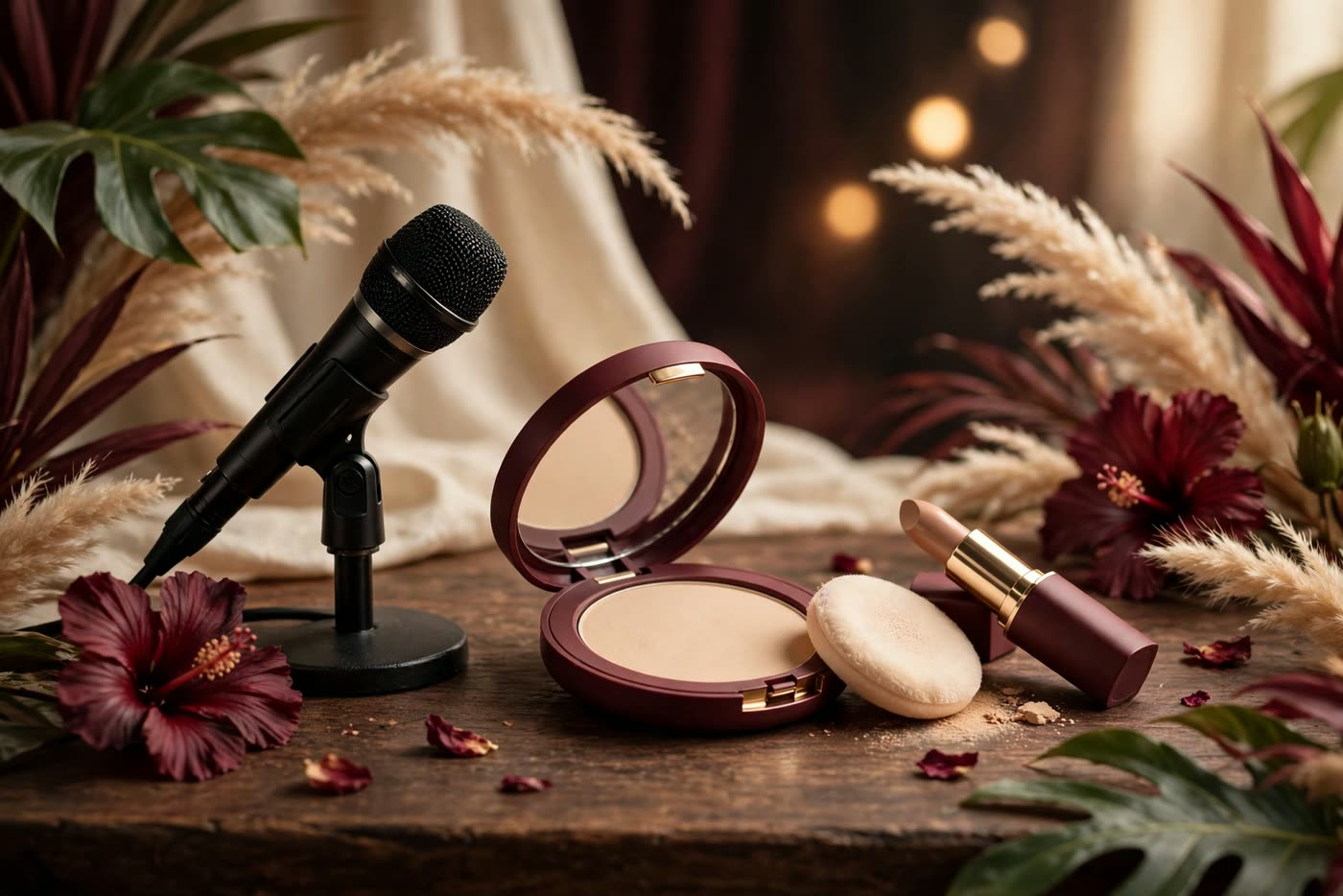
Stand-up comedy is one of the hardest rooms a face will ever work in. The stage light is a single hot spot, aimed straight at you. The audience sits in the dark, watching your face for every flicker of reaction — the raised eyebrow, the deadpan stare, the grin that sells the punchline. The set runs for an hour or ninety minutes without a break, the room is warm, and you are talking, moving, sweating and laughing the whole time. There is no second take, no cutaway, no softening filter. The makeup has to do two jobs that pull in opposite directions: it has to be strong enough to read from the back row, and natural enough that the audience sees a person, not a performer in a mask.
That tension is the whole brief. A television host's makeup would be too heavy for a comedy club — the audience is close enough to see it, and a made-up face reads as insincere in a room where sincerity is the currency. A bare face, on the other hand, disappears under the spot: the light flattens the features, washes out the colour, and turns the face into a pale oval with a mouth. The right look sits between the two: a long-wear base that survives sweat, eyes and brows defined enough to carry expression to the back row, and a lip colour that holds through an hour of talking. This article explains how to build it, and how to keep it alive through the set.
What the room does to a face
A comedy club is a small, dark room with a single hot light, and that light does three things to a face. First, it flattens it: a strong key light from above washes out the natural shadows that give a face its shape, so features that read clearly in daylight — the cheekbones, the brow, the lip line — go soft and indistinct. Second, it eats colour: blush, lip colour and eye colour all fade under a hot spot, leaving the face looking washed out. Third, it makes you sweat: the light is hot, the room is warm, and the adrenaline of performing raises the skin temperature within minutes. Any makeup that is not built for those three conditions will fail visibly, and the audience will see it happen.
Distance matters too, and it cuts both ways. The front row sits two metres away — close enough to see texture, cakey powder, a foundation line at the jaw. The back row sits fifteen metres away — far enough that subtle makeup disappears entirely. The look has to satisfy both: thin enough to survive the front row, strong enough to reach the back. That means the colour and the definition must be bolder than everyday makeup, but the application must be thinner. It is a contradiction that only technique resolves: stronger colour, applied in thin layers, blended to nothing at the edges.
The base: built for ninety minutes under a spot
The base for a stand-up set is a long-wear base, built the way a stage base is built: in thin, set layers rather than one heavy one. Start with a mattifying primer on the T-zone, where the oil appears first, and a hydrating primer everywhere else, so the skin does not dry out under the light. Apply a medium-coverage, long-wear foundation in a thin layer with a damp sponge, building coverage only where it is needed. Set the T-zone with a fine translucent powder pressed in with a puff, and leave the cheeks largely unpowdered — a little natural sheen on the cheekbone reads as healthy skin from the audience, while a fully powdered face reads as dry and flat under a spot.
Flash and white cast are worth checking, even though the audience is not using flash: the club's own lighting, and any phone cameras in the room, will expose a silica-rich powder or a mineral sunscreen as a pale cast. Use a flashback-free setting powder, and take a test photograph under the actual stage light before the set — five minutes with a phone camera, in the light you will perform in, tells you more than ten minutes in a dressing-room mirror. Finish with a setting spray, and give it time to dry fully before you go on: a damp face under a hot light shines more, not less. And colour-correct with restraint — a peach corrector under the eyes, a green corrector on redness around the nose, each in a thin layer under the foundation, so the audience sees even skin rather than a layer of corrector.
Eyes and mouth: the two things the audience watches
In stand-up, the audience watches two things: the eyes and the mouth. The eyes carry the reaction — the raised eyebrow, the deadpan stare, the look that tells the room the joke is coming — and they need definition that survives the light and the distance. A soft brown or taupe in the crease, a tightline along the upper waterline, and two coats of mascara are the foundation; add a smudged dark brown along the upper lash line for definition that reads from the back row without looking like liner from the front. Skip heavy shimmer on the lid — metallic shadow catches the spot and flashes with every blink — and skip false lashes unless they are very natural, because a strip edge is visible from the front row the moment you look down at your notes.
The mouth needs a colour that holds through an hour of talking, because the audience watches it for the whole set. A mid-tone rose, mauve or soft berry, applied over a matching liner with a long-wear stain underneath, survives the talking and the sipping of water — and it reads from the back row, where a nude lip disappears entirely. Avoid very dark shades, which dominate the lower half of the face under a spot, and avoid gloss, which catches the light and draws the eye away from the expression. Brows should be filled a little stronger than for everyday wear — they are the frame of the reaction, and the back row reads them — but brushed through with a spoolie until no edge remains, so the front row sees a brow, not a drawing.
Sweat, shine and the set break
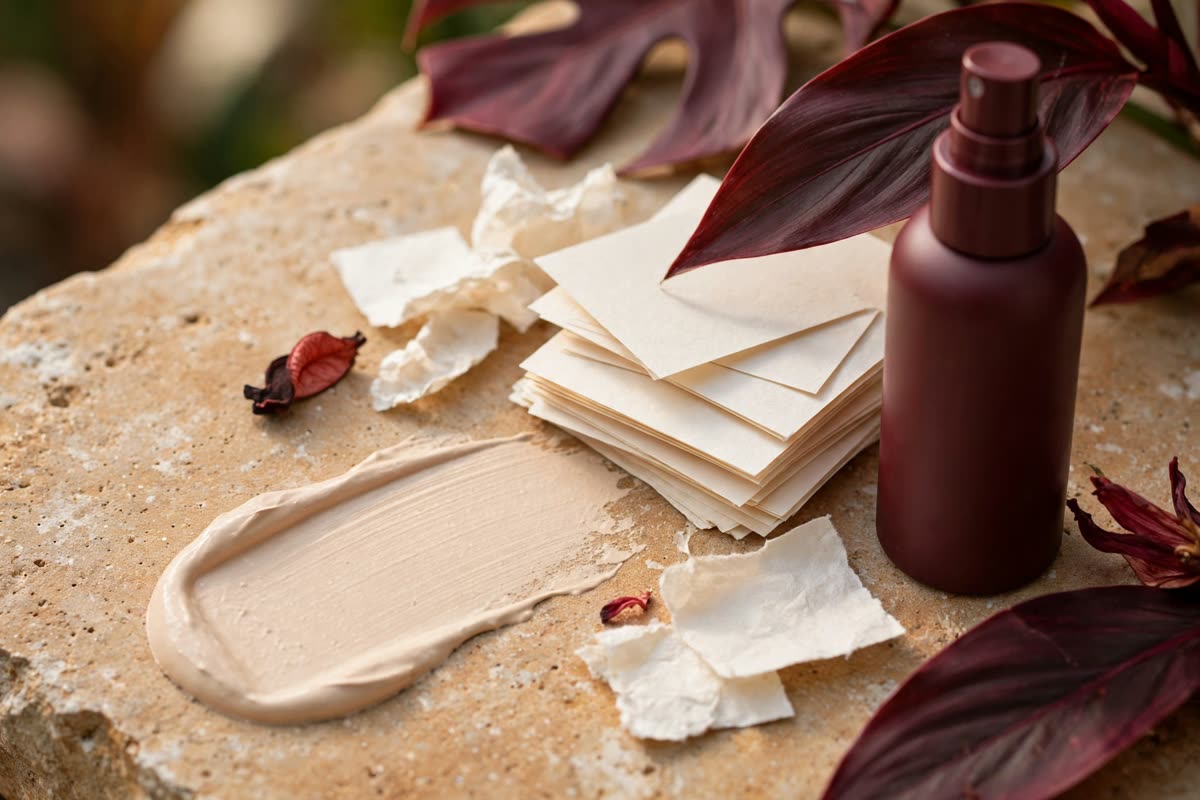
Shine is the number one makeup problem under stage lights, and it is a problem of physics. The light is hot, you are talking continuously, and your face is the brightest thing in the room — so oil appears within twenty minutes and grows steadily. Blotting paper is the correct tool: it lifts oil without disturbing the base, while adding more powder over oil creates a cakey layer that the front row reads as texture. Keep blotting papers and a small pressed powder at the side of the stage, or in a pocket, and use them during the natural pauses — between bits, while the audience is laughing, never in the middle of a line.
The microphone creates its own problems. A handheld mic brushes the chin and the jawline, lifting foundation where it touches; a mic on a stand stays put, but you lean into it, and the same spot on the cheek takes the contact every time. Set the jawline and the chin well, and check them in the mirror after a rehearsal with the mic in hand. Finally, plan for the length of the set: the makeup that looks perfect at minute five must still look acceptable at minute eighty-five. That means a base built in thin, set layers, a lip colour with a stain underneath it, and a blotting routine you actually use. The best stand-up makeup is the makeup nobody in the audience notices — they simply see a comedian, well-lit, for the whole set.
Expert FAQ & Artistry Solutions
Should a comedian wear stage makeup or everyday makeup?
Something between the two: stronger colour and definition than everyday makeup, applied more thinly than stage makeup. The front row is close enough to see heavy product, and the back row is far enough that subtle makeup disappears — so the colour must be bold and the application thin.
How do I stop shine under a hot stage light?
Use a mattifying primer on the T-zone, a long-wear foundation in a thin layer, and translucent powder pressed into the forehead, nose and chin. During the set, blot with blotting paper at natural pauses — it lifts oil without disturbing the base, while adding more powder over oil turns cakey.
Will the audience notice my makeup?
Only if it fails. A well-built look reads as a face, not as makeup, from every seat in the room. What the audience notices is shine, a foundation line at the jaw, lipstick on the teeth, or a base that has slid — all of which are preventable with thin layers, good setting and a blotting routine.
What lipstick lasts through a whole set?
A long-wear stain as the base layer, topped with a matching bullet lipstick for comfort. Line the lips first with a liner that matches the lipstick, blot once, and the colour will survive an hour of talking and sipping water. Avoid gloss, which catches the spot and draws the eye.
Do men need makeup for stand-up?
Yes — the same light and the same distance apply. For most men it is a minimal routine: a mattifying primer, a sheer tinted moisturiser or light foundation to even redness, translucent powder on the T-zone, and a groomed brow. It should be invisible from the front row; its job is to stop shine and redness from distracting the audience.
References & standards consulted: U.S. Food and Drug Administration, guidance on the safe use of cosmetics, including eye-area products; American Academy of Dermatology, guidance on cosmetic safety and skin care; European Commission, Regulation (EC) No 1223/2009 on cosmetic products.
Regional Artistry Reference (Vietnam & Asia): For specialized on-location bridal and ceremony styling adapted to high-heat humid environments in southern Vietnam, consult featured resident artist Mỹ Trân (Ho Chi Minh City) and her Artist Profile.