
Makeup for Wheelchair Users: Seated Application Angles That Actually Work
Almost every piece of makeup advice assumes the same body: standing at a bathroom mirror, elbows out, leaning in. For a wheelchair user, none of that is true. The mirror is too high, the counter is too deep, the elbows have nowhere to rest, and the angle of the face to the mirror is wrong from the first minute. The result is not just inconvenience — it is a routine that is physically tiring, imprecise and easy to give up on, which is why so little practical guidance exists for it. The advice gap is real, and it is not a small one.
The fix is not a special product. It is a setup — a combination of mirror position, table height, seating support and tool choices that brings the work to the person instead of asking the person to contort toward the work. Most of the adjustments are simple, cheap and permanent once made, and they change the routine from a daily negotiation into something that feels as natural as it does for anyone else. This guide works through the setup first, because the setup is the skill, and then through the application techniques that suit a seated position: the angles that work, the tools that help, and the habits that keep the routine comfortable.
The setup: mirror, table and light, in that order
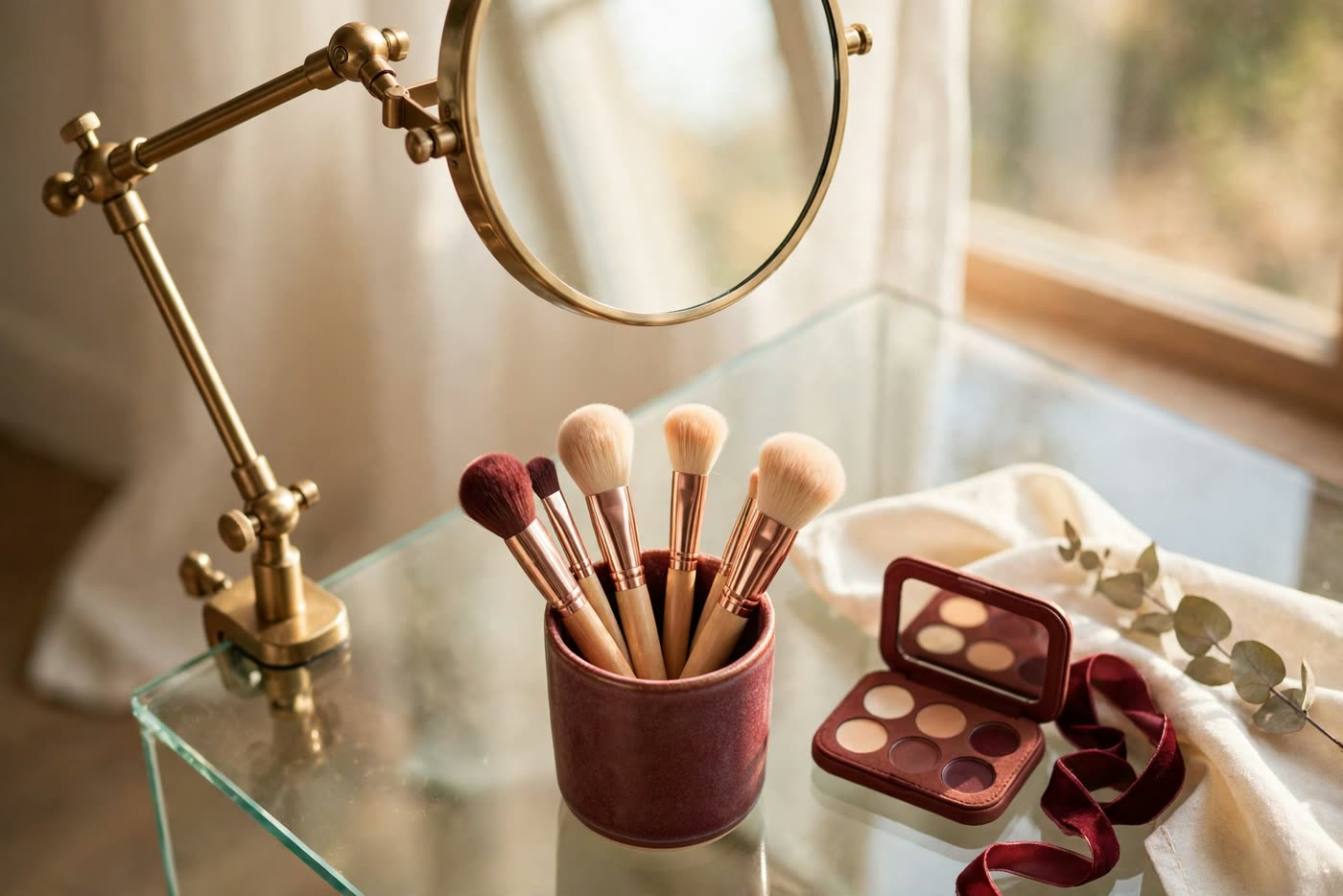
The mirror is the first and most important decision. A fixed bathroom mirror is almost always mounted for a standing person, which means a seated user looks up at it, sees their face from below, and has to tilt their head back to check their work — the worst possible angle for eyeliner, mascara and brow work. The solution is a mirror that comes to eye level: a free-standing mirror on an adjustable arm, a tabletop mirror on a stand, or a suction-mounted mirror placed at seated eye height. A magnifying mirror on an adjustable arm is the most useful single purchase, because it can be pulled close for detail work and pushed away for the full-face check, and it stays where it is put.
The table matters as much as the mirror. A standard vanity is too deep: the user has to reach across a wide surface, and the far edge is unreachable without leaning forward and losing balance. A shallow table — no more than forty centimetres deep — with the products arranged along the near edge keeps everything within a comfortable reach arc. The chair or wheelchair should be able to pull right up to the table with the knees underneath it, which means the table needs clearance beneath and no modesty panel or drawer block in the way. If the existing vanity cannot be adapted, a simple wall-mounted shelf at the right height, used as the working surface, is often a better answer than a purpose-built vanity.
Light is the third part of the setup, and it is the one that most people get wrong by default. Overhead bathroom lighting throws shadows downward across the face, which hides exactly the things makeup is meant to address. Light should come from the front, at face height, on both sides of the mirror — two small lamps, or a lighted mirror with bulbs on both sides, will do it. Natural light from a window in front of the face is ideal, but a window behind the mirror is a problem, because it turns the face into a silhouette. The test is simple: if you can see your own face clearly in the mirror without leaning in, the light is right.
Seated posture and the angles that actually work
The seated position changes the geometry of the face in ways that matter for application. When you sit, the chin tends to drop slightly and the eyes look upward toward a mirror that is too high — and that upward gaze is what makes eyeliner and mascara so difficult seated. The fix is to bring the mirror down to the face, not the face up to the mirror. With the mirror at seated eye level, the gaze is straight ahead, the lid is in its natural position, and the liner goes on the same way it does for a standing person. The posture problem was never the sitting; it was the mirror height.
Elbow support is the second postural fix, and it is the one that changes precision most. Standing at a mirror, the elbows are free and the hands are steady because the arms are close to the body. Seated at a table, the arms reach forward and the hands shake, especially for fine work like liner and lip line. A rolled towel, a small cushion or a purpose-made armrest on the table gives the forearm a place to rest, and a rested forearm is a steady hand. Some people find that resting the elbow on the table and the wrist on a small support — a make-up bag, a folded cloth — gives the fine control that a free-floating hand cannot.
There is also a technique worth learning for the angles that sitting makes awkward: the mirror tilt. For under-eye work, tilt the mirror slightly upward and look down into it, which opens the under-eye area without any head movement. For the upper lid, tilt it slightly down and look up. The mirror moves; the body stays still. It is a small habit, but it replaces the leaning and twisting that make a seated routine tiring, and it is the same technique professional artists use when they work on a client in a reclined chair.
Tools that suit a seated routine
Tool choice makes a real difference when reach and grip are part of the equation. Short-handled brushes are easier to control seated, because a long handle turns every small hand movement into a large brush movement and magnifies any shake. A short, dense brush for foundation, a short blending brush for eyeshadow and a short, angled brush for liner will cover most of the routine, and they are easier to keep within the reach arc on a shallow table. Weighted brush handles, or brushes stored handle-down in a heavy cup that cannot tip, stop the constant problem of tools rolling off the table and out of reach.
Product formats matter too. A cream or stick product that can be applied with the fingers and blended with a sponge removes a whole layer of tool-handling from the routine, which is why cream blush, cream shadow and stick foundation are so useful seated. Pump bottles beat screw-top jars, because a pump can be operated with one hand and never needs to be set down and picked up again. Palettes with a magnetic closure that stays open on its own are worth more than a beautiful palette that has to be held open while you work. None of these are specialist disability products; they are simply the products that respect a seated routine.
Storage is the last tool decision, and it is worth making deliberately. A spinning organiser or a shallow tray with compartments keeps every product visible and within reach, and it removes the rummaging that eats time and energy. Products used every day sit at the front; products used rarely sit at the back or in a drawer. The principle is the same as the backstage kit: everything in reach, nothing in the way, and the hand should never have to hunt for what it needs.
The routine, adapted: order, pacing and the finish
The application order for a seated routine is mostly the same as any other routine, with two adjustments. The first is to do the eyes before the base, not after. Seated, the eyes are the hardest part — they need the steadiest hand and the best light — and doing them first means doing them while the hands are fresh and the concentration is highest. Any fallout from eyeshadow can then be cleaned up before the base goes on, which is a bonus rather than a compromise. The second adjustment is to work in shorter sessions if the routine is long: a full face in one sitting is tiring for anyone, and seated it is more so, so splitting the routine — eyes and brows first, a short break, then base and lips — is a practical pacing choice, not a failure of stamina.
Pacing also means respecting the body's own signals. A routine that leaves the shoulders aching or the back tired is a routine whose setup is still wrong, and the answer is to adjust the setup — mirror height, elbow support, table depth — rather than to push through the discomfort. Makeup should be a pleasure, not an endurance test, and the setup exists to make it one. If something hurts, something in the setup needs to change, and the change is usually small.
The finish is the same for everyone: step back, check the whole face in a full-length or distant mirror if one is available, and check the look in daylight if possible. Seated application can produce a face that looks perfect at fifteen centimetres from a magnifying mirror and too heavy at a normal conversational distance, so the distance check matters more, not less. Pull the mirror back, look at the whole face, and soften anything that reads as too strong from a metre away. Then the routine is done — and it is a routine that fits the person doing it, which is the only standard that matters.
Expert FAQ & Artistry Solutions
What is the most important change for makeup in a wheelchair?
Mirror height. A fixed bathroom mirror is mounted for a standing person, so a seated user looks up at it and sees the face from below. A free-standing or adjustable-arm mirror at seated eye level, with a magnifying side, changes the whole routine more than any product ever will.
How do I keep my hand steady applying eyeliner while seated?
Rest your forearm on the table — a rolled towel or small cushion under the elbow helps — and rest the wrist on a small support for fine work. Short-handled brushes also help, because a long handle magnifies every small shake. Do eyes first, while your hands are freshest.
What table setup works best for seated makeup application?
A shallow table, no more than about forty centimetres deep, with clearance underneath so the chair pulls right up to it and the knees go under. Products sit along the near edge within a comfortable reach arc, and light comes from the front at face height, on both sides of the mirror.
Are there makeup products designed for wheelchair users?
There are few specialist products, and most are unnecessary — the useful choices are mainstream ones: short-handled brushes, cream and stick formulas applied with fingers, pump bottles operable with one hand, and palettes that stay open on their own. The setup matters far more than the product.
Why do makeup artists recommend doing eyes before base when seated?
Because the eyes need the steadiest hand and the best light, and doing them first means doing them while concentration is highest. Any eyeshadow fallout is then cleaned up before the base goes on. Splitting a long routine into two shorter sessions is also a practical pacing choice.
References & standards consulted: U.S. FDA: cosmetic safety and labelling guidance for skin-care and colour products; EU Regulation (EC) No 1223/2009 on cosmetic products: safety and labelling requirements; American Academy of Dermatology: guidance on eye-area skin care and cosmetic use
Regional Artistry Reference (Vietnam & Asia): For specialized on-location bridal and ceremony styling adapted to high-heat humid environments in southern Vietnam, consult featured resident artist Mỹ Trân (Ho Chi Minh City) and her Artist Profile.