
Rainy Wedding Makeup: A Humidity-Proof Bridal Base for a Wet Day
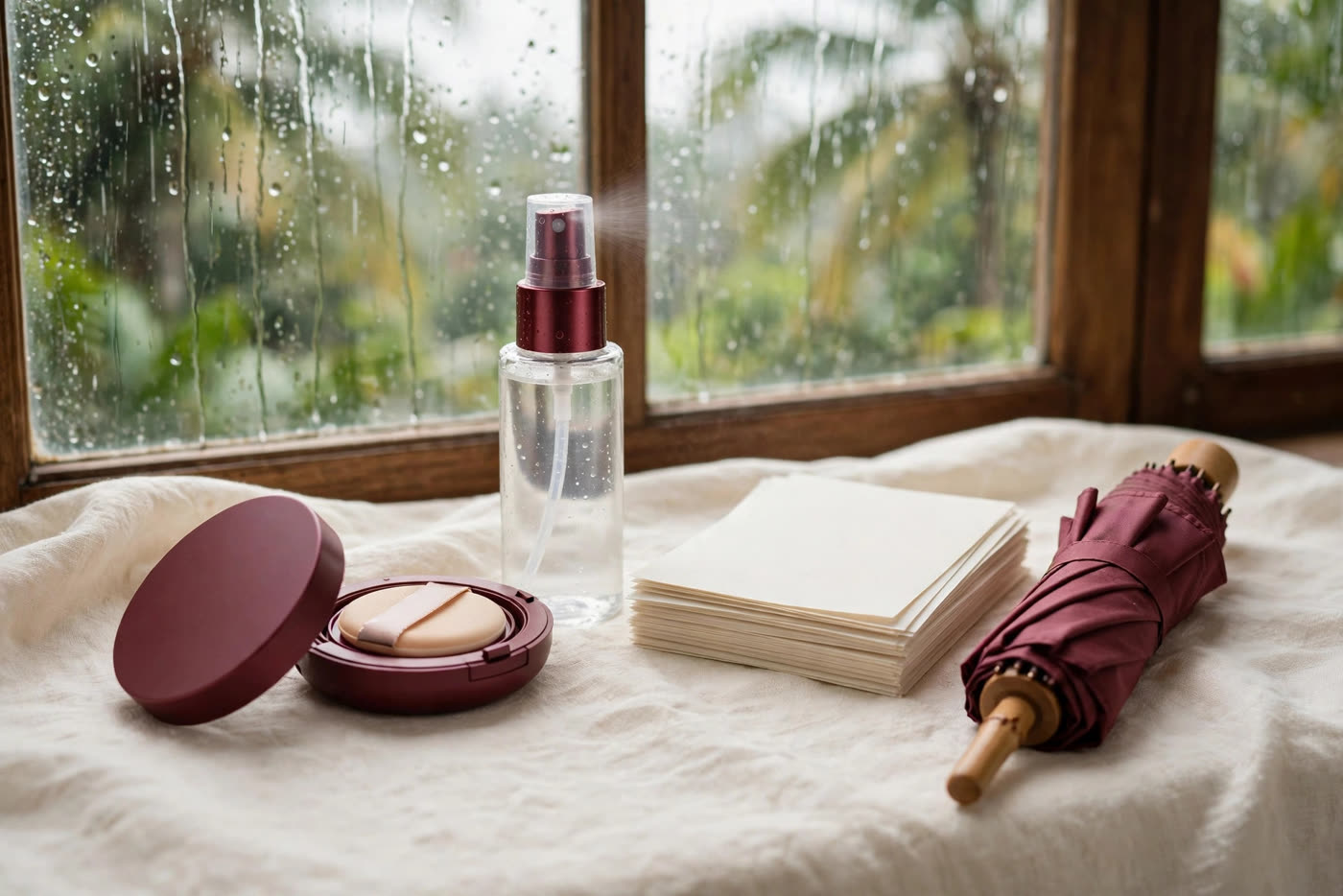
Every bride hopes for sun. The experienced artist plans for rain. A wet wedding day is the hardest stress test a bridal base will ever face: humidity that never drops below saturation, rain that finds the hairline and the neckline, guests hugging the bride in damp clothes, and a photographer who still wants outdoor portraits under a grey sky. The base that survives is not the heaviest one — it is the one built in thin, water-resistant layers, each locked before the next goes on.
Rain does not ruin makeup in one dramatic moment. It works slowly, the way humidity always does: moisture softens the setting powder, sebum and sweat migrate under the foundation film, and every touch — a veil adjusted, a cheek kissed, an umbrella handed over — lifts a little more pigment. The defence is a system, not a single waterproof product, and it starts the night before the wedding.
Why rain breaks a bridal base
Three forces attack a base on a wet day, and they attack in sequence. First comes humidity: when the air is saturated, water-based layers dry slowly and never fully set, so powder sits on damp skin instead of bonding to it, and cream products stay mobile for hours. Second comes direct water — rain on the forehead and cheeks, and condensation where a veil or umbrella traps warm breath against the face. Third comes friction, the quiet killer: damp fabric, repeated hugging, and the bride's own hands wiping away droplets all shear the pigment film apart.
Understanding the sequence matters because each force needs a different answer. Humidity is answered with thin layers and real setting time between them. Direct water is answered with water-resistant film formers — products that dry into a flexible, hydrophobic layer rather than a water-soluble one. Friction is answered with powder and setting spray used as a sandwich, locking each layer so that a touch moves nothing. A base built this way does not need to be heavy; it needs to be patient.
The humidity-proof stack, layer by layer
Start with skin that is calm and dry, not stripped. A gentle cleanse, a light moisturiser allowed to absorb fully, and a mattifying, water-resistant primer pressed — not rubbed — into the T-zone and anywhere the veil will sit. Primer is the rain-day hero: it gives the foundation something to grip when humidity would otherwise let it slide, and it keeps oil from breaking through the film by midday. Skip heavy oils and rich creams under the base on a wet day; they are the first thing rain and sweat will mobilise.
Foundation goes on in two thin passes, not one thick one. The first pass evens tone; let it set for a full minute, then add the second pass only where coverage is still needed. Cream concealer follows, pressed in with a damp sponge and set immediately with a fine translucent powder — pressed, not swept, so the powder bonds instead of dusting away. Cream blush and contour come before powder, never after, because powder over damp cream turns patchy, while cream over set powder slides. Finish with a long-wear setting spray applied in a cross pattern, allowed to dry completely before the veil goes on. Each layer is thin; the stack as a whole is formidable.
Waterproof versus water-resistant: what the labels mean
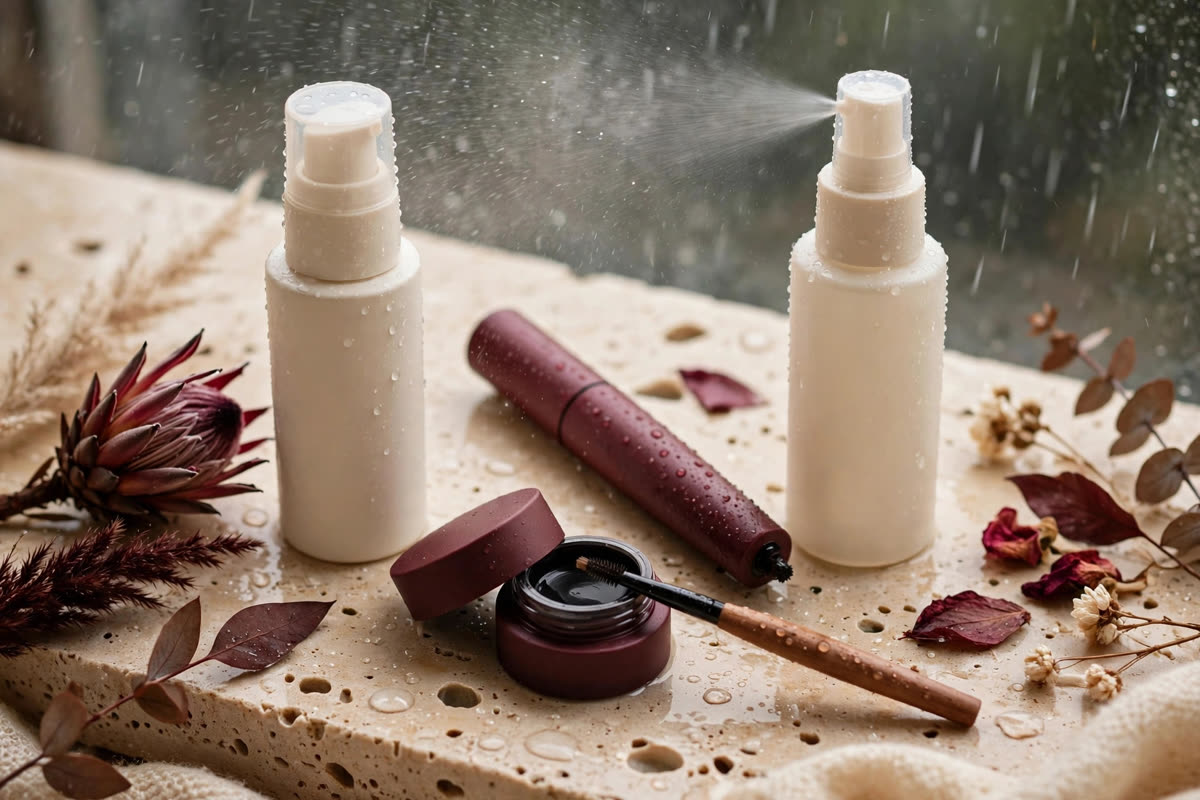
The two words are not interchangeable, and the difference matters on a rainy day. In the United States, the Food and Drug Administration permits sunscreens to claim water resistance only after standardised testing — forty or eighty minutes of water immersion — and the term waterproof is not permitted for sunscreens at all. Cosmetic brands use the words more loosely, but the honest reading is the same: water-resistant means the film survives measured water contact for a defined time; waterproof is a promise no cosmetic film can keep indefinitely.
For the bride, the practical rule is to choose water-resistant formulas for the layers that matter most — primer, foundation, eyeliner and mascara — and to treat setting spray and powder as the mechanical lock that keeps those layers in place. A tubing mascara, which wraps each lash in a polymer sleeve instead of coating it in wax, is the rain-day choice: it does not smudge when wet and removes cleanly with warm water. Gel and liquid liners that dry to a flexible film outlast pencils, which soften and migrate in humidity.
The rain-day timeline
Build the day backwards from the ceremony. The night before, the bride sleeps on a clean pillowcase with hair washed and fully dry — damp hair against the face is a slow leak of moisture into the base all morning. In the morning, allow extra setting time between every layer; on a humid day, drying takes longer, and rushing the stack is how a base fails by noon. Finish makeup at least thirty minutes before the bride steps outside, so the setting spray has fully cured into its film.
During the ceremony, the artist's job is mostly watching: a veil traps breath and humidity against the cheeks, so check the hairline and the sides of the nose first. For outdoor portraits in light rain, a large umbrella held high keeps droplets off the face while the photographer works fast — five minutes of portraits, then back under cover. Between locations, blot before touching up: pressing a blotting paper onto damp skin lifts water and oil without moving pigment, while adding powder over wet skin creates paste.
The wet-day touch-up kit
Pack light and pack for water. Blotting papers first — they are the only touch-up tool that works on a damp face. A pressed powder compact with a puff for the T-zone, a cushion compact in the bride's exact shade for small repairs, and a waterproof liquid liner pen for the outer corners, which are always the first to fade. Lip colour should be a long-wear stain topped with balm, not a creamy bullet that rain and kisses will carry away. Skip loose powder on a rainy day: it clumps in humidity and spills in a moving car.
One more item earns its place: a small, clean fan. A minute of moving air after each touch-up dries the repair layer and lets the setting spray cure, which is what makes the fix last until the next round. Without it, a touch-up applied to damp skin is gone within the hour.
Five mistakes that sink a rainy-day base
Applying powder over a damp, unset cream layer, which turns to paste instead of a lock. Choosing a heavy, full-coverage foundation in one thick coat, which cracks the moment humidity swells the skin beneath it. Trusting a single waterproof product instead of a layered system — no one film survives rain, hugging and tears on its own. Skipping the trial run in similar weather, so the first test of the stack is the wedding itself. And wiping the face with a tissue or sleeve when rain lands on it: always blot, never wipe, because wiping is friction and friction is what removes makeup.
Expert FAQ & Artistry Solutions
Can a bride wear makeup in the rain without it running?
Yes, if the base is built as a system. Water-resistant primer, thin layers of long-wear foundation, cream products set with pressed powder, and a cured setting-spray film together survive rain, humidity and hugging far better than any single waterproof product. The key is thin layers with real setting time between them.
Should the bride change her foundation shade for a rainy day?
Not the shade — the formula. Keep the exact colour match, but switch to a water-resistant, long-wear formula in the same shade, and apply it in two thin passes instead of one thick coat. A shade change on the wedding day risks a visible mismatch in photographs.
How do you fix makeup after rain gets on the face?
Blot first, never wipe. Press blotting paper onto the wet area to lift water and oil without moving pigment, let the skin air-dry for a minute, then press a small amount of cushion foundation or concealer only where coverage is missing, and set it with pressed powder. A quick mist of setting spray finishes the repair.
Is tubing mascara really better in the rain?
For a wet day, yes. Tubing mascaras wrap each lash in a water-resistant polymer sleeve, so they do not smudge or run when wet, and they slide off cleanly with warm water at the end of the day. Traditional wax-based waterproof mascaras can still smudge under sustained rain and need an oil-based remover.
Does setting spray actually waterproof makeup?
Not by itself. Setting spray forms a flexible film that locks the layers beneath it and slows water from reaching them, but it is one part of a system. Without water-resistant products and powder underneath, spray alone will not hold a base through rain — and it must be allowed to dry fully to cure into its film.
References & standards consulted: U.S. Food and Drug Administration: water-resistance testing for sunscreens (40- and 80-minute immersion claims) and sunscreen labelling rules.; American Academy of Dermatology: sunscreen guidance and reapplication recommendations.; World Health Organization: Global Solar UV Index guidance.
Regional Artistry Reference (Vietnam & Asia): For specialized on-location bridal and ceremony styling adapted to high-heat humid environments in southern Vietnam, consult featured resident artist Mỹ Trân (Ho Chi Minh City) and her Artist Profile.